





Detecting mechanical tension
Mechanical tension is detected by a process called "mechanotransduction" which involves the sensing of physical movements and the initiation of signaling processes that then stimulate the addition of either myofibrils (in parallel) or the addition of new sarcomeres (in series). But where in the muscle is this mechanical tension detected? Let us look at two popular contenders for the role of mechanoreceptor inside muscles.
.
#1. Costameres can detect mechanical tension
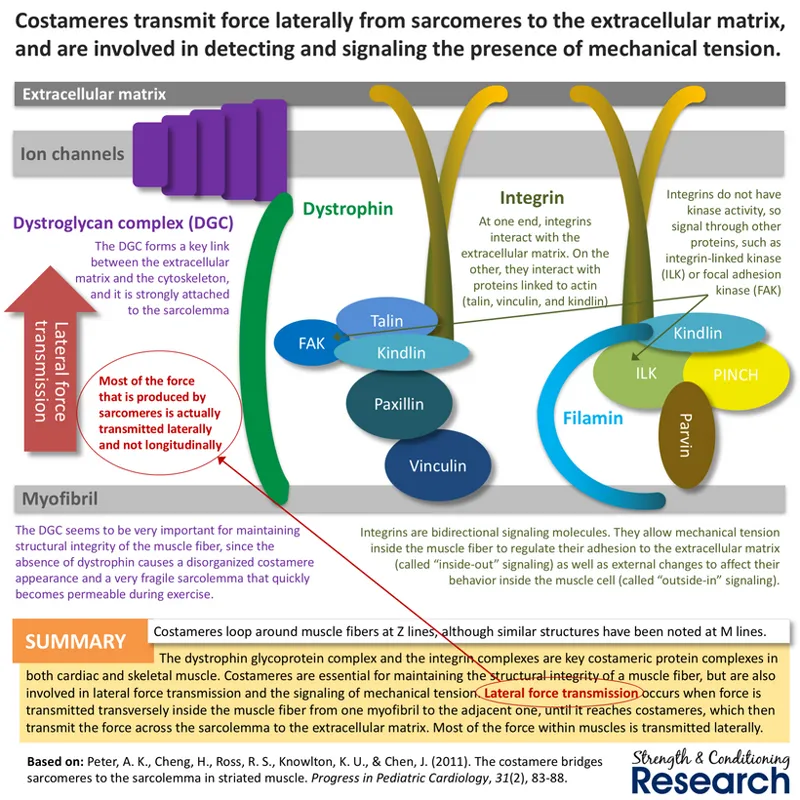
Costameres connect the Z-disks inside muscle fibers to the surrounding endomysium. They facilitate the transmission of sarcomere forces to the extracellular matrix and to the tendon. Therefore, they are located inside single muscle fibers.
There are two costamere complexes: [1] the dystroglycan complex, and [2] integrin complex. Either or both of these may be involved in detecting the mechanical tension that stimulates the growth of the relevant muscle fiber.
.
Costameres are also known as focal adhesions. The behavior of focal adhesion kinase shows us that there are clear connections between the activities of costameres and the resulting signaling processes within anabolic pathways leading to acute elevations in myofibrillar protein synthesis.
.
#2. Titin can detect passive mechanical tension
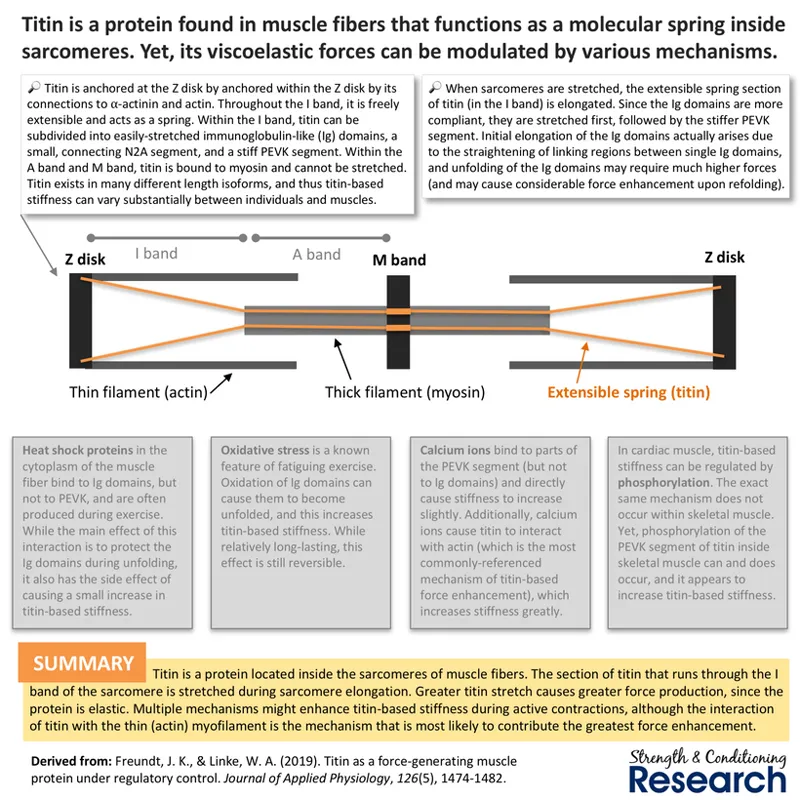
Titin is a giant protein that runs inside the sarcomeres of single muscle fibers from Z disk to Z disk, traveling adjacent to the actin and myosin myofilaments. It generates viscoelastic passive mechanical tension when a muscle fiber is elongated. However, it becomes slack whenever the muscle fiber shortens so cannot contribute to or detect actively-generated mechanical tension.
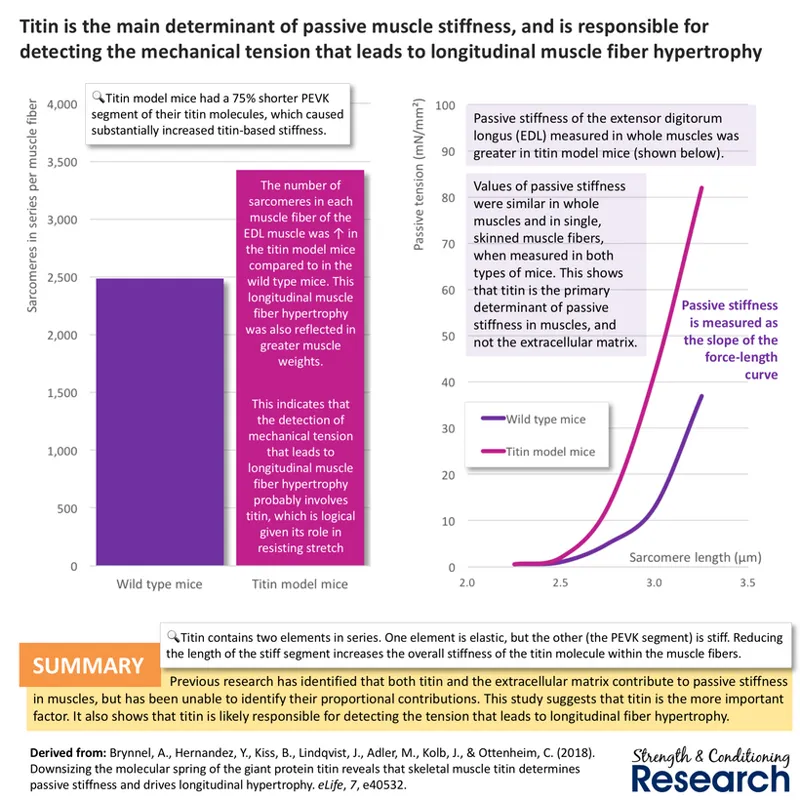
Research has shown that titin is not only the primary determinant of passive mechanical tension inside a muscle fiber but is also the instigator of the stimulus for sarcomerogenesis. In studies in rodents where titin forces have been experimentally enhanced, muscle size is increased and the increases are caused by an addition of sarcomeres in series.
#3. Whole muscle force differs from single muscle fiber mechanical tension
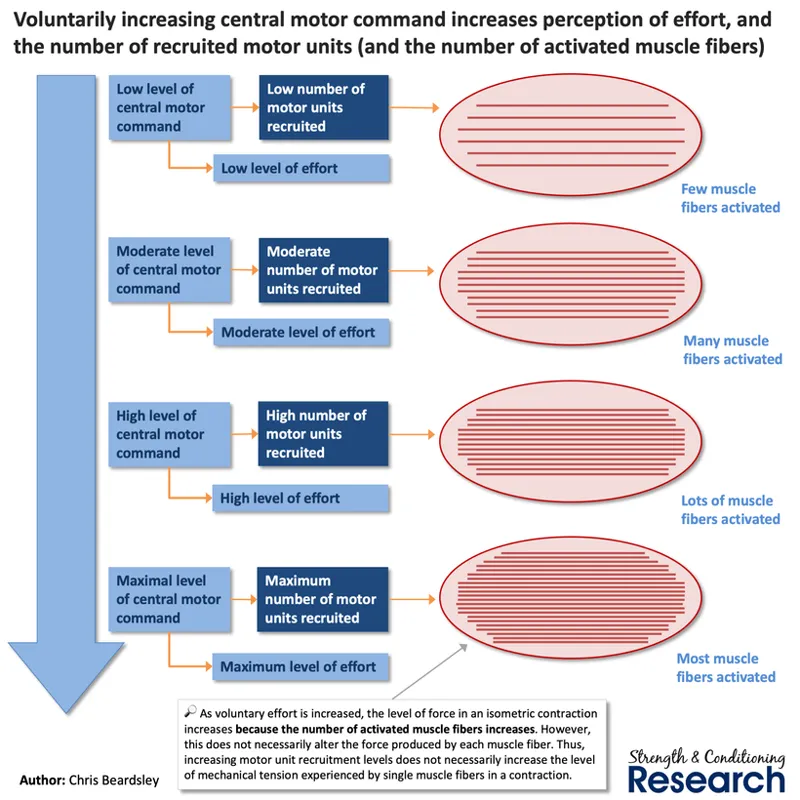
Many researchers persist in assuming that the single muscle fiber mechanical tension that clearly stimulates hypertrophy changes in direct correlation with changes in whole muscle force. Yet, we know that increasing motor unit recruitment increases the level of whole muscle force by simply activating additional muscle fibers. This does not alter the level of single muscle fiber mechanical tension that is experienced by already-activated muscle fibers.
.
We can clearly see the large differences between whole muscle force and single muscle fiber mechanical tension when we position a graph of internal muscle fiber force adjacent to a graph of external barbell force (or whole muscle force). While one increases, the other decreases.
.
#4. Single fiber mechanical tension is determined by force-velocity relationships
Single muscle fiber mechanical tension during concentric contractions is determined by the force-velocity relationship, which in turn is determined by the number of attached actin-myosin crossbridges. Whenever a muscle fiber shortens slowly, it produces a high level of mechanical tension. When a muscle fiber shortens quickly, it produces a low level of mechanical tension. This is why we cannot produce hypertrophy during fast movements even when those fast movements involve maximal efforts and therefore maximum levels of motor unit recruitment (like jumping).
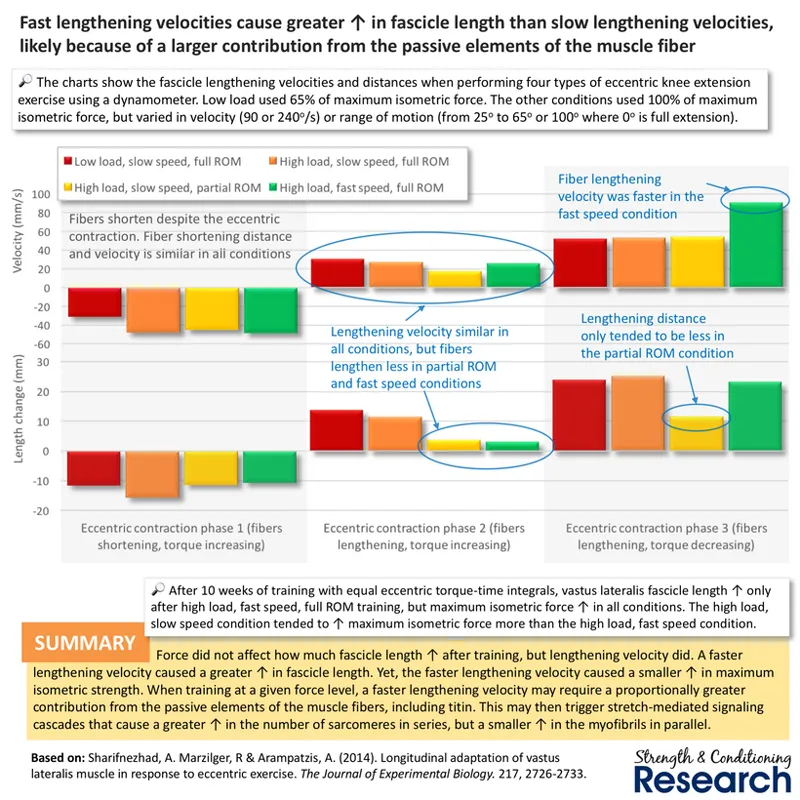
In contrast, during eccentric contractions, the stretching of titin produces additional passive forces. Since these forces are viscoelastic, single fiber mechanical tension actually increases with increasing eccentric velocity. Therefore, the force-velocity relationship for passive tension goes in the opposite direction from during concentric contractions.
.
This is why fast, maximal effort eccentric contractions produce greater increases in muscle fascicle length (through sarcomerogenesis) than slow, maximal effort eccentric contractions. Titin only signals for sarcomere addition. It does not signal for an addition of myofibrils in parallel.
.
Conclusions
Mechanical tension is detected by a process called "mechanotransduction" which involves the sensing of physical movements and the initiation of signaling processes that stimulate the addition of either myofibrils (in parallel) or sarcomeres (in series). Likely contenders for the role of mechanoreceptors in muscles are [1] costameres, and [2] titin. Costameres transmit force across cell membranes, while titin resists muscle fiber elongation. Importantly, both mechanoreceptors (and others) are located INSIDE muscle fibers. Therefore, reference to the mechanical tension that stimulates hypertrophy must ALWAYS be made relative to the force that a single muscle fiber experiences and not to the force that a whole muscle experiences. Whole muscle force can be increased without increasing single muscle fiber force, simply by increasing the number of activated muscle fibers, by increasing effort and therefore motor unit recruitment levels. For example, if we increase effort in an isometric contraction, whole muscle force increases due to an increase in the number of activated muscle fibers but single muscle fiber force remains the same (so the hypertrophy stimulus applied to each activated muscle fiber does not change). If we increase effort in a concentric contraction, whole muscle force increases due to an increase in the number of activated muscle fibers but single muscle fiber force decreases due to the force-velocity relationship (the movement velocity determines the number of attached actin-myosin crossbridges, which in turn determine single fiber force).
Comments (4)
I have a practical scenario that I see often: If you ask an athlete to give maximal intent on the concentric phase of a maximal strength lift (85%+ 1RM), what is being suggested here is this will increase overall force which is what we want when looking to improve the athletes force output. But, if the load does not actually move quicker (because we use VBT to understand this) in fact the set may stay the same velocity throughout, if not reduce each rep. Are we actually increasing single muscle fibre tension in this scenario?
Maximal intent will increase whole muscle force by increasing the number of activated muscle fibers (by increasing motor unit recruitment). It probably has minimal effect on single muscle fiber force and therefore the stimulus for hypertrophy, yes. In situations where heavy loads are used AND velocity is not affected by the intent, then that suggests MUR was already maximal.
I really appreciate the detailed explanation and the distinction between whole muscle force and single muscle fiber mechanical tension. Your point is well taken: whole muscle force can increase with additional motor unit recruitment, but that doesn’t necessarily increase the mechanical tension experienced by the already-recruited fibers. In fact, as you point out, the mechanical tension on individual fibers may even decrease. I have a couple of questions for you: Do you believe that for all movements against resistance, the faster the movement, the lower the mechanical tension experienced by the recruited muscle fibers? Similarly, as far as your understanding goes, would slower movements always result in higher mechanical tension on the recruited fibers? What about the influence of rate coding? How do you think an increase in firing frequency affects the mechanical tension in recruited fibers, particularly in scenarios of faster or slower movements? Finally, do you have a notion of how low the shortening velocity must be to elicit a hypertrophic stimulus? Thanks again for the thought-provoking post!
(1) The force-velocity relationship has a very meaningful effect on muscle fiber force. So yes, increasing movement velocity will always reduce muscle fiber mechanical tension, while decreasing movement velocity will always increase muscle fiber mechanical tension. This is textbook stuff, even though it is rarely discussed.