




Deloads
Deloads are common during many high-volume strength training programs because fatigue accumulates and interferes with our ability to stimulate adaptations such as hypertrophy. Yet, the logic behind performing deloads is fundamentally flawed because any strength training program that requires a deload is necessarily less effective than one that does not.
.
#1. Post-workout fatigue does accumulate over time and it does reduce adaptations
While some researchers have argued that doing workouts while we are still in a fatigued state from a previous workout does not further augment the magnitude of muscle damage and post-workout fatigue, recent research has shown that it definitely does. For example, in this study, we can see that five days of daily strength training workouts with just four sets per workout causes post-workout fatigue to last for approximately two weeks after finishing the training block.
.
During this period of accumulated fatigue, hypertrophic adaptations are not really happening. However, they can seem to be happening because of the muscle swelling that is occurring. Nevertheless, once the swelling dissipates during the deload, it becomes clear that the training block was nowhere near as effective as it appeared to be at the time.
.
After each strength training workout, there is muscle fiber swelling that can last for several days. Importantly, this would be detected as hypertrophy even in a research context, since we currently do not have the technology to differentiate between the muscle fiber size increases caused by swelling and the muscle fiber size increases caused by the addition of new myofibrils.
.
#2. Post-workout fatigue impairs our ability to stimulate adaptations by means of several mechanisms
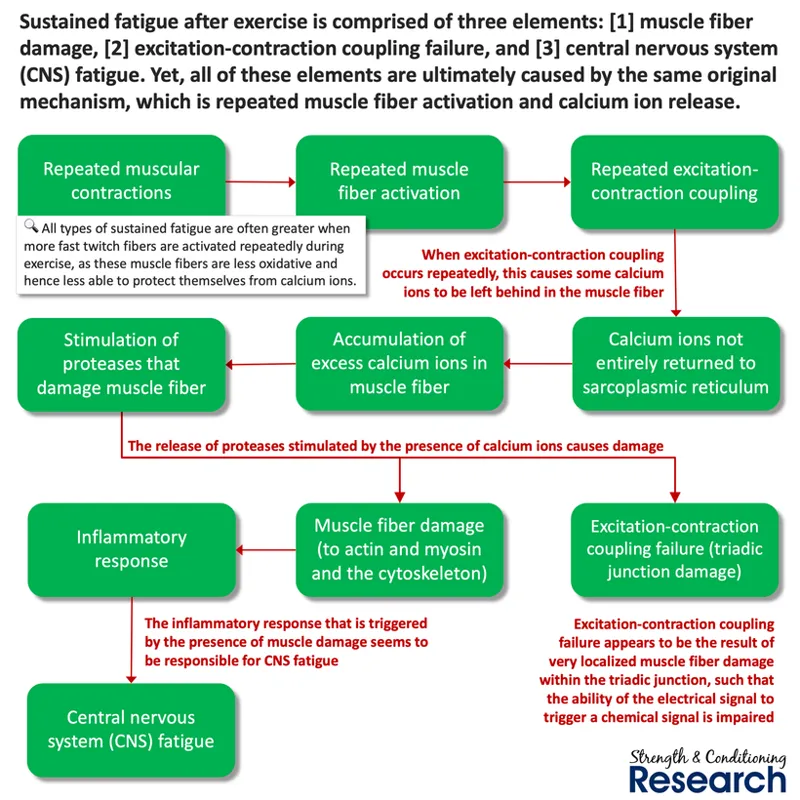
Post-workout fatigue comprises multiple mechanisms, all of which are initiated by the influx of excessive amounts of calcium ions into fast twitch fibers during strength training workouts. The three key post-workout fatigue mechanisms that affect our ability to produce hypertrophy are: [1] muscle damage, [2] excitation-contraction coupling failure, and [3] supraspinal CNS fatigue.
.
The capacity of a strength training workout to produce post-workout fatigue varies depending on the training variables that we use. Workouts with higher volumes of lighter loads, with sets taken closer to failure, and with stretched-position exercises will cause far more post-workout fatigue than workouts with lower volumes of heavier loads, with reps in reserve, and which involve mainly contracted-position exercises.
.
All local, calcium ion-related fatigue mechanisms (which include muscle damage) cause reductions in the ability of the affected muscle fibers to generate mechanical tension, which obviously reduces their capacity to experience muscle growth. We can observe such reductions in muscle fiber force by reference to fatigue in involuntary, electrically-stimulated contractions.
.
.
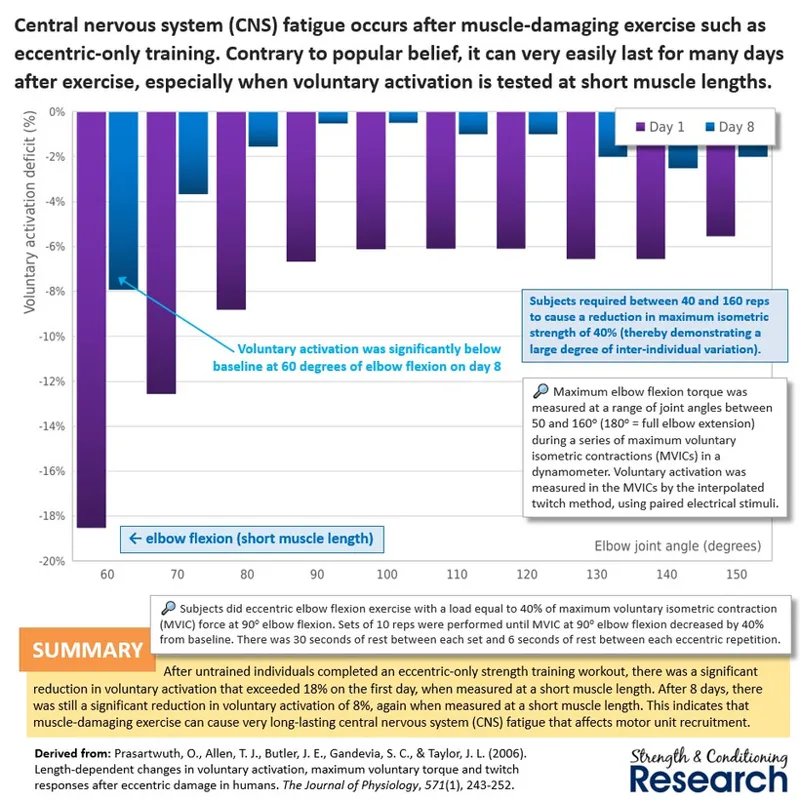
Central nervous system fatigue mechanisms reduce our ability to recruit high-threshold motor units , which obviously reduces the capacity of the muscle fibers belonging to those motor units experience muscle growth. We can observe such reductions in motor unit recruitment levels by reference to either [1] reductions in voluntary activation, or [2] reductions in the strength of other, untrained muscles (this is termed "non-local fatigue" in the exercise science literature). When workouts are not extremely damaging, this fatigue typically only lasts for a couple of days.
.
In contrast, when workouts are very damaging, the post-workout CNS fatigue can last for a week.
.
Conclusions
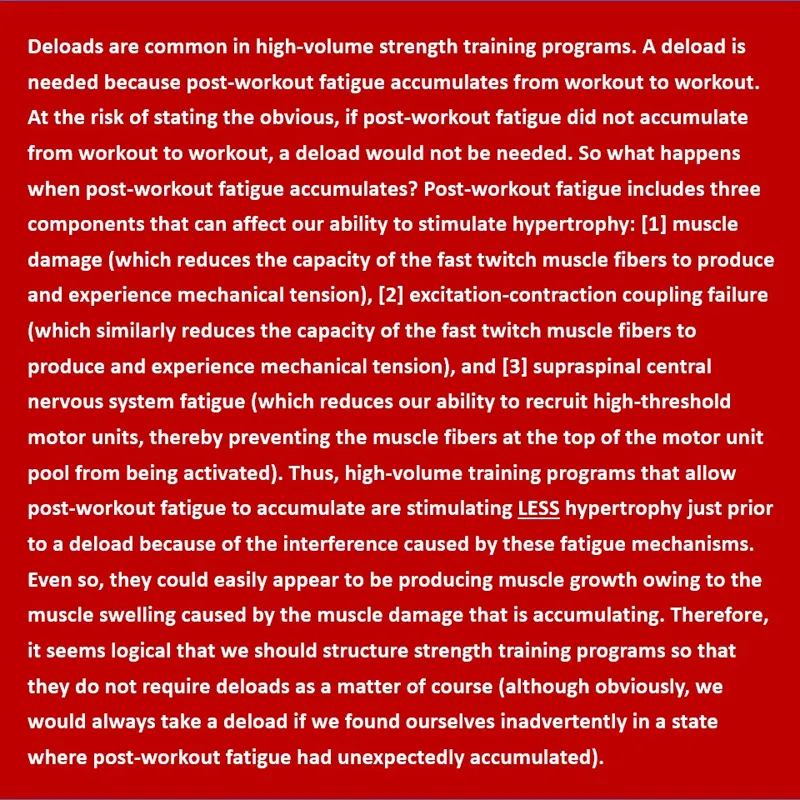
Deloads are common in high-volume strength training programs. A deload is needed because post-workout fatigue accumulates from workout to workout. At the risk of stating the obvious, if post-workout fatigue did not accumulate from workout to workout, a deload would not be needed. So what happens when post-workout fatigue accumulates? Post-workout fatigue includes three components that can affect our ability to stimulate hypertrophy: [1] muscle damage (which reduces the capacity of the fast twitch muscle fibers to produce and experience mechanical tension), [2] excitation-contraction coupling failure (which similarly reduces the capacity of the fast twitch muscle fibers to produce and experience mechanical tension), and [3] supraspinal central nervous system fatigue (which reduces our ability to recruit high-threshold motor units, thereby preventing the muscle fibers at the top of the motor unit pool from being activated). Thus, high-volume training programs that allow post-workout fatigue to accumulate are stimulating LESS hypertrophy just prior to a deload because of the interference caused by these fatigue mechanisms. Even so, they could easily appear to be producing muscle growth owing to the muscle swelling caused by the muscle damage that is accumulating. Therefore, it seems logical that we should structure strength training programs so that they do not require deloads as a matter of course (although obviously, we would always take a deload if we found ourselves inadvertently in a state where post-workout fatigue had unexpectedly accumulated).