



Active insufficiency
Active insufficiency has become a popular topic since fitness influencers learned about the length-tension relationship. Even so, it is not commonly described correctly, so let's take a closer look at it in this article.
.
#1. What is active insufficiency?
Active insufficiency refers to a lack of sufficient active mechanical tension during a muscular contraction, such that muscle fiber force is reduced and hypertrophy cannot be stimulated despite the muscle being activated. It happens when the activated muscle fibers are working at extremely short sarcomere lengths such that there is little overlap between the actin and myosin myofilaments. We can describe the location of the extremely short sarcomere lengths as being at the very start of the ascending limb of the active length-tension relationship.
.
#2. When do muscles experience active insufficiency?
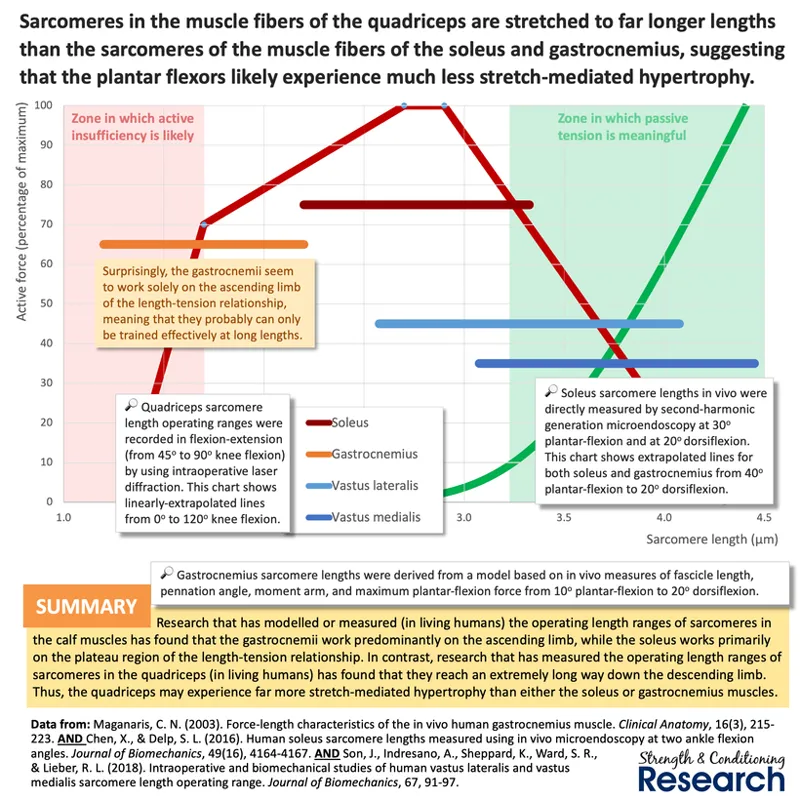
Muscles will only experience active insufficiency when their sarcomeres work at the very start of the ascending limb of the length-tension relationship. This certainly does not apply to all muscles, and it cannot be guessed from looking at the muscle. We must look at the sarcomere operating length ranges that are available in the literature to see how far back along the ascending limb they reach. Here, we can see that the quadriceps do not work anywhere close to the ascending limb and therefore will never experience active insufficiency. This makes sense because we do want to be able to stand upright (when the quadriceps are fully shortened) without difficulty.
.
While many fitness influencers assume that two-joint muscles will automatically experience active insufficiency, this is not true. Early estimates for the sarcomere operating lengths of the hamstrings suggested that the semitendinosus did not experience active insufficiency, and the most recent estimates indicate that none of them experience it (whether that is true is another matter but it goes to make the point that we cannot assume active insufficiency will always happen).
.
#3. Which muscles definitely experience active insufficiency?
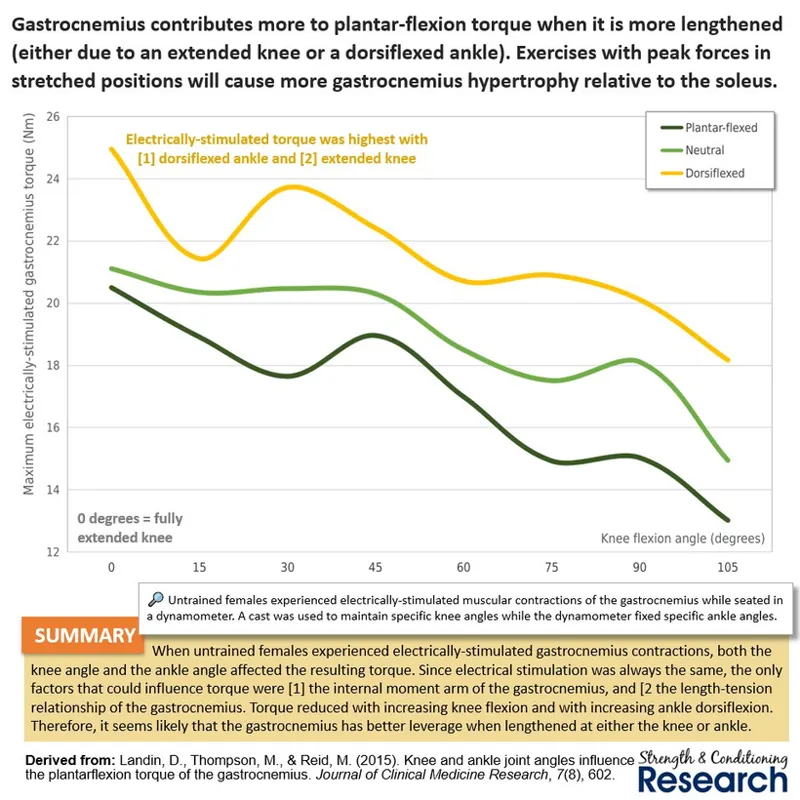
Since sarcomere operating length estimates are not the easiest thing to calculate, we cannot be that confident about the current data sets regarding the capacity of specific muscles to experience active insufficiency. However, it does seem quite likely that the gastrocnemius muscles will find themselves in an actively-insufficient state when the knee is flexed and the ankle is plantar-flexed, such as during seated calf raises. This indicates that their plateau will occur as the muscle is lengthened towards end-range when the knee is extended and the ankle is dorsiflexed.
.
Curiously, the gastrocnemius has its very worst leverage for plantar-flexion when (1) the knee is flexed, and (2) the ankle is plantar-flexed. In accordance with the principle of neuromechanical matching, it will therefore not be very strongly activated when working at a very short muscle length, thereby avoiding the possibility of entering into active insufficiency.
.
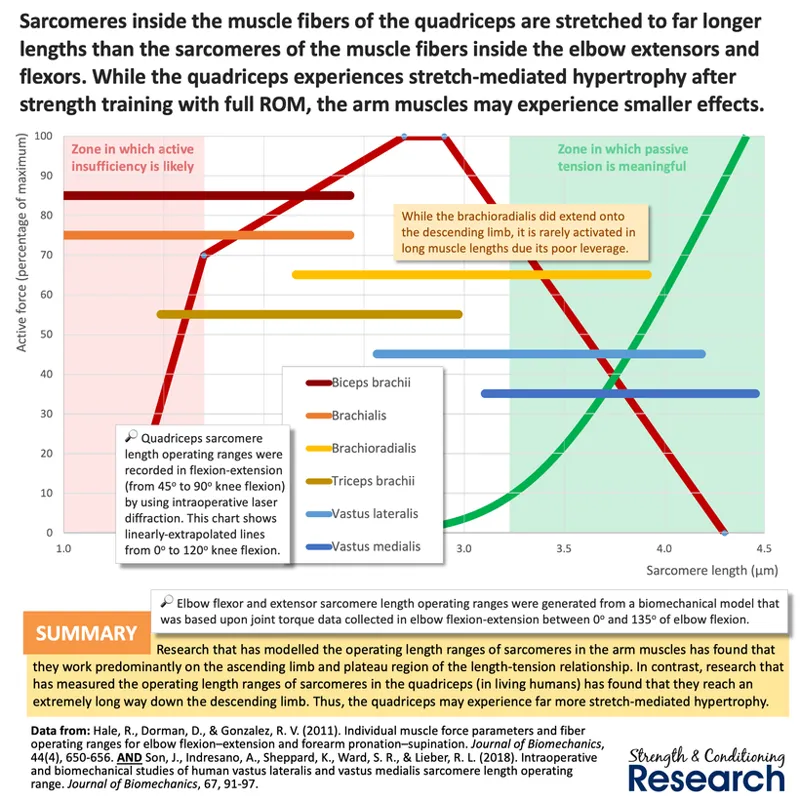
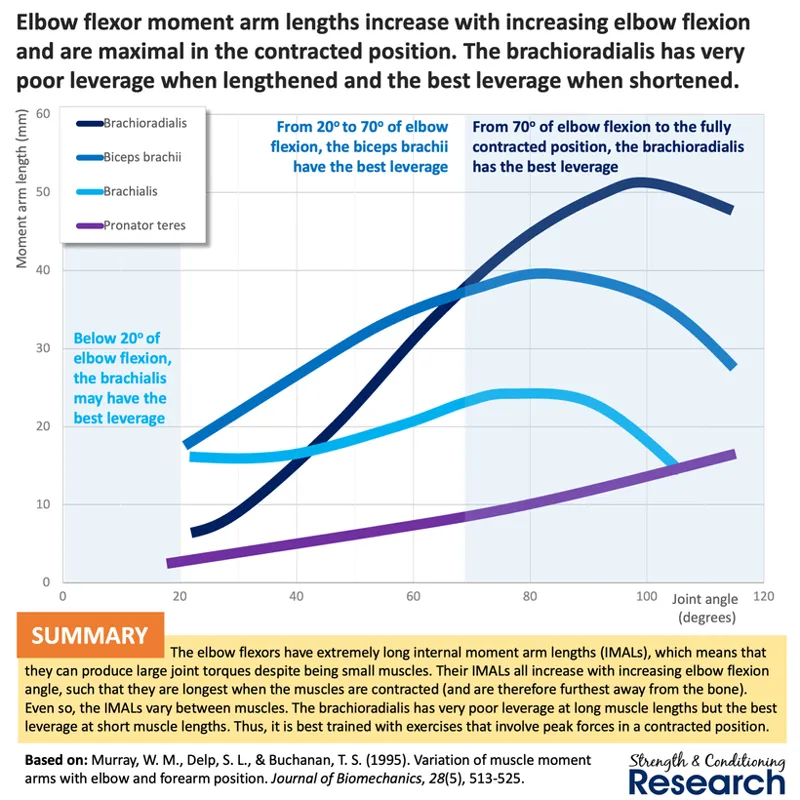
Similarly, the biceps brachii also has muscle fibers that work extensively on the ascending limb of the length-tension relationship, so we should expect it to display active insufficiency if the elbow and the shoulder are both flexed.
.
The biceps brachii have their worst leverage for elbow flexion (relative to the brachioradialis) when the elbow is flexed. In accordance with the principle of neuromechanical matching, it will similarly not be very strongly activated when working at a very short muscle length, thereby avoiding the possibility of entering into active insufficiency.
.
#4. Why might muscles experience active insufficiency?
It is interesting that the both the gastrocnemii and the biceps brachii display active insufficiency and that they both have good leverage at long muscle lengths and poor leverage at short muscle lengths. According to the principle of neuromechanical matching, neither muscle will be regularly activated at short muscle lengths and both will be regularly activated at long muscle lengths. This will cause a corresponding addition of sarcomeres in series to the muscle fibers of the muscles. It is possible that the lack of regular muscle activation in a shortened position (and the presence of regular activation in a lengthened position) causes muscle fibers to adapt such that they have too many sarcomeres to be able to exert force effectively at short muscle fiber lengths.
.
Conclusions
Active insufficiency is the term given to describe the reduction in the active mechanical tension produced by a muscle when it is activated at a very short muscle length. Physiologically, it occurs when muscle fibers are activated and contract at very short sarcomere lengths such that there are extremely few opportunities for myosin heads to bind with actin to make crossbridges. Since it is crossbridges that pull the sarcomere inwards, a lack of them reduces the active mechanical tension that the muscle fiber generates once activated. The active length-tension relationship can be divided into regions: the ascending limb (where the sarcomere is short), the plateau (where the sarcomere is at a moderate length), and the descending limb (where the sarcomere is long). Only when the sarcomere is at the start of the ascending limb does a muscle fiber experience active insufficiency. So, whether a muscle experiences active insufficiency depends upon its operating sarcomere lengths. Indeed, we cannot simply assume that all muscles (or all two-joint muscles) will necessarily display active insufficiency at short muscle lengths (indeed, the semitendinosus does not). Interestingly, two muscles that do display active insufficiency are the gastrocnemii and the biceps brachii. In both cases, they have poor leverage relative to the other muscles working at the same joint when they are short, which means that they are not very activated at this length (in accordance with the principle of neuromechanical matching). It is possible that the lack of regular muscle activation in a shortened position (and the presence of regular activation in a lengthened position) causes muscle fibers to adapt such that they have too many sarcomeres to be able to exert force effectively at short muscle fiber lengths.
Comments (7)
In the Summary of the Infographic «Gastrocnemius contributes more to plantar-flexion torque when it is more lengthened…» where it states: "Torque reduced with increasing knee flexion and with increasing ankle dorsiflexion", isn't it "... and with increasing plantarflexed ankle" ? Sorry, the error may be due to my interpretation.
Great article, Chris! Interesting would be to think about doing a seated hip adduction: is there a risk of going into either active or passive insufficiency? This could be useful when thinking about the best ROM for the exercise.
I don't know of any data showing the active length-tension relationships or leverages of the hip adductors TBH
tremendous information Chris as usual - thanks!
Also in the study regarding the gastroc and torque in relation to knee flexion and ankle Dorsi flexion, your summary started force reduces with increasing knee flexion and increasing dorsi flexion (stretch at the ankle), is this correct? Should it have read increasing knee flexion and increasing plantarflexion? Again my brain couldn’t quite figure it out so thought I would ask the question. Thanks.
Well that is mildly confusing Chris. So the sarcomere operating lengths for biceps and gastroc both suggest they are optimal at shorter lengths (ascending limbs) but the principle of neuromechanical matching suggests there leverages are best at long muscle lengths and are therefore activated here (in a position where their sarcomeres may experience passive insufficiency as they are lengthened to a greater extent). Have I got that right or am I way off the mark here?
An analysis of the sarcomere operating length ranges suggests that the biceps brachii and gastrocnemius are optimal (i.e on the plateau) at their maximum physiological whole muscle lengths.