



Myths about muscular failure
Muscular failure is poorly understood among fitness influencers and even among hypertrophy researchers. Here are some
.
Myth #1. Muscular failure occurs when muscles can no longer produce enough force to continue doing reps with the current weight
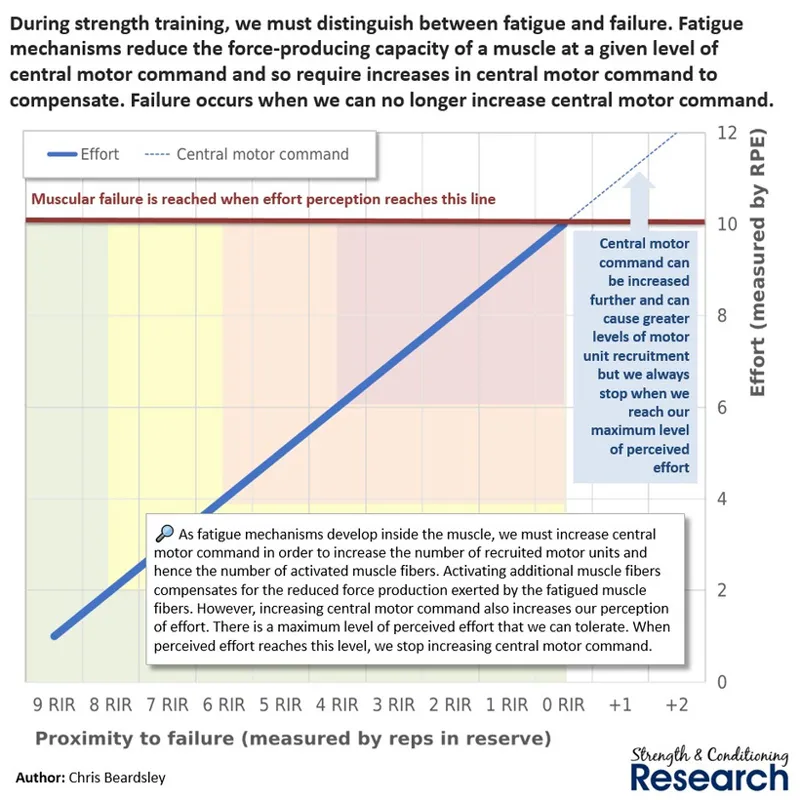
Hypertrophy researchers often state that muscular failure occurs when muscles can no longer exert enough force to continue lifting the weight that is currently on the bar. Implicitly, they are assuming that the limitation is happening inside the muscle. This is absolutely not true. We reach muscular failure when we reach our maximum tolerable perception of effort because the effort perception is linked to the central motor command we send to the muscle to recruit motor units.
Our performance during any bout of exercise is regulated by our perception of effort. As muscles fatigue, we have to increase our motor unit recruitment levels to compensate. Yet, as we increase our motor unit recruitment levels, this increases our perception of effort (owing to the sensation of innervation). Once we reach our maximum tolerable perception of effort, we cannot increase our motor unit recruitment levels any further.
.
In practice, this means that we reach muscular failure during maximal efforts even without actually using all of the muscle fibers available in a muscle. This is especially common in larger muscles because they have more motor units and therefore would need higher levels of central motor command than we are capable of producing in order to be fully activated.
Myth #2. Motor unit recruitment is always maximal at the point of muscular failure
The level of motor unit recruitment that we achieve at muscular failure varies greatly depending on a large number of factors and is rarely maximal. Typically, motor unit recruitment is greater at muscular failure when the total amount of muscle mass being used in the exercise is smaller. For example, when using single-limb variations compared to two-limb exercise variations, the levels of motor unit recruitment are higher (this is seen regularly in the bilateral force deficit). Motor unit recruitment of a target muscle will always be higher when other muscles are not working at the same time because the brain detects central motor command to all muscles simultaneously.
.
Similarly, motor unit recruitment is greater when performing high-force muscular contractions with maximal efforts in comparison to when performing low-force muscular contractions with maximal efforts. Despite using a maximal effort in both cases, motor unit recruitment is still higher when using a shorter-duration, higher-force contraction. This is because central nervous system fatigue builds up when exercising and the shorter the duration of the contraction, the less the effect of this fatigue mechanism on motor unit recruitment.
.
Myth #3. Hypertrophy cannot occur unless we train to muscular failure because it is the last rep that makes all the difference
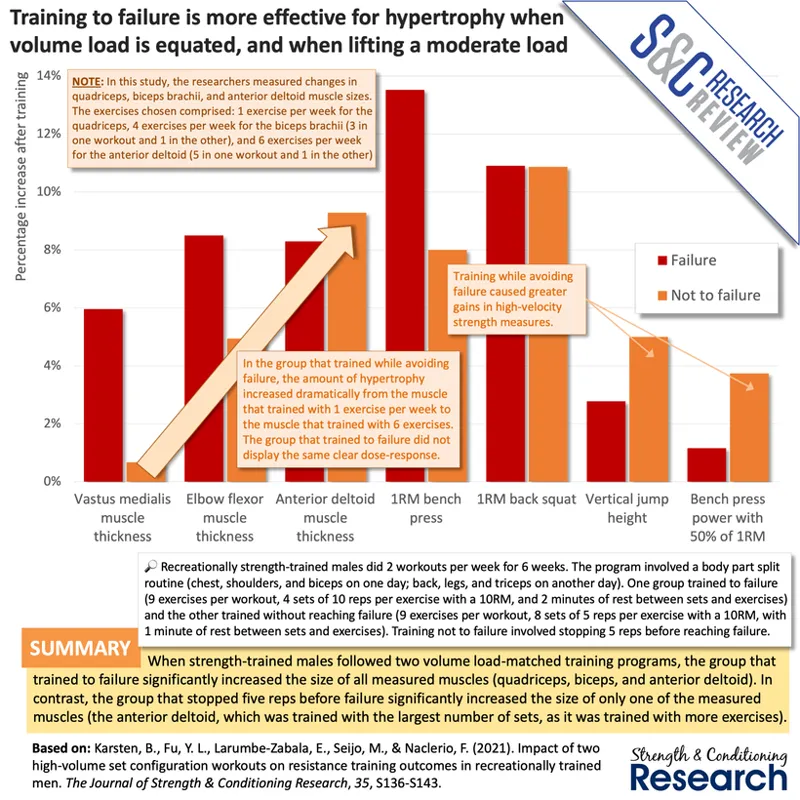
Some bodybuilders have argued that reaching muscular failure is essential for producing muscle growth. In fact, we have tons of velocity-based training studies showing that hypertrophy can and does occur when performing sets with 2-3 reps in reserve (RIR).
.
Similarly, we have studies showing that hypertrophy does occur when doing cluster sets with several reps in reserve. Cluster training is important because unlike velocity-based training it does not involve maximal efforts on each rep so we cannot ascribe the hypertrophy to maximal levels of motor unit recruitment alone.
.
Myth #4. Muscular failure produces more central nervous system fatigue than leaving reps in reserve
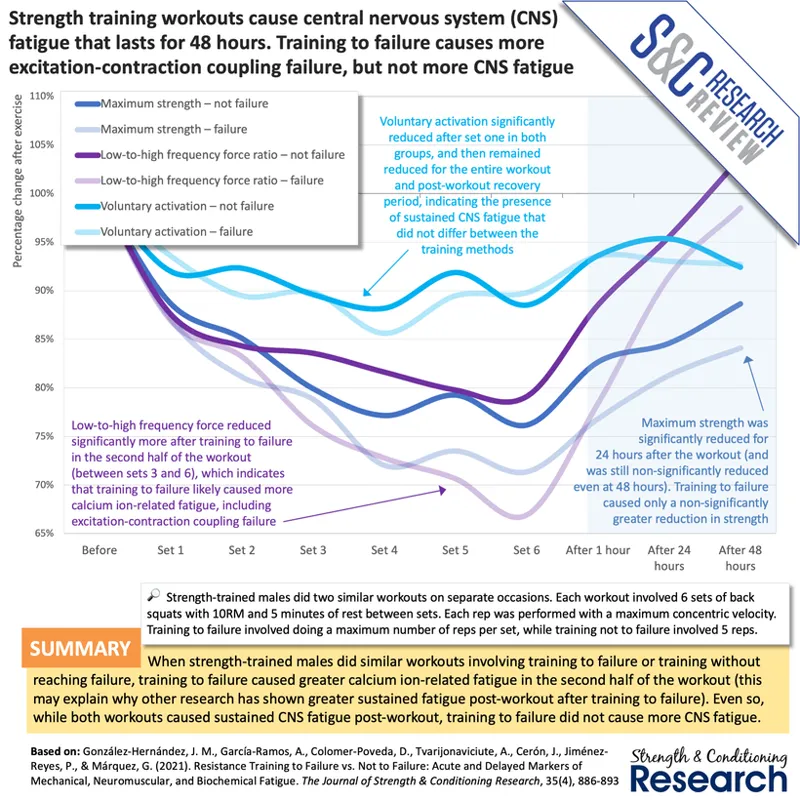
Many fitness influencers will try to warn their unwary listeners away from training to failure on the basis that it causes central nervous system fatigue. The reality is that training to failure does not really have that big an impact on the central nervous system. It does create more post-workout fatigue but the way it does this is by causing more calcium ion-related fatigue mechanisms, like excitation-contraction coupling failure. Excitation-contraction coupling failure happens when a muscle fiber is exposed to calcium ion accumulation for a sufficiently long period of time. So the long duration reps at the end of a set to failure are perfect for generating this type of fatigue.
.
Conclusions
Muscular failure is extremely poorly understood among fitness influencers. Here are four commonly-repeated myths about muscular failure. Myth #1: muscular failure occurs when muscles can no longer produce enough force to continue lifting the weight. In fact, muscular failure occurs when we reach our maximum tolerable perception of effort, which limits our ability to send central motor command to the working muscle to recruit motor units. If we could override or reduce the size of this feeling, we could activate more muscle fibers and continue doing reps. Myth #2: motor unit recruitment is always maximal at the point of muscular failure. In fact, the level of motor unit recruitment achieved varies depending on training variables. Motor unit recruitment levels are higher at muscular failure when using single-limb exercises compared to two-limb exercises. Similarly, they are higher at muscular failure when lifting heavy loads compared to when lifting lighter loads. Myth #3: hypertrophy cannot occur unless we train to muscular failure because it is the last rep that makes the difference. In fact, many studies have shown that muscle growth can and does occur when training with at least 2-3 reps in reserve (if not more). Myth #4: training to failure causes more central nervous system fatigue than leaving reps in reserve. In fact, the main fatigue mechanism that is increased by training closer to failure is calcium ion-related fatigue (owing to the slow reps just prior to failure, which allow more calcium ion accumulation). However, this does cause more post-workout fatigue.