




Functional relevance of regional hypertrophy
It is currently quite popular for strength training experts to dismiss the functional importance of regional hypertrophy. Frequently, they suggest that a small selection of (their favourite) exercises is sufficient to maximize muscle growth and achieve maximum gains in strength. However, there is good evidence to suggest that regional hypertrophy does produce differences in terms of functional outcomes.
.
#1. Hypertrophy occurs in different parts of a muscle or muscle group after training
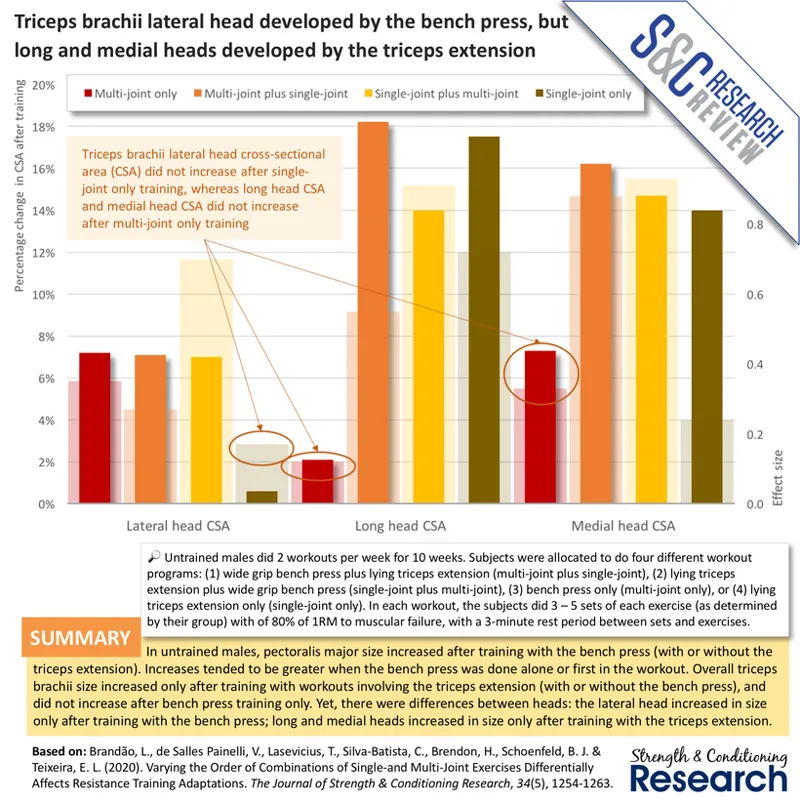
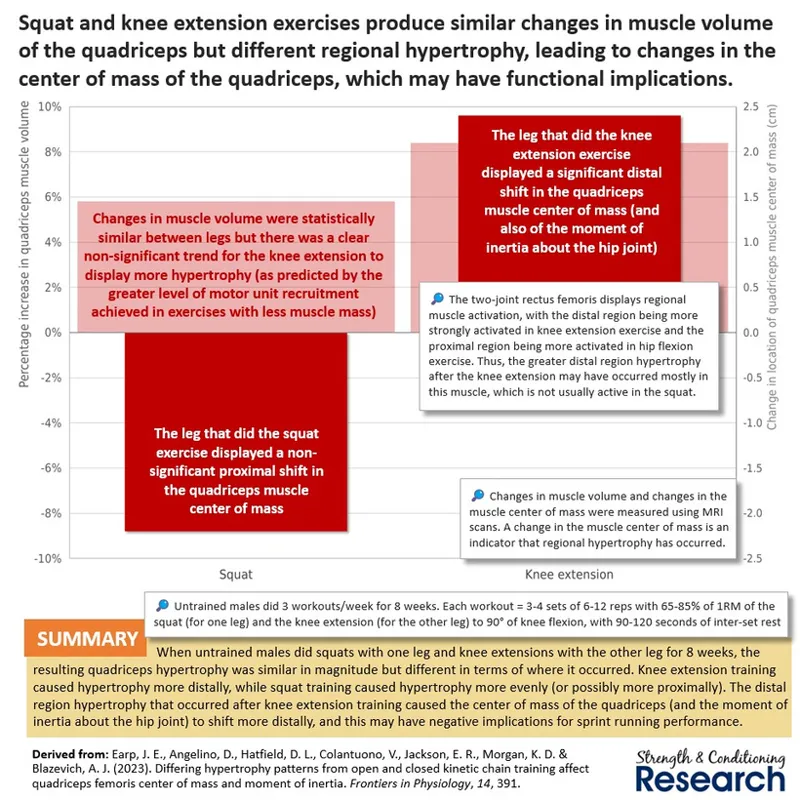
Over the last few years, many studies have reported that hypertrophy can occur in different parts of a muscle or of a muscle group, depending on the exact training variables used in a program. For example, multi-joint exercises tend not to develop the two-joint muscles within a group (like the rectus femoris) while single-joint exercises tend to develop those muscles very effectively.
.
The exact same phenomenon occurs in the two-joint triceps brachii long head, which is not developed by multi-joint exercises but is very successfully trained by single-joint exercises.
.
Similarly, different multi-joint exercises can also target different regions within a muscle group even when this does not involve the exclusion of two-joint muscles, as we can see by studying the differences in pectoralis hypertrophy caused by incline bench presses and flat bench presses.
.
Similarly, different single-joint exercises can also target different regions within a muscle group, as we can see by studying the differences in hamstrings hypertrophy caused by leg curls that are done with an extended hip position and leg curls that are done with a flexed hip position.
.
In addition to exercise selection, contraction mode also plays a role in altering the location of the hypertrophy that is produced after a strength training program. Eccentric contractions tend to cause more distal region growth while concentric contractions cause more proximal hypertrophy.
.
Similarly, range of motion also plays a role in altering the location of the hypertrophy that is produced after a strength training program. Stretched positions tend to cause more distal region growth while concentric contractions cause only proximal region hypertrophy.
.
Overall, a wider variety of exercises and training variables tend to produce more hypertrophy in comparison with less variety within the context of a well-written strength training program.
.
#2. Greater exercise variety is better for strength gains and regional hypertrophy very likely contributes to that effect
Importantly, studies have shown that greater exercise variety contributes positively to strength gains, which is a finding that is generally ignored by commentators who do not really understand the principle of specificity.
.
It seems likely that differences in regional hypertrophy are in part responsible for this superior effect of greater exercise variety on strength gains in a marker exercise. Indeed, research has shown that specific areas of a muscle can contribute disproportionately to exercise strength.
.
#3. Differences in regional hypertrophy cause changes in where future muscle growth will happen
When a muscle has a longer internal moment arm, it will be called upon to contribute during an exercise to a greater extent in accordance with the principle of neuromechanical matching. Greater muscle sizes are associated with longer internal moment arms. Therefore, once a muscle region experiences hypertrophy, it is more likely to experience more hypertrophy in the future.
.
#4. Differences in regional hypertrophy cause changes in muscle center of mass
In addition to the differences in strength gains caused by differences in regional hypertrophy, there are changes in the muscle center of mass. During fast movements like sprint running, the location of the muscle center of mass is very important for performance. A more proximal center of mass will be associated with faster running speeds because the angular momentum of the rotating limb is smaller. Conversely, a more distal center of mass will be associated with slower running speeds because the angular momentum of the rotating limb is larger. These differences will have an important effect regardless of the level of force that the muscle can generate.
.
Conclusions
Muscles do not grow uniformly after strength training. Various factors have been shown to affect the exact location where hypertrophy happens. Differences in regional hypertrophy occur when training with: [1] multi-joint exercises and single-joint exercises for the same muscle group (e.g. bench presses and triceps extensions), [2] exercises for two-joint muscles at different muscle lengths (e.g. lying leg curls and seated leg curls), [3] exercises using different ranges of motion (i.e. partial and full), and [4] exercises with differing contraction modes (i.e. eccentric and concentric). It is likely that these differences in regional hypertrophy contribute to differences in strength gains, athletic performance, and the potential for future muscle growth. Indeed, research has shown that not all muscle size gains after training contribute equally to the gains in strength in a tested exercise. The hypertrophy of some regions contributes more to gains in an exercise 1RM than the hypertrophy of other regions. Also, when the center of mass of a muscle is altered by regional hypertrophy, this will change the ratio of its force-producing ability to its angular momentum in fast movements like sprinting. Greater angular momentum is disadvantageous for both accelerating and decelerating in the sprinting gait cycle. Finally, when a muscle increases in size, its internal moment arm length increases, which means that the central nervous system will allocate more central motor command to it during movements in the future, in accordance with the principle of neuromechanical matching, thereby enhancing its capacity for hypertrophy.
Comments (8)
Hi Chris, I understand the NMM based argument of variety and how it benefits strength gain in advanced lifters. How does this explain the results for untrained lifters in the constant/varied load and exercise study above? Since they are untrained, wouldn’t they not be facing the maxed out regional growth issue? If not, where are these greater/faster gains coming from ?
Thanks for this very interesting piece Chris. I am having trouble understanding two concepts, so two questions 1) In the Earp (2023) study, the rectus femoris had more proximal hypertrophy in a squat. In the Franchi (2014) study it noted muscles gain more distal hypertrophy following eccentric actions. My question is because this seems contradictory because the proximal part of the rectus is eccentrically contracting the hip in the lowering portion of a squat. So wouldn't by this thinking the distal part of the rectus be gaining size, but still the distal part is showing more hypertrophy? 2) I am confused how the Biceps Femoris Long head, ST and SM are experiencing more hypertrophy while the hip is flexed, Maeo, S (2024)? I am confused because of your Two-Joint article from January of 2023. Where muscles do not experience a greater activation if they are acting as a agonist and antagonist over two joints as all three of the hamstring muscles I mentioned are hip extenders and knee flexors, but yet the study showed when the hip was flexed they received greater activation. So why do you think this is? Do questions make sense? Because these 2 points lead me to think the rectus femoris is way more active in a squat than the Two-Joint article said.
In their discussion, Earp (2023) comment that they too were surprised to see any rectus femoris hypertrophy after squats because the literature generally reports that it does not happen. Sometimes, odd results occur. Overall, we have [1] most studies reporting no two-joint muscle growth after multi-joint exercises, and [2] a mechanism by which these two-joint muscles are prevented from experiencing any mechanical loading. So on balance, I don't see a strong argument for abandoning the two-joint muscle problem/principle at the moment.
For flexing, how does the central motor command allow both agonist and antagonist motor unit recruitment to be maximized, won't it always be inferior to try and activate maximum MUR in two muscles compared to one in strength training? And Is the optimal way to flex for muscle growth to just contract the biceps hard only and the triceps will have antagonis coactivation occuring naturally or to focus on contracting the biceps and triceps together as a cocontraction?
Yes, flexing in a single-joint exercise will be more similar to strength training with a multi-joint exercise as far as MUR is concerned because there are more muscles working at a high level of MUR. As regards your second question, the answer is in the question... one is an external focus of attention (performance or goal-oriented) while the other is an internal focus of attention (muscle-oriented). Which focus you employ determines the outcome you get.
Its interesting that more variety increases the 1RM. Would more variety also increase high velocity strength, or would more specific training with the same joint angles that are used in the movement be better? And what are the reasons for that? I dont understand why using different muscle regions is superior, instead of the one with the best leverage
Hi Chris. Are there any regional differences in the two joint principle? Could the distal rectus femoris still be somewhat active in the squat without causing a two joint problem, which would line up with neuromechanical matching as well? I just wondered if this is an adaptation which might happen to a lifter over many years, perhaps?
That is an interesting possibility. I don't know of any research that would help us identify whether it is happening however.