






Training to failure and leaving reps in reserve
Every so often, someone will point to a study that has failed to identify any differences in hypertrophy between a training program involving performing sets to failure and a training program that leaves a couple of reps in reserve. They will say that this provides proof that the two training programs are producing an identical hypertrophy stimulus. This betrays a complete lack of curiosity into how physiology actually works. Let us walk through the problem.
.
#1. Does training to failure cause more hypertrophy than leaving reps in reserve?
There are studies that have reported similar hypertrophy after either training to failure or after training while leaving a couple of reps in reserve. For example, in this study with heavy loads.
.
Similarly, in this study with both moderate and light loads, where two groups trained to failure and the other two groups trained while leaving one rep in reserve (so stopping just short of failure).
.
If this result was not caused by the inability of the study design to detect a difference between groups statistically, then there is only one possible physiological explanation, which is that the final 1-2 reps of a set to failure do not stimulate hypertrophy. Moreover, there are only really two possible reasons why the final 1-2 reps of a set to failure might not stimulate hypertrophy. Firstly, it could be the result of central nervous system fatigue building up. Secondly, it could be the result of calcium ion-related fatigue building up.
.
#2A. Do the last one or two reps of a set to failure still stimulate hypertrophy? The possibility of central nervous system fatigue
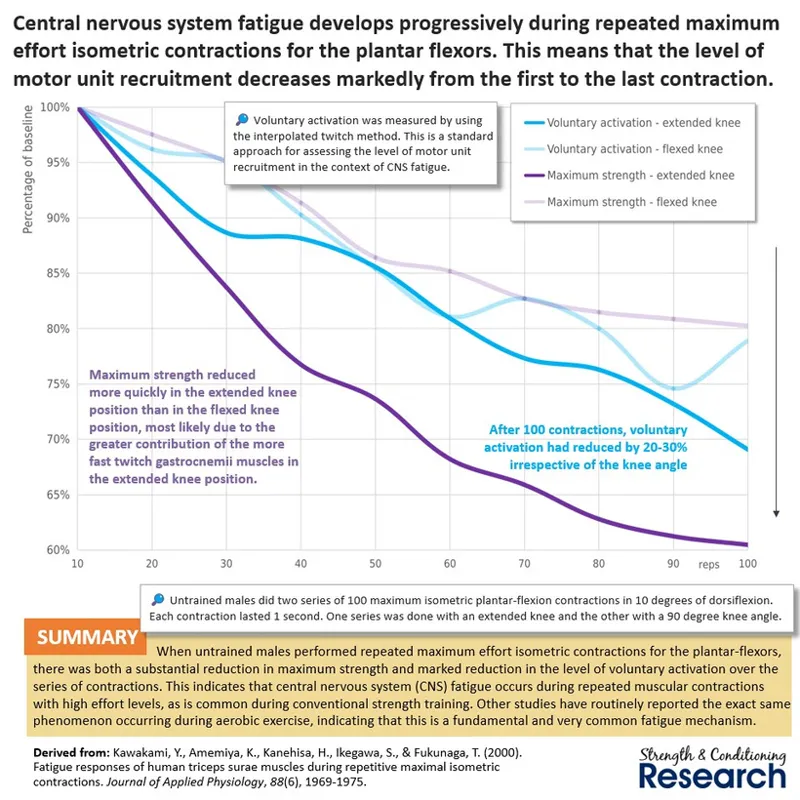
During any bout of exercise, spinal and supraspinal central nervous system fatigue mechanisms build up gradually. Central nervous system fatigue mechanisms reduce motor unit recruitment levels and thereby reduce the hypertrophy stimulus. If the final reps of a set involve very high levels of central nervous system fatigue, then they might not produce much hypertrophy. Indeed, we do have evidence that central nervous system fatigue does increase progressively over the course of any bout of exercise, and can reach relatively high levels. For example, in this study into isometric contractions, we can see motor unit recruitment levels (here measured by voluntary activation) reducing by 30% from the start of the set of contractions.
.
Similarly, in another study into isometric contractions, we can see voluntary activation levels reducing by 35-40% over the course of a sustained, maximal effort contraction. Such studies do indicate that we could theoretically ascribe a much reduced hypertrophy stimulus to the final reps of a set performed to failure compared to the previous reps of the set.
.
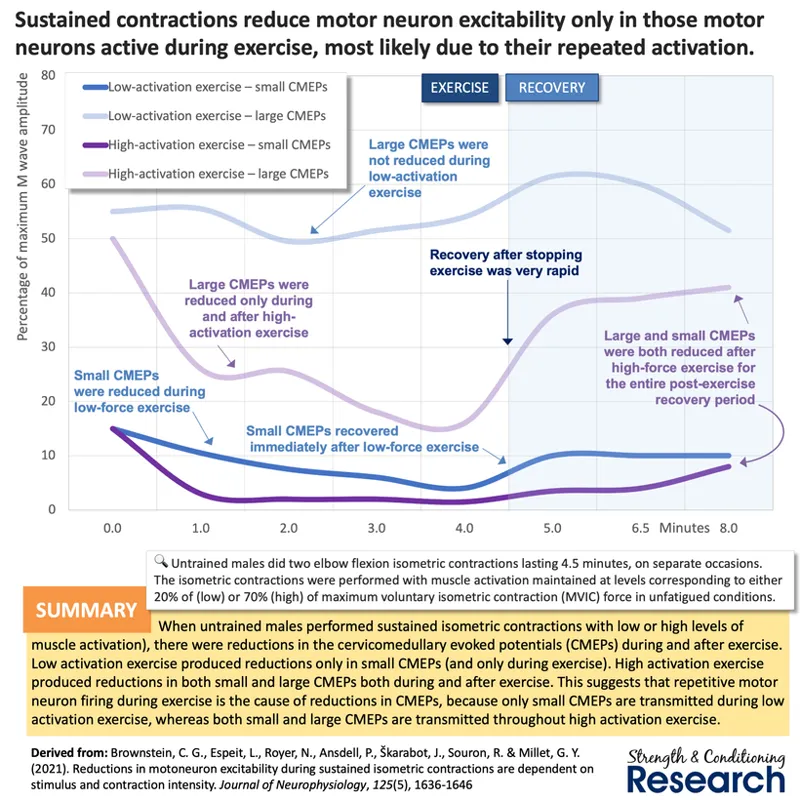
Nevertheless, a key feature of central nervous system fatigue is that both spinal and supraspinal mechanisms increase dramatically with increasing duration of time spent exercising. Indeed, here we can see spinal central nervous system fatigue building up over a period of sustained exercise.
Similarly, we can see the effects of pain and discomfort causing gradually increasing supraspinal central nervous system fatigue during a sustained bout of exercise. In practice, this means that central nervous system fatigue is greater during lighter load exercise that involves more reps to failure (which is why we fail to see gains in motor unit recruitment after training with light loads). Therefore, if central nervous system fatigue can stop the final reps of a set to failure from being stimulating even with heavy loads, then it should completely prevent hypertrophy from being stimulated with light loads (which obviously does not happen).
.
#2B. Do the last one or two reps of a set to failure still stimulate hypertrophy? The possibility of calcium ion-related fatigue
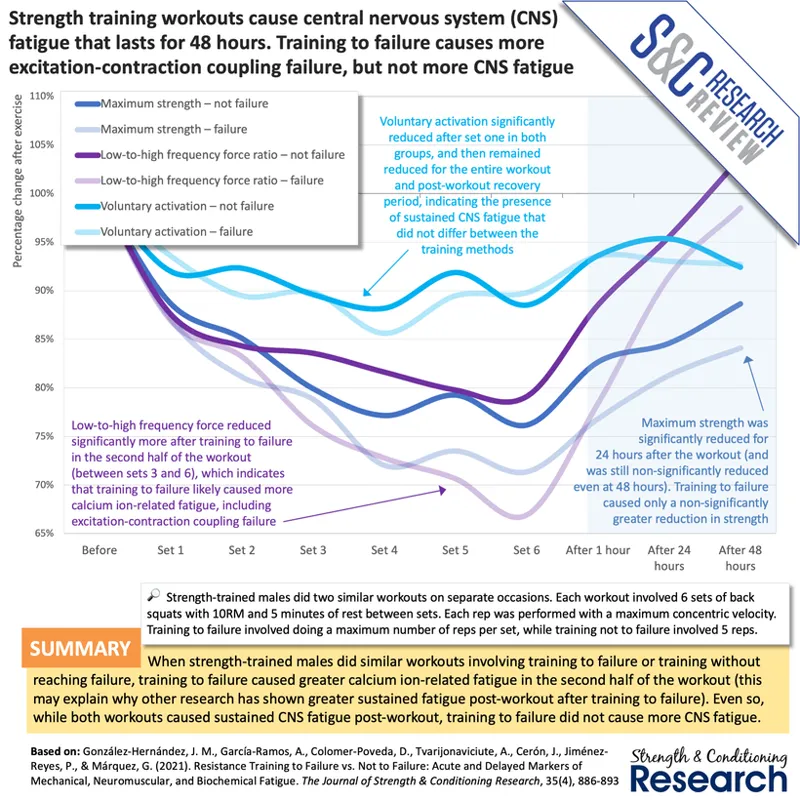
During any bout of exercise, calcium ion-related fatigue mechanisms build up gradually. Calcium ion-related fatigue mechanisms reduce single fiber mechanical tension and thereby reduce the hypertrophy stimulus. If the final reps of a set involve very high levels of calcium ion-related fatigue, then they might not produce much hypertrophy. Indeed, we do have evidence that calcium ion-related fatigue does increase progressively over the course of any bout of exercise and is greater when training closer to failure (as measured by reference to low-frequency fatigue).
.
Nevertheless, a key feature of calcium ion-related fatigue mechanisms is that they really do not dissipate very much once they have been produced. So if calcium ion-related fatigue were to be entirely responsible for completely preventing any hypertrophy stimulus being achieved during the final one or two reps of a set, then the same fatigue mechanisms would completely prevent any hypertrophy stimulus being achieved in subsequent sets of the same workout for the same muscle group, which would contradict the dose-response relationship of hypertrophy. For this reason, we can probably discount calcium ion-related fatigue mechanisms as a sole explanation.
.
#3. Can we really detect whether the last one or two reps of a set to failure are capable of stimulating hypertrophy?
Perhaps the most likely explanation for why studies occasionally report that training to failure is equivalent to training while leaving one or two reps in reserve is simply that we cannot detect such small differences statistically. Indeed, it is widely-accepted that there is a dose-response relationship between hypertrophy and training volume. Yet, we can easily find studies that have not reported any significant differences between very different training volumes in athletic, strength-trained lifters. Obviously, this is just a problem of reaching statistical significance.
.
Conclusions
Sometimes, commentators will point to a study that has found no differences in hypertrophy between training to failure and training while leaving a couple of reps in reserve. They will say that this provides proof that the two training programs are producing an identical hypertrophy stimulus. There are three possible reasons why a study might report this result. Firstly, central nervous system (CNS) fatigue could be so high that it prevents the final reps in a set from being stimulating (by reducing motor unit recruitment). This is extremely unlikely because CNS fatigue differs greatly between rep ranges, being greater with lighter loads. For it to stop the final reps of a set with heavy loads from producing any muscle growth, it would have to totally prevent light load sets from stimulating any hypertrophy at all. Secondly, calcium ion-related fatigue could be so high that it prevents the final reps in a set from being stimulating (by reducing single fiber mechanical tension). This is also extremely unlikely because calcium ion-related fatigue remains for days once produced and this would stop later sets in the same workout from achieving any hypertrophy, thereby destroying the hypertrophy dose-response to training volume. Thirdly, the study might not have had the statistical power necessary to detect small differences in hypertrophy when the difference in hypertrophy stimulus is quite small. This seems very likely given that there are plenty of training volume studies that have failed to find any statistical differences in hypertrophy between quite wide-ranging numbers of sets to failure.
Comments (3)
Maybe it is not about acute response, maybe it is about chronic fatigue that accumulates with trainings to failure and because of that, following trainings are less stimulating.
Since there is a greater catabolic effect from training to failure, couldn’t that also be a factor in why stopping a set just before failure can be just as effective as going to failure? Also… if we stop just shy of failure, does the first set still give us the biggest bang for the buck, with each successive set being less effective at stimulation hypertrophy?
So it’s always better to leave few reps on reserve as it will produce the same or better hypertrophy stimulus with less fatigue and better recovery right !