







Muscle damage mechanism
Owing to an extremely successful marketing campaign over many years, a small group of researchers and strength and conditioning professionals have successfully convinced most people in the fitness industry that passive mechanical tension (pulling forces during eccentric contractions) causes muscle damage as well as hypertrophy. This is not true. Muscle damage is caused by the calcium ions released during sustained periods of muscle activation.
.
#1. How do we know that muscle damage is not caused by pulling forces?
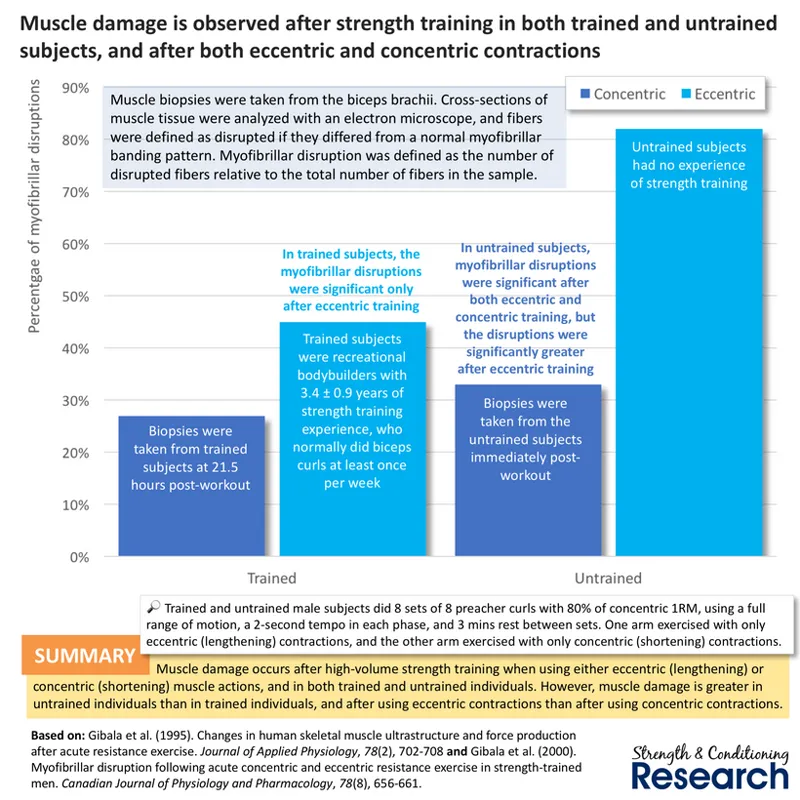
For many years, it has been claimed that muscle damage occurs when muscle fibers are pulled apart by passive mechanical tension during eccentric contractions. Nevertheless, we know that this is definitely not true because muscle damage can occur during concentric contractions.
.
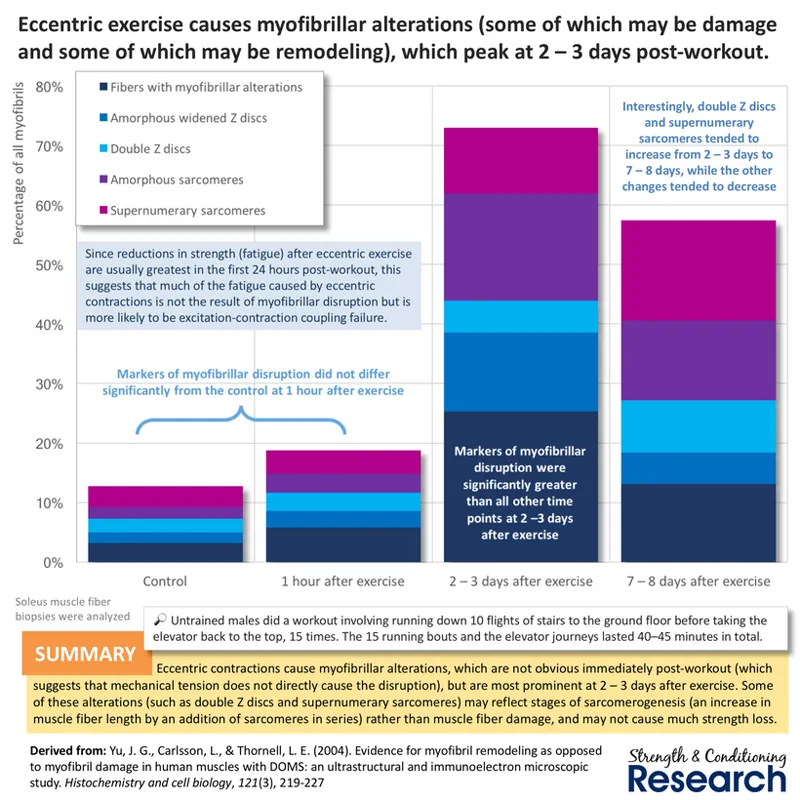
Additional important evidence that mechanical tension does not cause muscle damage is that damage only appears hours post-workout. If damage was caused by physical pulling forces, it would be present immediately. Yet, multiple studies show that most of the damage is delayed. Here, the loss of myofibrillar proteins begins one day post-workout and continues for a week.
.
Here, the loss of actin and myosin takes even longer to occur. It seems likely that in animal models where the damage is extremely severe, delays in muscle damage appearing are longer.
.
It seems likely that when investigating signs of muscle damage, some researchers have focused overmuch on the sarcoplasmic reticulum (which does display early signs of damage immediately post-workout) and not on the myofibrils themselves (which always display delayed damage).
.
For completeness, it is worth noting that the same delayed muscle damage phenomenon has been reported in humans as well as in these comparatively more common animal models.
.
#2. How do we know that muscle activation causes muscle damage?
One of the best demonstrations that muscle damage is caused by muscle activation duration can be found in studies comparing different durations of maximal isometric contractions. Critically, maximal isometric contractions involve essentially negligible force production after 10 minutes, which means that there are no muscle fiber forces of any kind. Yet, the longer the contraction (and the greater the build-up of calcium ions from the sustained muscle activation), the greater the post-workout fatigue (and muscle damage).
.
#3. How does muscle activation cause muscle damage?
The calcium ion accumulation model of muscle damage is extremely well-established and indeed accepted by the large majority of fatigue physiologists. Muscle activation necessarily causes an influx of calcium ions into the cytoplasm of a muscle fiber through the excitation-contraction coupling process. As these calcium ions accumulate, they cause a sequence of events leading to the release of enzymatic proteases called calpains that produce muscle damage.
.
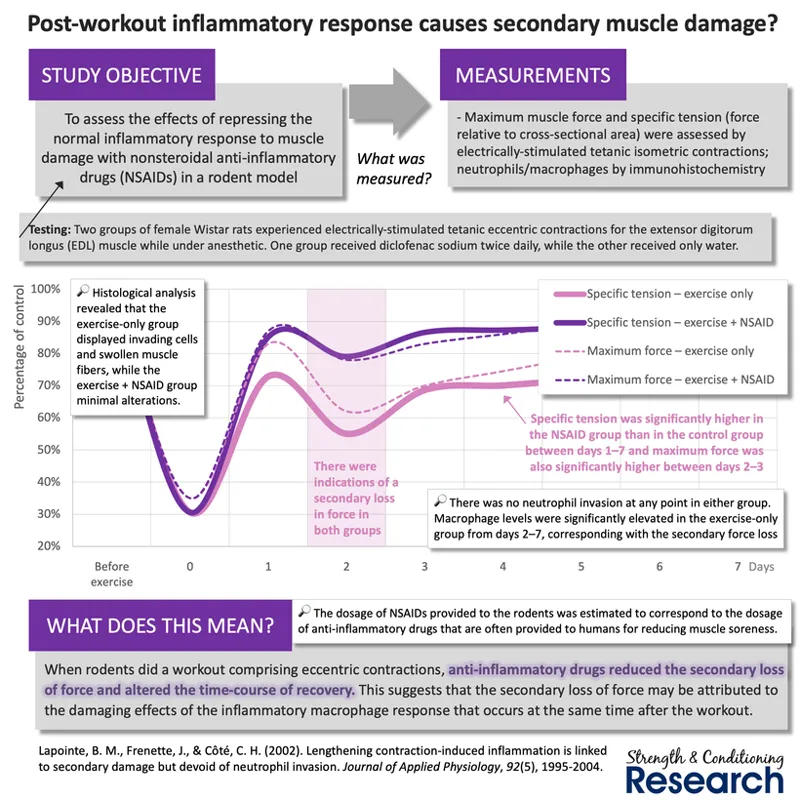
Additionally, once the calpains have started producing muscle damage, there is an inflammatory response that clears away the damage caused by these proteases and which causes additional losses of myofibrils as a result of the cleaning process. This process is called "secondary muscle damage" or the "secondary fatigue effect."
.
#4. Why do eccentrics cause more muscle damage than concentrics?
A common challenge to the calcium ion accumulation model of muscle damage is that eccentrics cause more damage than concentrics and thus pulling forces simply must be involved. However, this challenge neglects to recognize that eccentric contractions cause the opening of important ion channels between the inside and the outside of the muscle fiber that allow additional calcium ions to enter and accumulate, thereby causing more muscle damage.
.
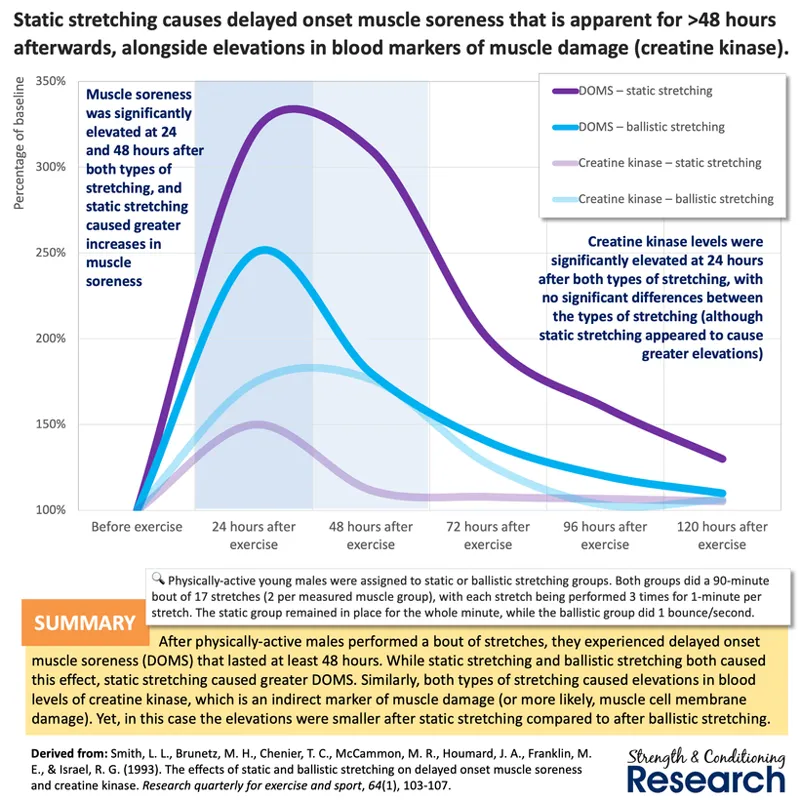
Indeed, this is why static stretching causes post-workout fatigue and muscle damage markers to be elevated for days after the stretching bout. Obviously, eccentric contractions produce more muscle damage because they involve both muscle activation and stretch at the same time.
.
#5. What does this mean in practice?
In practice, this means that longer durations of muscular contractions at a given intensity of effort (or proximity to failure) cause much more muscle damage than shorter durations of muscular contractions at the same level of effort. This is most obviously apparent when comparing light and moderate load strength training to failure sets. The light loads cause more post-workout fatigue (which is caused by muscle damage) due to their longer durations of muscle activation.
.
Similarly, more workout training volume causes more muscle damage because each additional set involves an extra period of time spent with the muscle activated. This relationship seems to be broadly linear, with each extra set correspondingly causing an extra unit of muscle damage.
.
Obviously, reaching a greater stretched position or using eccentric contractions similarly causes more fatigue and muscle damage because of the opening of the stretch-activated ion channels.
.
Conclusions
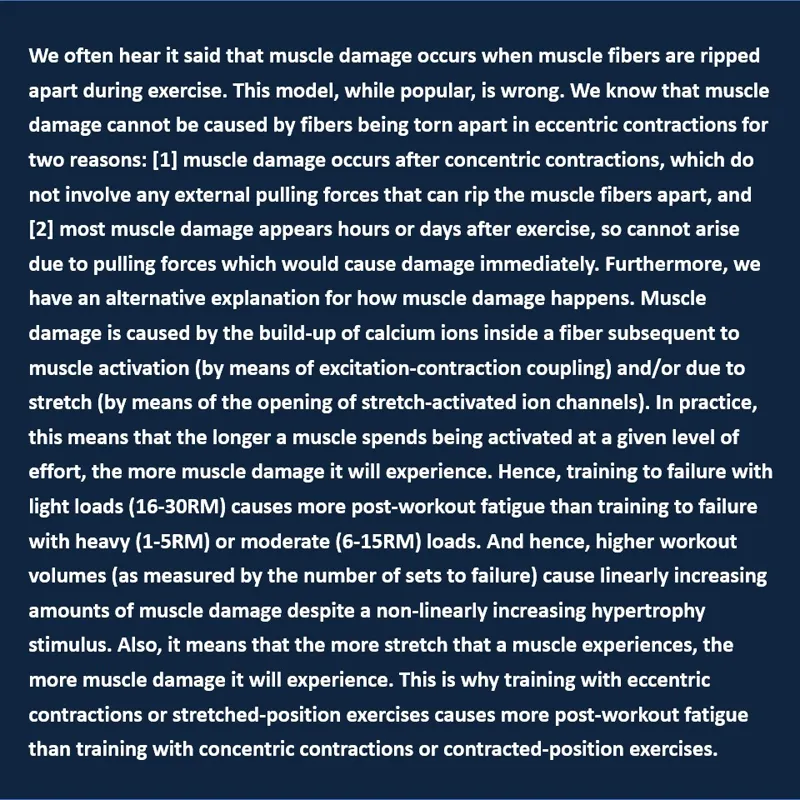
We often hear it said that muscle damage occurs when muscle fibers are ripped apart during exercise. This model, while popular, is wrong. We know that muscle damage cannot be caused by fibers being torn apart in eccentric contractions for two reasons: [1] muscle damage occurs after concentric contractions, which do not involve any external pulling forces that can rip the muscle fibers apart, and [2] most muscle damage appears hours or days after exercise, so cannot arise due to pulling forces which would cause damage immediately. Furthermore, we have an alternative explanation for how muscle damage happens. Muscle damage is caused by the build-up of calcium ions inside a fiber subsequent to muscle activation (by means of excitation-contraction coupling) and/or due to stretch (by means of the opening of stretch-activated ion channels). In practice, this means that the longer a muscle spends being activated at a given level of effort, the more muscle damage it will experience. Hence, training to failure with light loads (16-30RM) causes more post-workout fatigue than training to failure with heavy (1-5RM) or moderate (6-15RM) loads. And hence, higher workout volumes (as measured by the number of sets to failure) cause linearly increasing amounts of muscle damage despite a non-linearly increasing hypertrophy stimulus. Also, it means that the more stretch that a muscle experiences, the more muscle damage it will experience. This is why training with eccentric contractions or stretched-position exercises causes more post-workout fatigue than training with concentric contractions or contracted-position exercises.
Comments (4)
"More muscle damage" in eccentrics than static stretching happening only to the fibers that are active because recruitment is about 50% more than stretching? More importantly is activation and damage not at the muscle fiber level rather than muscle level? When its high reps versus lower reps, the high threshold fibers are going to be activated and thus damaged towards the end of the set. So the difference in duration of activation for the fibers that actually matter should not be drastic enough to explain the muscle damage difference?
My question was for Chris Beardsley who I have tremendous respect for - I listened to the podcast obviously - and you are wrong - they are one and the same ESSENTIALLY - wow 3 by 5 versus 5 by 3 - however if CHRIS corrects my I will contemplate
Awesome Chris - thank you - it seems from your writing the conclusion is that hypertrophy and strength are one and the same. A bigger muscle is a stronger muscle. The notion of "hypertrophy training" essentially makes no sense. Muscle damage and metabolic stress are irrelevant or a negative. True? Thanks
Listen to the podcast he did with Paul on November 2nd (Max Hypertrophy vs Max Strength). He certainly does not think hypertrophy and strength are one and the same. He even has an easy way to remember the difference in training them “For hypertrophy you’d do something like 3 x 5, for strength you’d do 5 x 3. (Same load)”. As he mentions in that podcast “coordination is king for strength”.