




Muscle activation and hypertrophy
Fitness industry influencers and social media commenters quite frequently bleat the refrain that "muscle activation does not predict hypertrophy" without really understanding what the literature says. Indeed, there are many situations in which the activation of a muscle during an exercise is a extremely good predictor of whether that muscle will or will not experience muscle growth after training with that exercise.
.
#1. Muscles that are not activated during an exercise will not grow
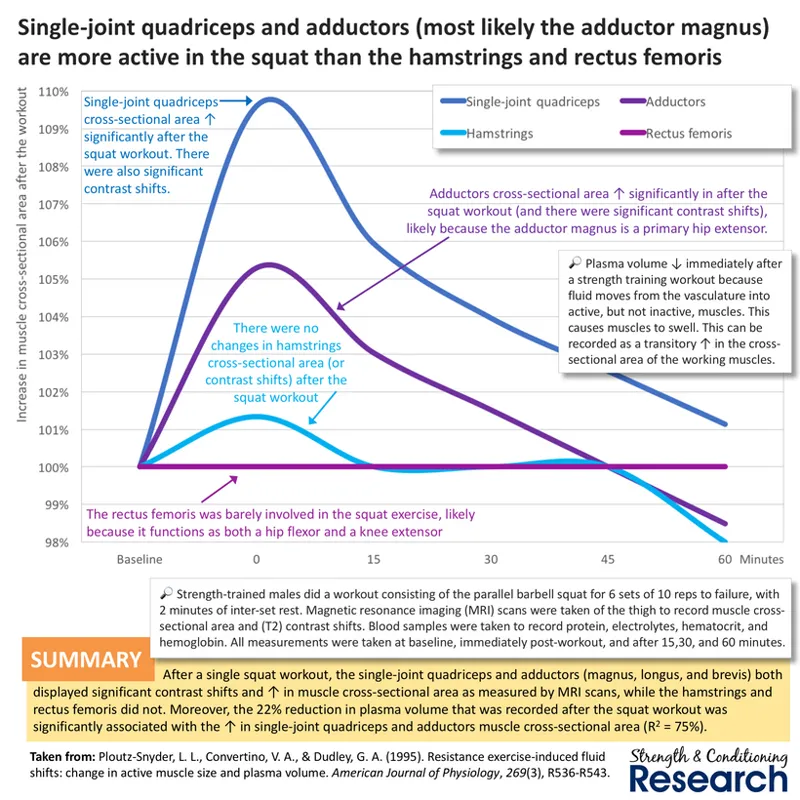
When muscles are not activated in an exercise, they do not grow after training with that exercise. For example, the rectus femoris is not activated during squats (measured by T2 signal intensity).
.
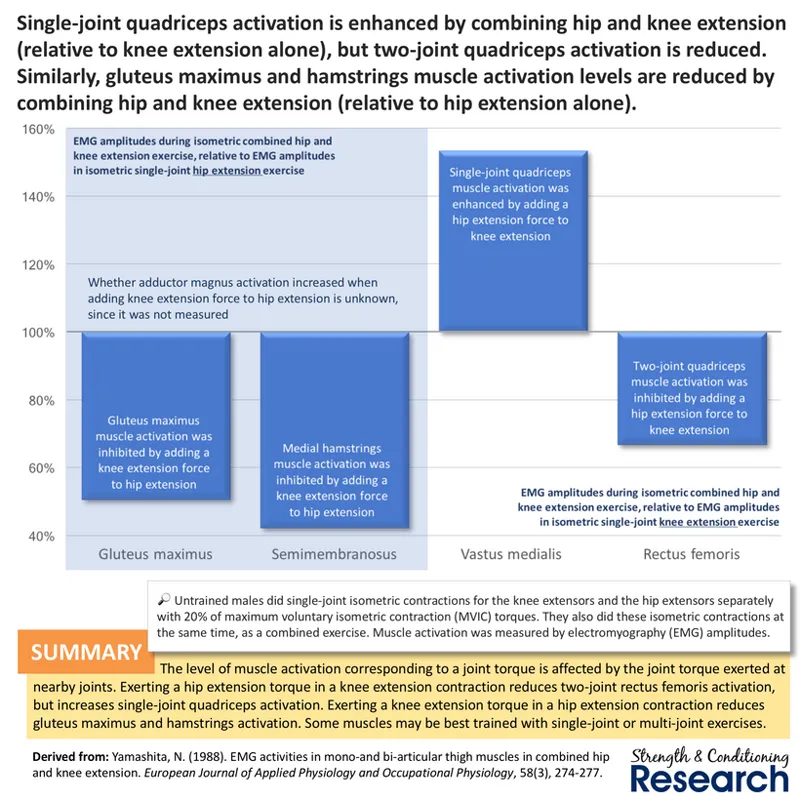
Similarly, the rectus femoris is not activated during combined isometric hip extension and knee extension (which is just an isometric squat exercise) as measured by surface EMG amplitudes.
.
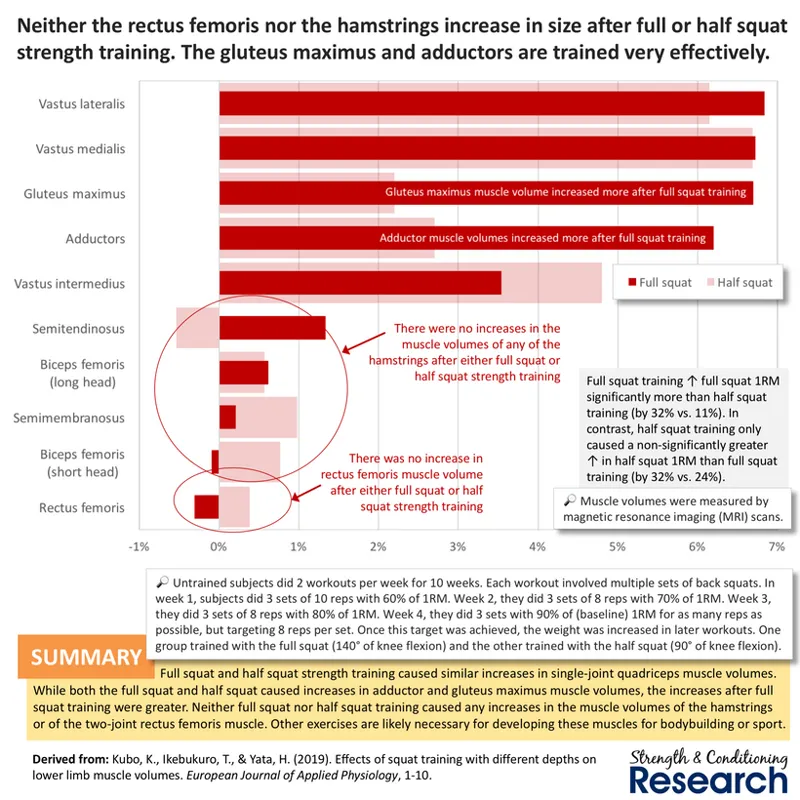
And in correspondence with such observations, long-term hypertrophy studies have frequently reported that there is no rectus femoris growth after training with any squat exercise variation.
.
#2. Within a group of muscles, the one that is most highly activated will be the one that typically grows the most after training
When examining an exercise, we often see that one or more muscles within a group are more strongly activated than other muscles of the same group. The exact muscle or muscles that are most highly activated differs between exercises. For example, the biceps femoris short head is more highly activated in lying leg curls (knee flexion with an extended hip) while the biceps femoris long head and semimembranosus are more activated in seated leg curls (knee flexion with a flexed hip).
.
Long-term strength training studies show that these same muscles are the ones that grow most after training with those specific exercises. So the biceps femoris short head grows the most after training with the lying leg curl (Nordic curl) and the biceps femoris long head and the semimembranosus grow more after training with the seated leg curl.
.
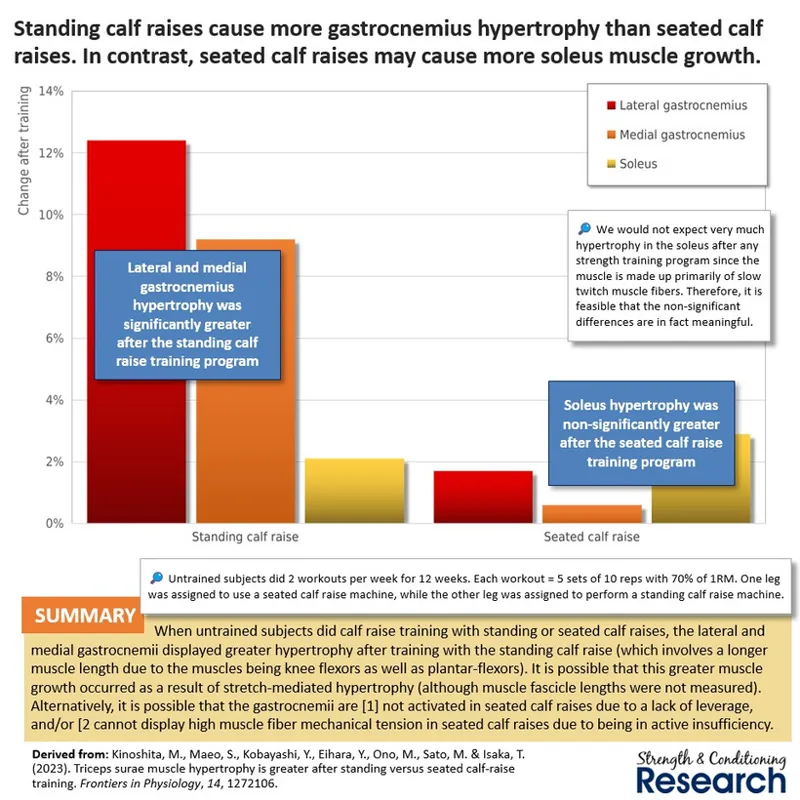
Similarly, when we look at the relative involvement of the calf muscles in the seated and standing calf raise exercise variations, we can see that the soleus is more involved in the seated variation, while the gastrocnemius is more involved in the standing variation (as measured by swelling).
.
This corresponds with the current long-term hypertrophy training data, which shows that the gastrocnemius is more well-developed after standing calf raises, while the soleus is likely more well-developed after seated calf raises.
.
#3. Within a muscles, the region that is most highly activated will be the part that typically grows the most after training
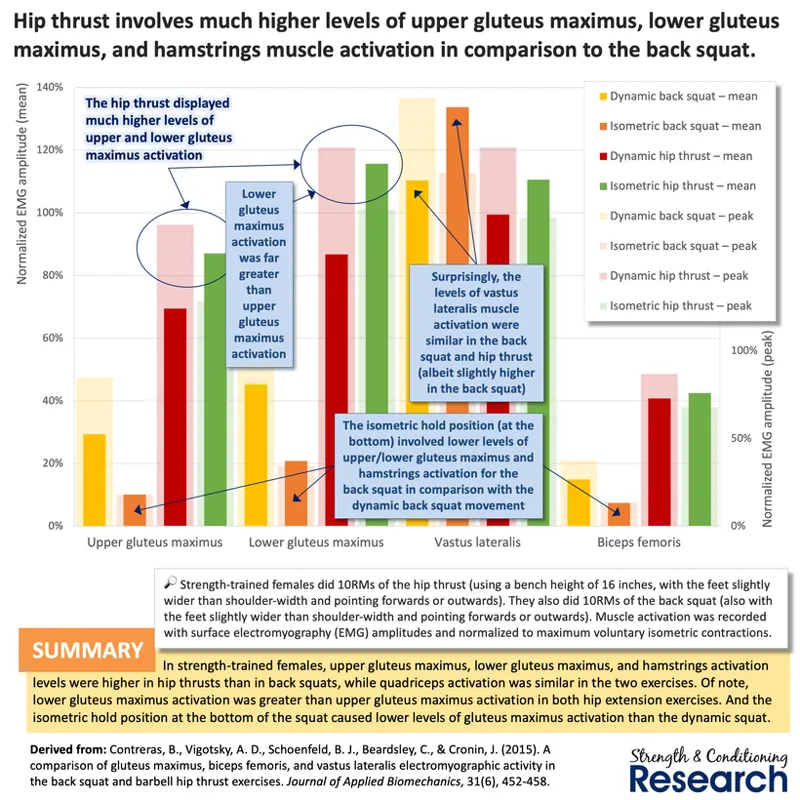
When examining an exercise, we often see that one region of a muscle tends to be more strongly activated than other regions of the same muscle. The exact region that is most highly activated differs between exercises. For example, the lower region of the gluteus maximus is more highly activated during hip extension exercise variations, like the squat and hip thrust.
.
In correspondence with this observation, we can see that training with hip extension exercises similarly causes preferential hypertrophy in the lower region of the gluteus maximus muscle.
.
Conclusions
We often hear the refrain that "muscle activation does not predict hypertrophy". Yet, the activation of a muscle in an exercise (whether measured by surface electromyography, T2 signal intensity, or muscle swelling) is a good indicator of the potential of an exercise to produce hypertrophy in the desired muscle. We can see this in three scenarios. Firstly, when muscles are not activated in an exercise, they do not experience hypertrophy after training with that exercise. The rectus femoris is not activated in squats and does not display hypertrophy after squat training. Secondly, when one muscle in a group is more activated in an exercise than other muscles within the same group, it will display the most hypertrophy after training with that exercise. The biceps femoris (short head) is more activated in the lying leg curl and grows more after training with that exercise, while the biceps femoris (long head) and the semimembranosus are more activated in the seated leg curl and grow more after training with that exercise. The soleus is more activated in the seated calf raise and grows more after training with that exercise, while the gastrocnemii are more activated in the standing calf raise and grow more after training with that exercise. And thirdly, when one region of a muscle is more activated in an exercise than the other regions of the same muscle, that region displays more hypertrophy after training with that exercise. Indeed, the lower part of the gluteus maximus is more activated in hip extension exercises than the upper part, and correspondingly grows preferentially after training with squats and hip thrusts.
Comments (3)
Hi Chris! If i understand correctly, when trying to target specific muscle in a musclegroup it's better to stay in the ROM where that specific muscle has a higher activation relativ to the other muscles in the same group rather than being in the position where that specific muscle has it's peak activation?
Hey Chris, why would someone think that high levels of muscle activation does not cause hypertrophy? Is there any research to suggest this isn’t the case?
Thank you Chris - this would seem to be obvious - hard to believe anyone would contest