







Hamstrings (individual muscles)
The hamstrings are a complex muscle group that is difficult to train without a variety of exercises to ensure that all of the four heads are developed completely.
.
#1. Can all of the hamstrings experience stretch-mediated hypertrophy?
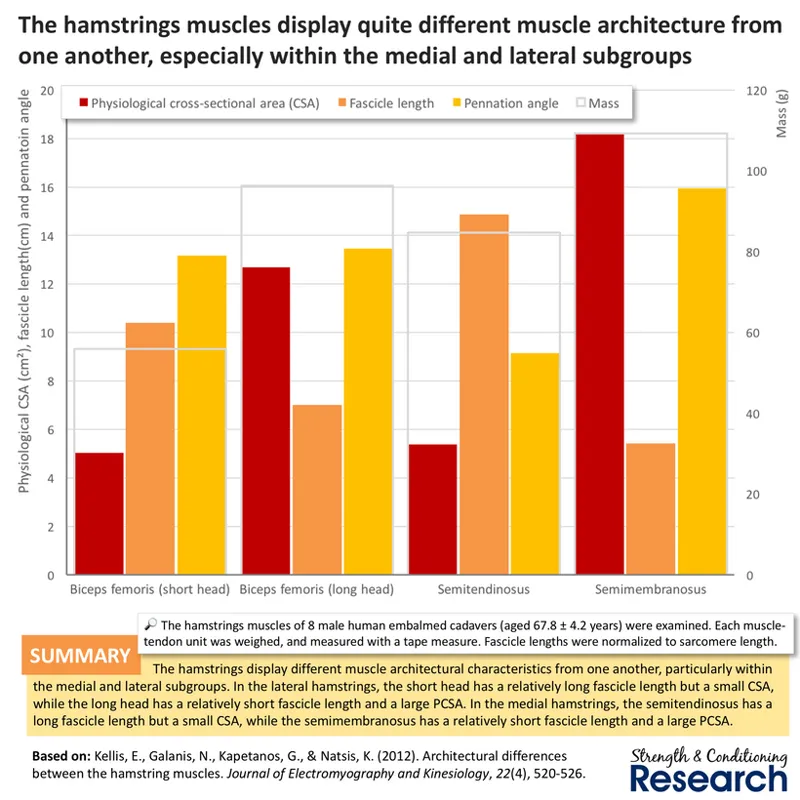
The hamstrings display different muscle architecture from one another. Multiple studies have been performed to elucidate the various characteristics of each muscle within the group.
.
Moreover, this difference in muscle architecture has led to correspondingly different sarcomere lengths. We should therefore expect substantial differences in the length-tension relationships of the various hamstrings muscles, which should lead to differences in their susceptibility to stretch-mediated hypertrophy.
.
Current estimates indicate that the sarcomeres in the hamstrings muscles work on the plateau and descending limb of the length-tension relationship, which implies that they should indeed experience substantial stretch-mediated hypertrophy, especially the semimembranosus.
.
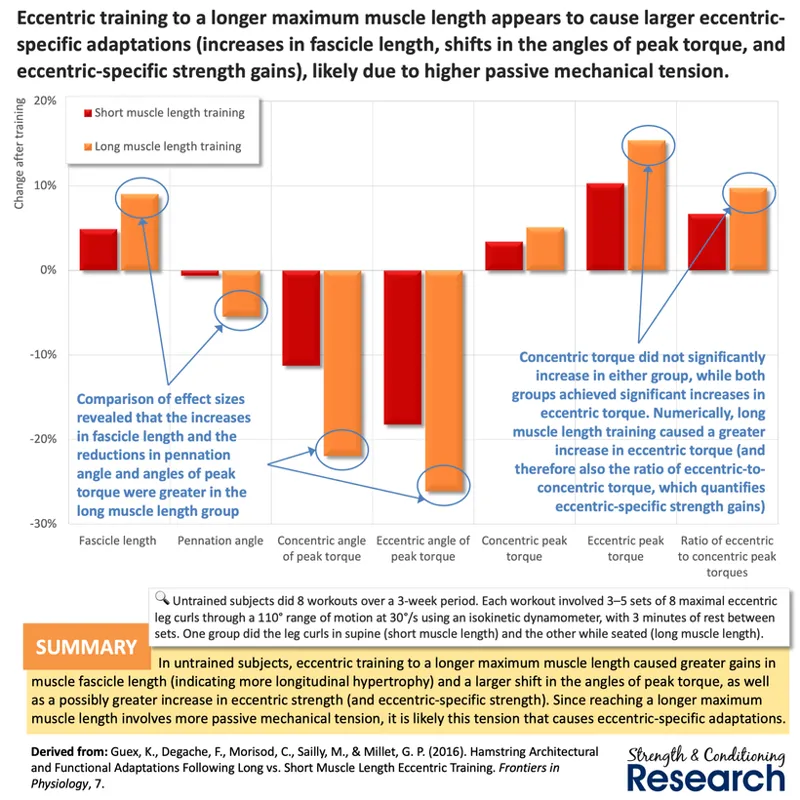
This lines up with the majority of studies published to date, which have reported more hamstrings hypertrophy after training at longer muscle lengths. This study employed eccentric contractions to compare seated leg curls (long muscle lengths) and lying leg curls (short muscle lengths). Importantly, stretch-mediated hypertrophy in the form of fascicle length increases was observed, and this was greater after the strength training program at longer muscle lengths.
.
Meanwhile, this study compared the same exercises (seated leg curl and lying leg curl) but in the context of conventional strength training, and reported very much the same kind of results.
.
Nevertheless, the most recent investigation into the hamstrings reported that there is similar overall knee flexor muscle growth between long muscle length training and short muscle length training. While the hamstrings did grow more after long muscle length training, this was balanced out by less growth in other knee flexor muscles (sartorius and gracilis). On balance, however, it seems most likely that the hamstrings do experience stretch-mediated hypertrophy owing to the increases in muscle fascicle length that have been observed in other studies.
.
#2. Do different exercises stimulate hypertrophy in different hamstrings muscles?
During hip extension, the three two-joint hamstrings muscles display very similar leverages to one another. This suggests that we should see similar muscle growth across these three muscles when training the hamstrings with back extensions or other hip extension exercises.
.
In contrast, there are differences between the internal moment arm lengths of the individual hamstrings muscles during knee flexion. The semitendinosus (a medial hamstrings muscle) displays the best leverage for most of the joint range of motion, albeit the semimembranosus (the other medial hamstrings muscle) displays slightly better leverage in full knee extension. Thus, we might expect that hip extension would be better for training the biceps femoris long head.
.
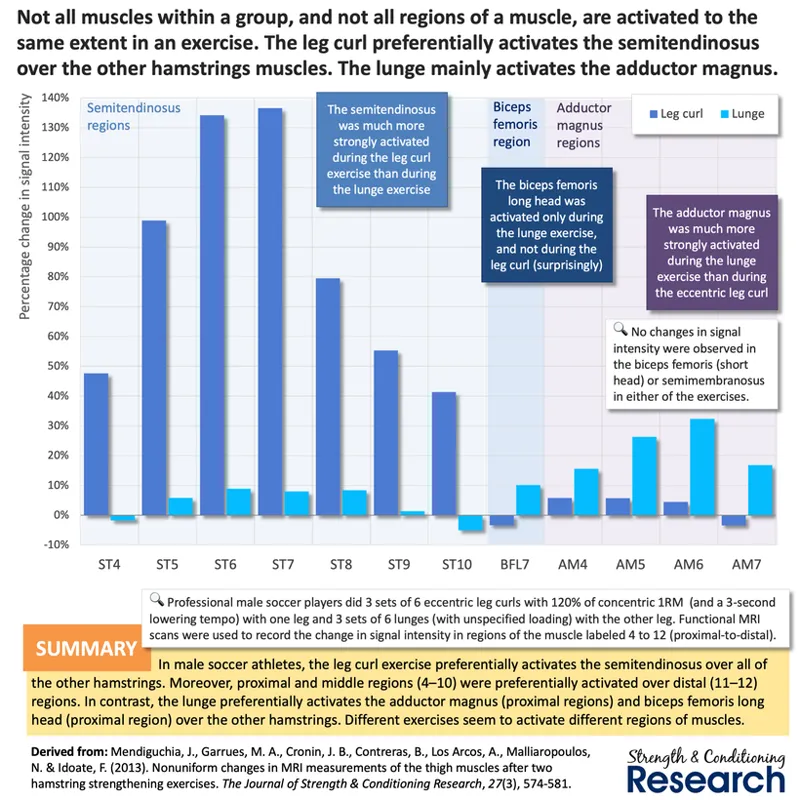
These differences in internal moment arm lengths are somewhat reflected in differences in muscle activation. When compared to a hip extension exercise, this study reported that the leg curl displayed similar levels of semitendinosus activation, higher levels of biceps femoris short head activation, and lower levels of biceps femoris long head and semimembranosus activation.
.
When compared to a hip extension exercise, this very different study reported that the leg curl displayed higher levels of semitendinosus activation and lower levels of biceps femoris long head activation.
.
#3. Does muscle length affect which hamstrings muscles are activated and trained by an exercise?
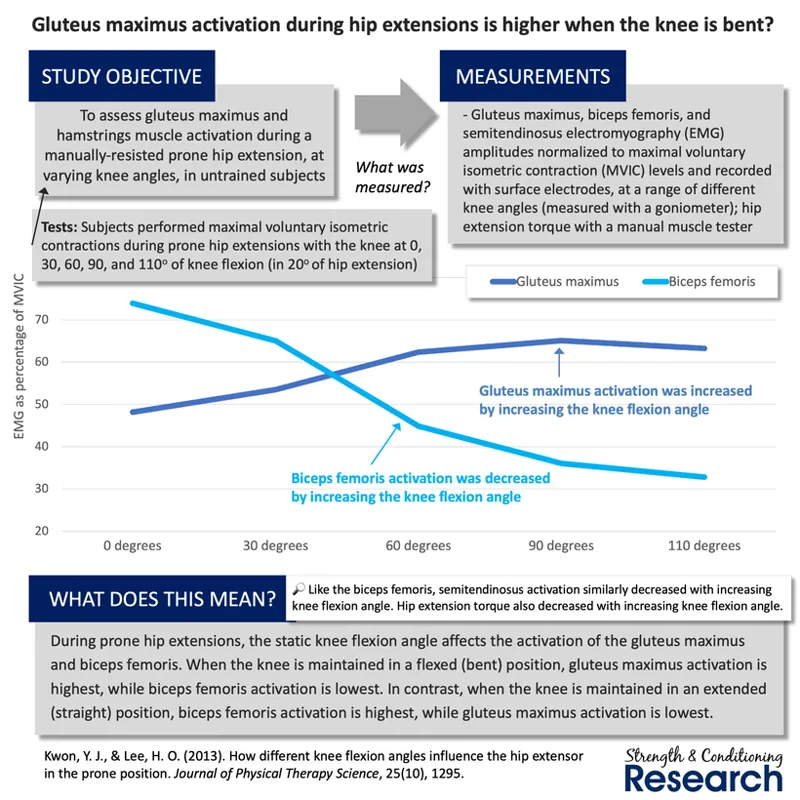
Indeed, it seems that the length of the two-joint hamstrings muscles has a substantial effect on their relative leverages and activations. The biceps femoris long head displays reduced activation during hip extension in a contracted position when the knee is flexed (such that the muscle is shortened) compared to when it is extended (such that the muscle is lengthened). This suggests that the muscle is more strongly activated when it is at a moderate length compared to when it is at a short length.
.
Additionally, this study found that biceps femoris long head muscle activation was higher during knee flexion with the hip flexed compared to knee flexion with the hip extended. This suggests that the muscle is more strongly activated when it is at a long length compared to when it is at a moderate length. The behavior of the biceps femoris short head appears to be the exact opposite.
.
These results correspond with the latest long-term training data showing that lying hamstrings curls (here performed as Nordic curls) stimulate the most hypertrophy in the biceps femoris short head and the semitendinosus and the least muscle growth in the biceps femoris long head and the semimembranosus.
.
Conclusions
Achieving maximum hypertrophy of the hamstrings muscle group requires an understanding of [1] the extent to which each muscle in the group is trained by any given exercise, and [2] their capacity for stretch-mediated hypertrophy. While previous investigations have focused on the differences in muscle activation and/or hypertrophy between hip extension and knee flexion exercises, some recent data suggests that there are also differences between lying leg curl variations (knee flexion with an extended hip) and seated leg curls (knee flexion with a flexed hip). Specifically, lying leg curl variations display higher levels of biceps femoris short head muscle activation (and also more hypertrophy of this muscle after strength training), while the seated leg curl displays higher levels of biceps femoris long head and semimembranosus muscle activation (and correspondingly more hypertrophy of these muscles after strength training). Therefore, there now seems to be validity in including both lying and seated leg curl variations in a strength training program for maximum hypertrophy. Regarding stretch-mediated hypertrophy, current estimates of sarcomere operating lengths line up well with the new long-term training data and indicate that the two-joint hamstrings (the semitendinosus, semimembranosus, and biceps femoris long head) all display meaningful stretch-mediated hypertrophy. Fortunately, since these muscles are all strongly-activated and trained by the seated leg curl, stretch-mediated hypertrophy should happen simply as a result of including this exercise in a routine.
Comments (5)
Great work as always Chris. Should one conclude (from only this data) that hip extension moves are not necessary for full hamstring development as there is no hip extension moves that outperform either the seated or standing leg curl for any of the hamstring muscles studied?
Thank you Chris - just curious - I have adopted the position that performing the seated leg curl is sufficient for full hamstring development - I do not bother with the prone version - is this correct or am I shortchanging myself? Thanks!
Hey, as far as I know and according this infographic, it does seem like you may be leaving overall hamstring gains on the table when you only use the seated leg curl for the hamstrings. The seated leg curl will emphasize (thus adequately stimulate) certain muscular regions over others(mainly the biceps femoris long head) . Meaning that there is a possibility that there are other regions that are not being adequately stimulated(like the bicep femoris shorthead) and therefore limiting overall hamstring development. Let me know, what do you think?
Great update, really glad to see things are being kept up to date. I've got one question though - as shown on the length-tension relationship infographic, none of the hamstring heads rest on the ascending limb. How could we explain the active insufficiency they suffer from on the prone leg curl at the end concentric range? Thanks in advance and thank you for your work.
Is it active insufficiency or a loss of leverage? Leverages of all hamstrings drop rapidly as we get into high degrees of knee flexion