


Hip abduction for the gluteus maximus
Some fitness influencers have argued that the gluteus maximus is not a hip abductor. Yet, the muscle is involved in hip abduction, albeit more under certain conditions than in others.
.
#1. Hip abduction during hip extension exercises
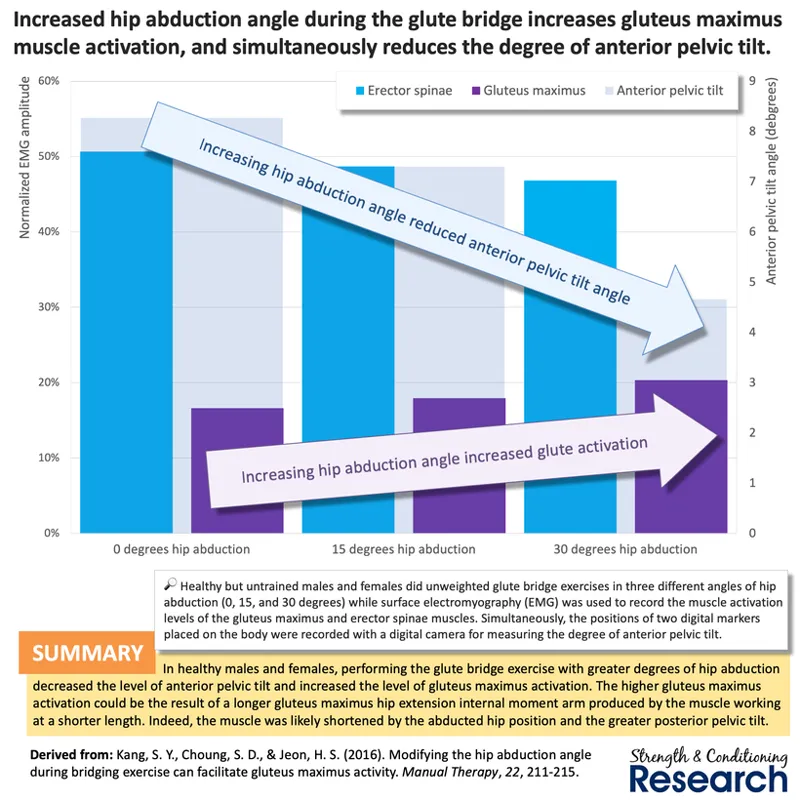
Several studies have reported that the gluteus maximus is more strongly activated during hip extension exercises (like glute bridges and hip thrusts) when the hip is held in an abducted position, possibly in part due to the reduced amount of anterior pelvic tilt that occurs.
.
.
#2. Hip abduction exercises
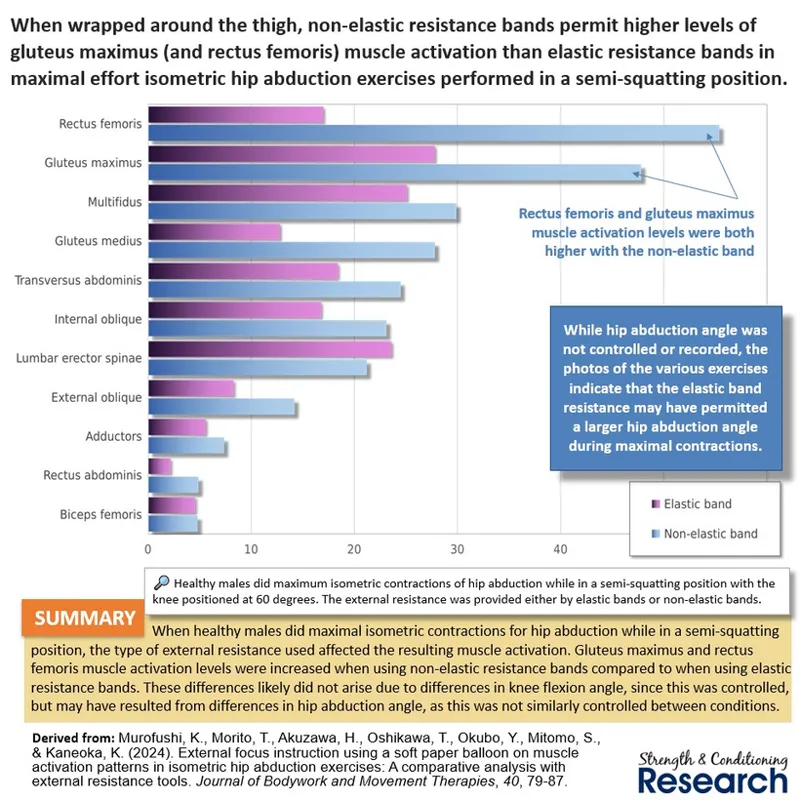
Several studies have also reported that the gluteus maximus is activated during dynamic and isometric hip abduction exercises even without any accompanying hip extension movement.
.
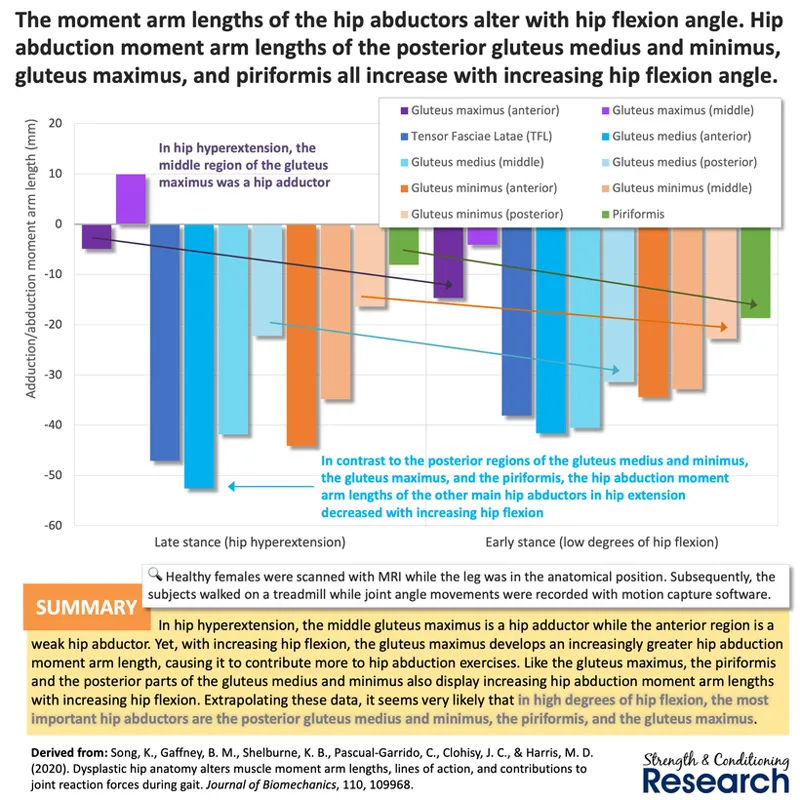
Indeed, the limited data that we have in respect of the gluteus maximus internal moment arms for hip abduction indicate that it can perform hip abduction but only if the hip is somewhat flexed. In full hip extension, the gluteus maximus is either a weak hip abductor or even a hip adductor. Thus, a semi-squatting or squatting position would be necessary to achieve gluteus maximus muscle activation while doing hip abduction contractions, but a lying or standing position would not work.
.
#3. Regional gluteus maximus activation during hip abduction
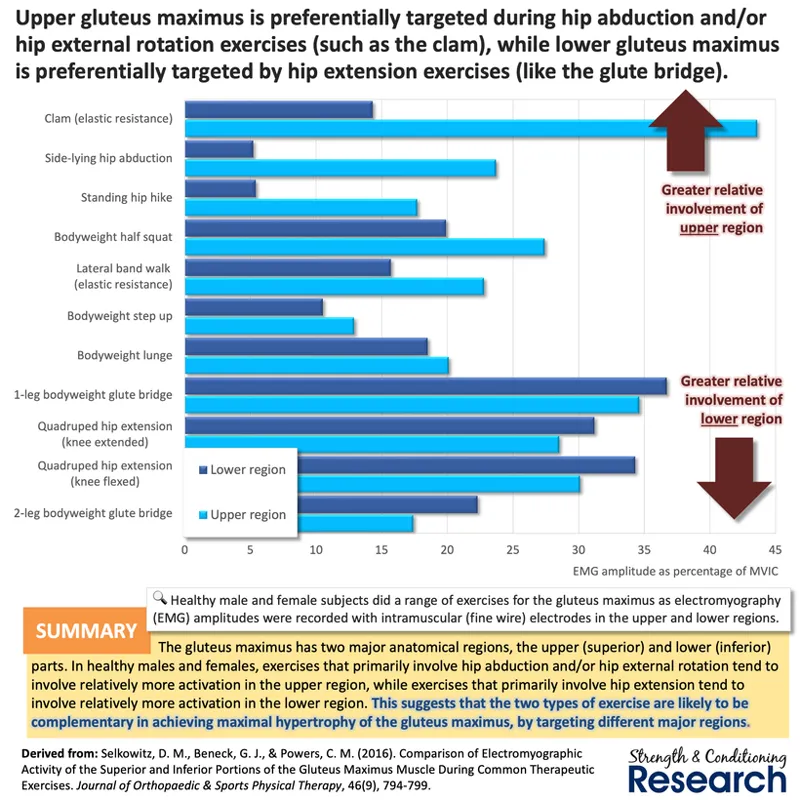
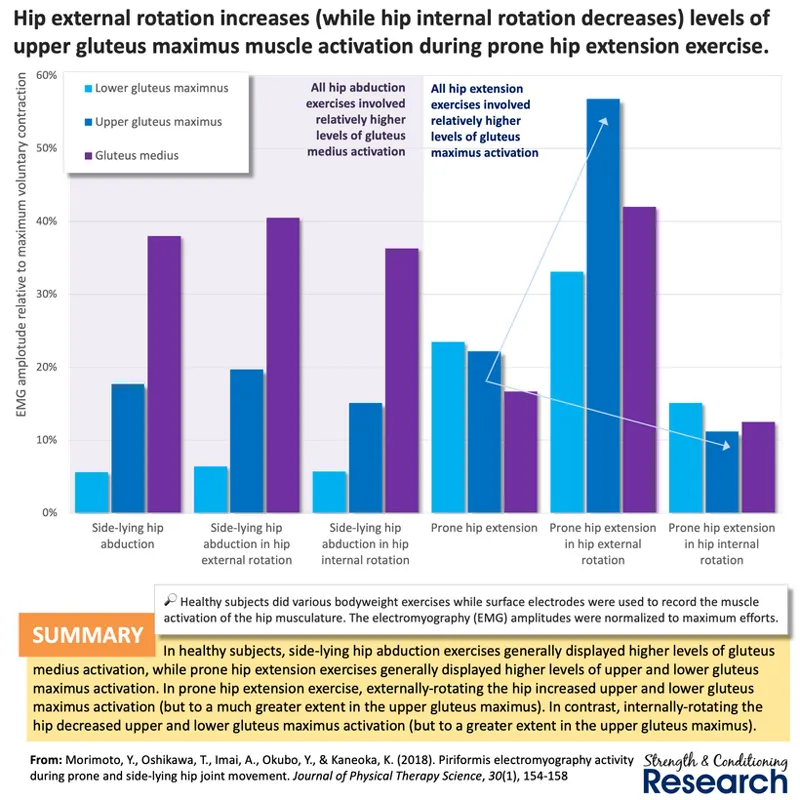
The upper gluteus maximus is more strongly activated in hip abduction activities than the lower gluteus maximus, while the lower gluteus maximus is more involved during hip extensions.
.
Many studies have reported this same finding, with exercises like the side-lying hip abduction achieving more upper gluteus maximus activation and exercises like the prone hip extension achieving more lower gluteus maximus activation.
.
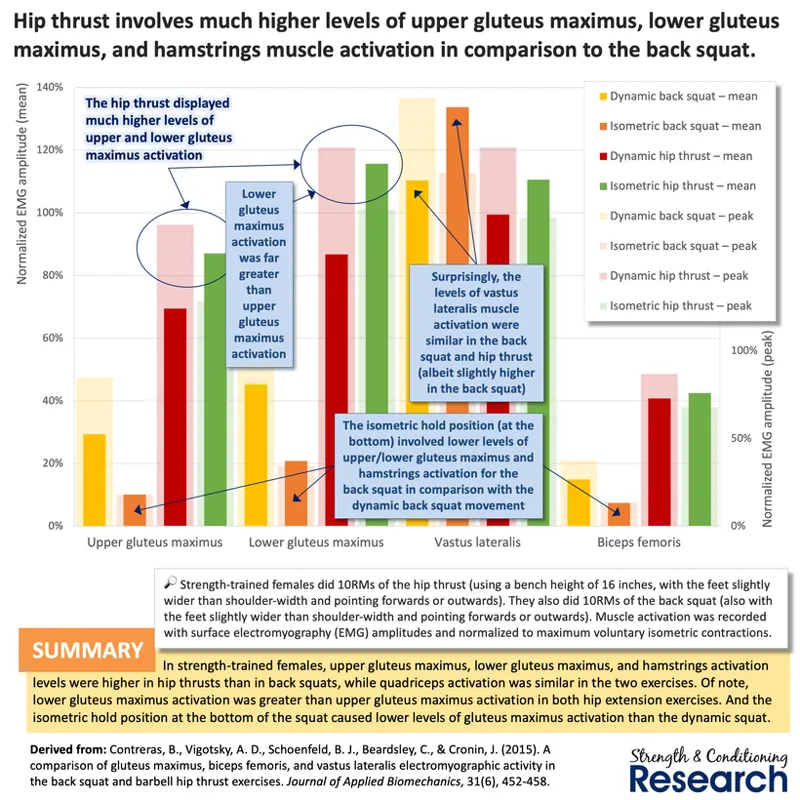
Indeed, as hip extension exercises, both the back squat and the hip thrust exercises involve much more lower gluteus maximus muscle activation than upper gluteus maximus activation.
.
The muscle activation data lines up with the hypertrophy produced in long-term training studies. As we can see, both the hip thrust and squat cause more lower gluteus maximus hypertrophy than upper gluteus maximus hypertrophy, since both are hip extension exercises.
.
Moreover, in line with the internal moment arm data, the upper gluteus maximus increases its activation during hip abduction contractions with increasing hip flexion to a greater extent than the lower gluteus maximus (which nevertheless is always less well-activated at all joint angles).
.
Conclusions
Although it is primarily known for its contribution to hip extension, the gluteus maximus is a relatively effective hip abductor. We can see the impact of hip abduction in two separate situations. Firstly, the muscle becomes more strongly-activated in hip extension exercises when the hip is placed in an abducted position (such as when the feet are moved further apart during glute bridges or hip thrusts). Secondly, the muscle contributes well to hip abduction exercises, albeit to a greater extent when the hip is flexed rather than extended. Indeed, internal moment arm data and muscle activation data both demonstrate that higher hip flexion angles (for example, in a seated position) cause greater gluteus maximus muscle contributions during the hip abduction movement. When considering the role of the gluteus maximus as a hip abductor, it is important to note that the muscle itself can be divided into two major compartments: upper and lower. The upper region is a much better hip abductor than the lower region (while the lower region is a better hip extensor). Indeed, studies have shown that [1] the upper region is more strongly activated during hip abduction exercises, and that [2] the upper region increases its activation to a greater extent with increasing hip flexion angle, during hip abduction exercises. Therefore, the hip abduction movement is a useful addition to any gluteus maximus hypertrophy training program (especially when done in high degrees of hip flexion), since it provides the ability to preferentially target the upper region of the muscle which hip extension exercises do not do.
Comments (3)
Hello Chris - thanks for the great information - 2 questions - surprised to see you comment that the gluteus maximus operates on the descending limb - I thought no data on this issue - also the piriformis - is this a muscle I wish to hypertrophy? - it is located in close proximity to the sciatic nerve - thanks!
Hi Chris. Which muscle would be losing activation in higher degrees of hip flexion in abduction exercises? I think before you said it was glute medius, but you're saying that medius also increases it's moment arm with increasing hip angle..So is it relative? So practically it would be glute medius working in a straight standing lateral band walk relative to glute max? Or TFL?
TFL and anterior/middle glute medius definitely reduce hip abduction leverage with increasing hip flexion (and probably therefore also muscle activation).