




Fatigue resistance changes
Fatigue is a temporary reduction in exercise performance that is caused by individual fatigue mechanisms. When adaptations take place as a result of exercise help us resist these fatigue mechanisms, muscular endurance increases.
.
#1. How do we measure resistance to fatigue? (absolute muscular endurance)
There are many ways of measuring changes in fatigue resistance as a result of a training program. The measurements can be divided into those that control for increases in maximum strength and those that do not. Those that do not control for increases in maximum strength include: [1] changes in absolute muscular endurance (defined as an increase in the number of reps with a given weight in kilograms or with a baseline percentage of 1RM), [2] changes in repetition strength such as 15RM or 20RM testing, [3] changes in average force across all of the reps in a fixed number of isokinetic repetitions, and [4] increases in volume load during a workout.
.
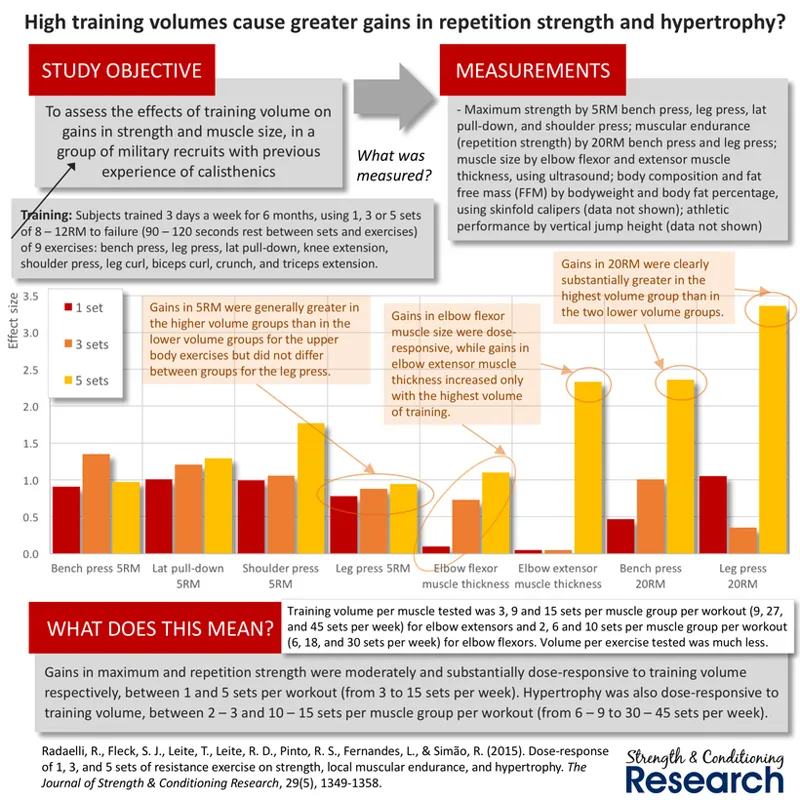
For example, volume studies often test increases in repetition strength (e.g. 15RM or 20RM). Of course, the measurements increase at least partly due to increases in maximum strength.
.
Similarly, many studies test increases in absolute muscular endurance. Again, these values increase after training at least partly due to increases in maximum strength.
.
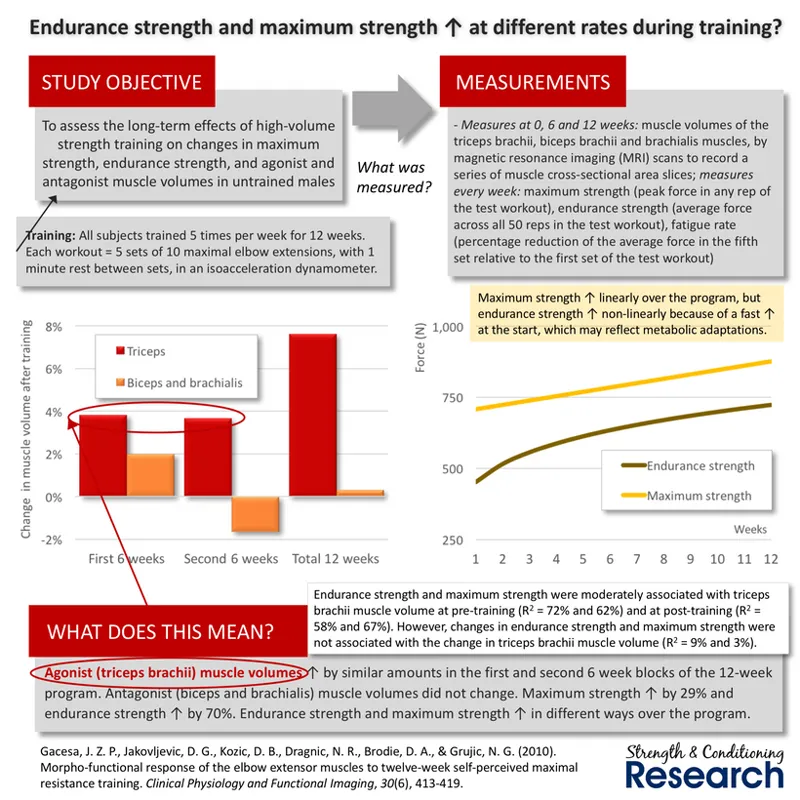
More rarely, researchers measure changes in the average force produced across a series of isokinetic repetitions. This again is a composite measure of changes in maximum strength and changes in fatigue resistance.
.
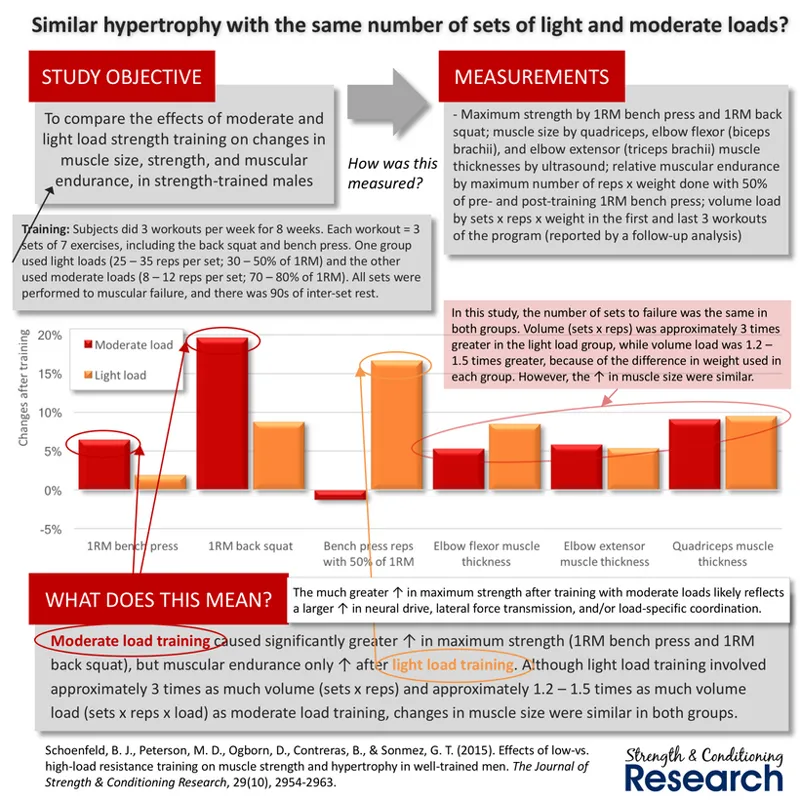
Changes in the workout volume load are far more commonly measured. Interestingly, training with light loads tends to cause larger increases in volume load than training with moderate loads. Given that gains in maximum strength are either similar or smaller when training with light loads, this implies that the larger increases in muscular endurance must occur due to increases in fatigue resistance.
.
#2. How do we measure resistance to fatigue? (relative muscular endurance)
There are many ways of measuring changes in fatigue resistance as a result of a training program. The measurements can be divided into those that control for increases in maximum strength and those that do not. Those that do control for increases in maximum strength include: [1] changes in relative muscular endurance (defined as an increase in the number of reps with a percentage of 1RM) and [2] changes in the extent to which force reduces from one rep to the next over a fixed number of isokinetic repetitions.
.
Interestingly, relative muscular endurance tends NOT to increase after heavy or moderate load strength training. It only increases meaningfully after light load strength training. In doing so, it demonstrates that increases in fatigue resistance are necessarily occurring.
.
Changes in fatigue resistance can also be measured in isolation from changes in maximum strength by assessing percentage losses in strength from set to set over the workout. Here, the researchers reported that the changes in fatigue resistance were limited to the first four weeks of a training program with moderate loads.
.
#3. How does rep range affect changes in relative muscular endurance?
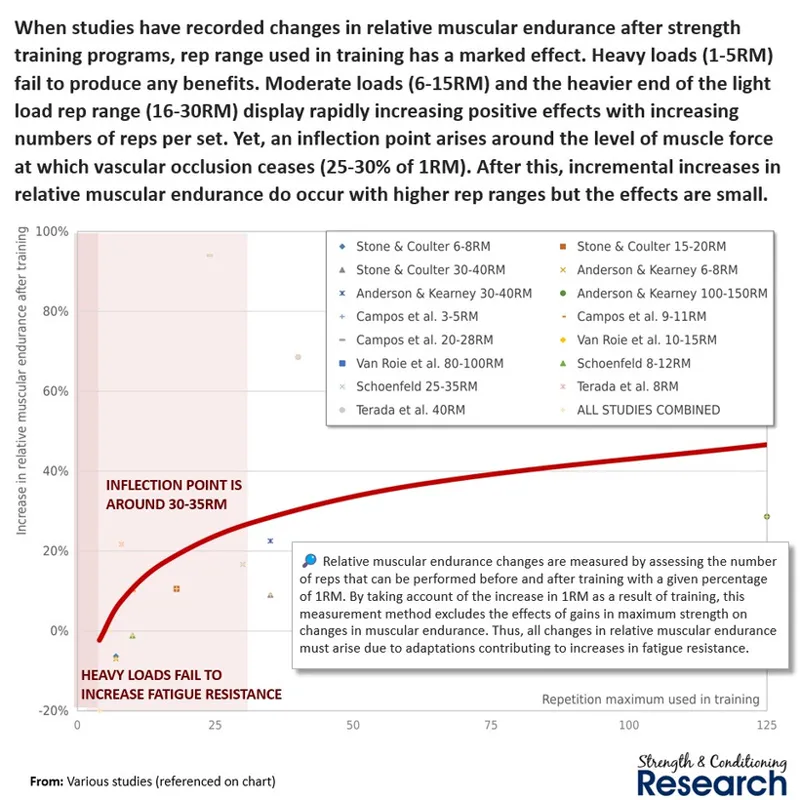
Relative muscular endurance is a much more interesting outcome to study than absolute muscular endurance because it excludes the effects of a separate quality (maximum strength) that we already understand relatively well. When we look at the available studies, we see that changes in relative muscular endurance are profoundly affected by the rep range used during training. Heavy loads produce no beneficial effects and indeed occasionally can cause negative effects. As the load is reduced, the positive effects on fatigue resistance are apparent and display a logarithmic trend. This indicates that there is zero stimulus for fatigue resistance adaptations with heavy loads, a rapidly increasing stimulus through the moderate and light load zone, and a slowly increasing stimulus thereafter. Very interesting results.
.
Conclusions
Strength training programs often cause larger increases in repetition strength than gains in maximum strength. When changes in repetition strength are measured in absolute terms by reference to measures like absolute muscular endurance (maximum number of reps with a certain weight) or volume load (sets x reps x weight), the changes are affected by both adaptations underpinning maximum strength and adaptations underpinning fatigue resistance. When changes in repetition strength are measured in relative terms by reference to measures like relative muscular endurance (maximum number of reps with a certain percentage of 1RM), they are only affected by changes in fatigue resistance. Thus, relative muscular endurance is a much more interesting outcome to study because it excludes the effects of a separate quality (maximum strength) that we already understand relatively well. When we look at the available studies, we see that changes in relative muscular endurance are profoundly affected by the rep range used during training. Heavy loads produce no beneficial effects and can cause negative effects. As the load is reduced, the positive effects on fatigue resistance are apparent and display a logarithmic trend. There is zero stimulus for fatigue resistance adaptations with heavy loads, a rapidly increasing stimulus through the moderate and light load zone, and a slowly increasing stimulus thereafter.
Comments (2)
Very interesting. What mechanisms do you think are responsible for the increase in fatigue resistance? If metabolite accumulation only occurs with loads above 25–30% of maximal isometric strength, can we exclude buffering capacity?
That's the interesting part. Most of the data suggest that increased buffering capacity is one of the only adaptations that can be tied to the increases in fatigue resistance. But not every load that increases fatigue resistance involves high levels of metabolites.