




Reducing muscle strain injury risk
What adaptations are useful for reducing the risk of muscle strain injury? To identify them, we must first create a model of how muscle strain injury happens.
.
#1. How do muscle strain injuries to happen?
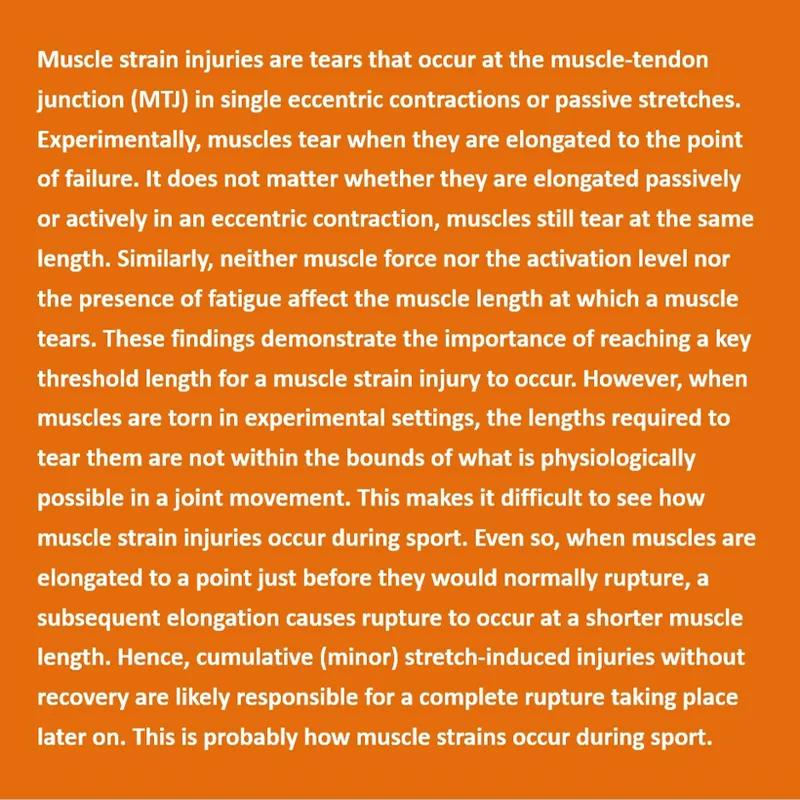
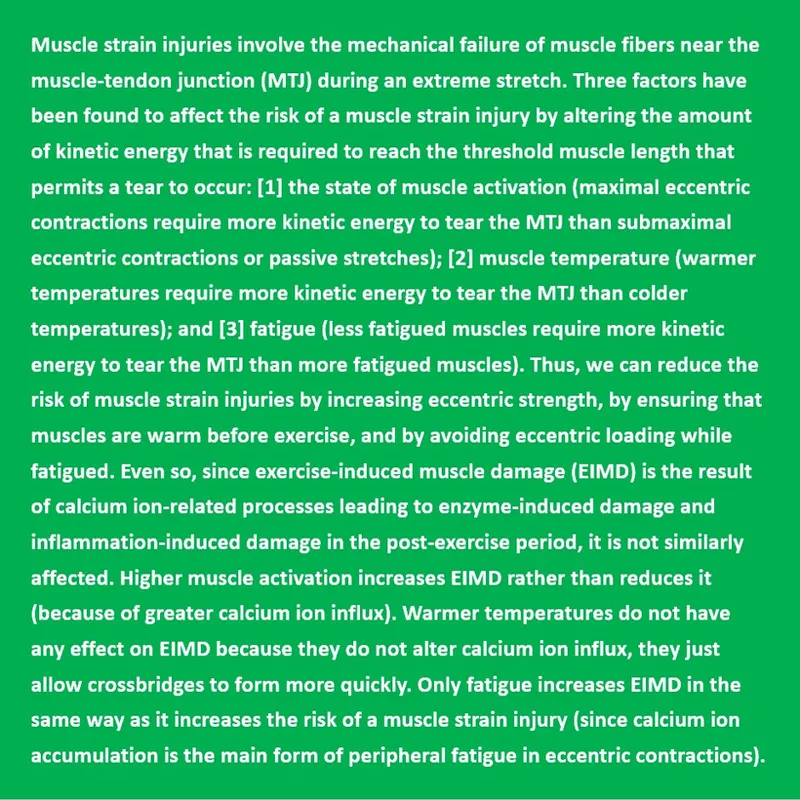
Muscle strain injuries appear to happen by way of mechanical failure of muscle fibers at the proximal or distal muscle-tendon junctions of a muscle. This mechanical failure involves the stripping away of the dystrophin of the costameres, reducing the capacity of the muscle fibers to transmit force laterally and leaving them vulnerable to being over-lengthened and subsequently torn (read more).
.
#2. Why do muscle strain injuries happen?
Muscle strain injuries seem to happen after muscle fibers close to the muscle-tendon junction experience a series of minor strains that strip away the dystrophin from their costameres, leaving them more vulnerable at shorter and shorter muscle lengths. Eventually, they are torn within the physiological range of motion of sporting movements (read more).
.
#3. What increases muscle strain injury risk?
Muscles experience strain injuries when [1] they are elongated to long muscle lengths, and [2] have recently experienced minor strains that have stripped away their costameres. Evidently, this means that anything that increases the lengths that muscles reach in eccentric contractions will increase the risk of a strain injury (read more).
.
#4. What adaptations would logically reduce muscle strain injury risk? (part one)
Since it is maximum length of the muscle that determines whether muscle fibers are torn, any adaptation that reduces the extent to which muscle fibers lengthen will reduce the risk of muscle strain injury. Muscle fibers experience less lengthening in relative terms when they have more sarcomeres in series and less lengthening in absolute terms when tendons are more compliant. Of course, any high effort eccentric training technique will cause the addition of sarcomeres in series. Also, plyometric training causes tendons to behave in a more compliant way by increasing eccentric strength without increasing tendon stiffness (read more).
.
#5. What adaptations would logically reduce muscle strain injury risk? (part two)
Since it is maximum length of the muscle that determines whether muscle fibers are torn, any adaptation that reduces the extent to which muscle fibers lengthen will reduce the risk of muscle strain injury. Muscle fibers experience less lengthening for a given level of external force when the muscle as a whole is capable of producing a higher eccentric force. To reduce muscle lengthening in eccentric contractions, we would first and foremost therefore want to ensure high levels of eccentric muscle activation in sporting movements. Since eccentric muscle activation is reduced by low levels of coordination, this indicates that improving coordination in the key sporting activities where muscle strain injury risk is high (like sprint running) is key (read more).
.
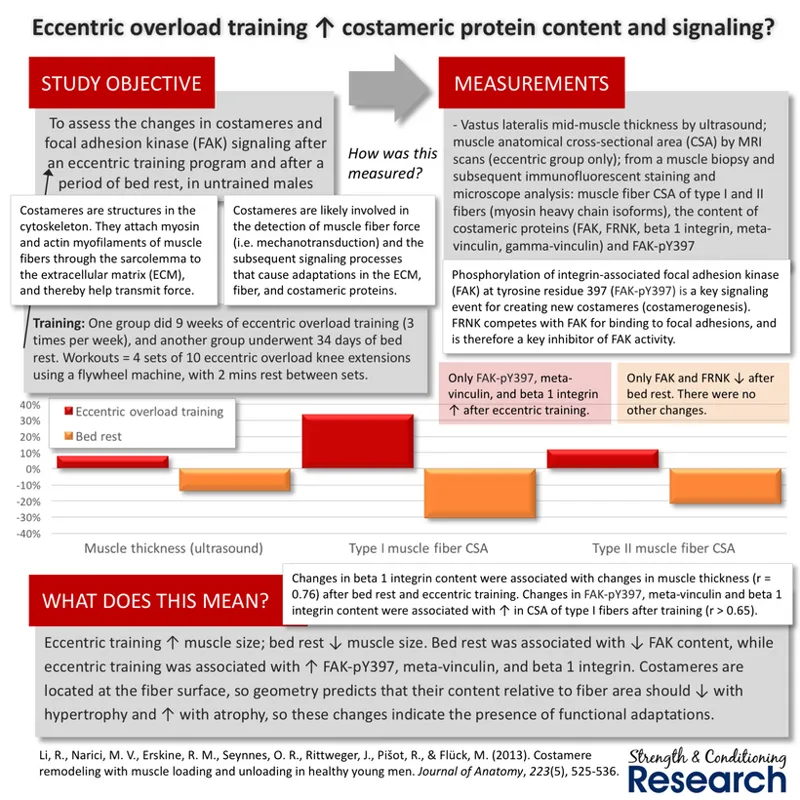
Naturally, we would also want to increase muscle fiber mechanical tension during the eccentric contractions in order to reduce muscle lengthening. This is achieved by hypertrophy, sarcomerogenesis, and increases in the amount of titin and in the number of costameres. Interestingly, in addition to producing hypertrophy and of course sarcomerogenesis, eccentric-only training has been shown to increase the amount of titin inside muscle fibers.
.
Eccentric-only training is also well-known to increase the number of costameres inside muscle fibers, although exactly why this happens (and whether the effect is much greater than other types of training) is unclear.
.
Conclusions
Muscle strain injuries involve mechanical failure of muscle fibers at proximal or distal muscle-tendon junctions. The key risk factor for experiencing a muscle strain injury during a bout of exercise is likely how much accumulated minor strain damage exists beforehand. However, for any given amount of accumulated minor strain damage, it is the maximum muscle length reached in exercise that determines whether a muscle strain injury is experienced. Thus, any strength training adaptation that causes the muscle fibers to lengthen less in large-amplitude athletic movements involving eccentric contractions will reduce the risk of muscle strain injury. Muscle fibers will experience less lengthening in relative terms when they have more sarcomeres in series and less lengthening in absolute terms when tendons are more compliant. While any type of high-effort, eccentric training will stimulate sarcomerogenesis, plyometric training also causes tendons to behave in a more compliant way by increasing eccentric strength without also increasing tendon stiffness. Muscles also lengthen less during athletic movements if they can produce more force. Eccentric muscle force is determined by [1] eccentric muscle activation, and [2] eccentric muscle fiber force. Eccentric muscle activation in any sporting movement is largely dependent upon coordination, which implies that skill training in high-risk sporting movements is key. Eccentric muscle fiber force can be increased by hypertrophy, sarcomerogenesis, and the addition of titin and costameres, all of which increase after high-effort, eccentric training.


Comments (1)
So these minor strains (dystrophin damage) is caused by large sarcomere elongations independent of force? So are larger loads more or less damaging to the myotendinous junction? If only the length matters it should be better because less time is spent in that length. But does the repetitive nature also matter for this? Because i never saw somebody straining a muscle just passivly moving their joint in their daily life.. Even if held for a long time.