




Muscle strain injuries
Much has been written about muscle strain injuries but rarely do commentators address the underlying physiological mechanisms. Fortunately, several older studies provide insights into how muscle strain injuries happen.
.
#1. Muscles tear when their muscle fibers are stretched beyond a certain length
Studies have tested how far a muscle needs to be stretched before it tears. Using isolated muscle preparations, studies have found that muscles tear at approximately the same threshold length regardless of whether they are stretched while passive or while activated, even though the muscle force required to produce the same elongation varies considerably.
Additionally, when comparing muscles, more pennate muscles tend to require greater whole muscle lengthening for a tear to happen in comparison with less pennate muscles. Since a larger pennation angle means less muscle fiber lengthening for the same amount of whole muscle lengthening, this indicates that it is not the degree of whole muscle lengthening that determines when a muscle tears. Rather, it is probably the degree of muscle fiber lengthening that determines when a muscle tears.
#2. How is muscle damage different from a muscle strain injury?
Muscle strain injuries differ from exercise-induced muscle damage because of where in the muscle they are located. Muscle tears almost always occur at the distal or proximal MTJ. In contrast, muscle damage after eccentric exercise is more frequently found in the middle of the muscle instead.
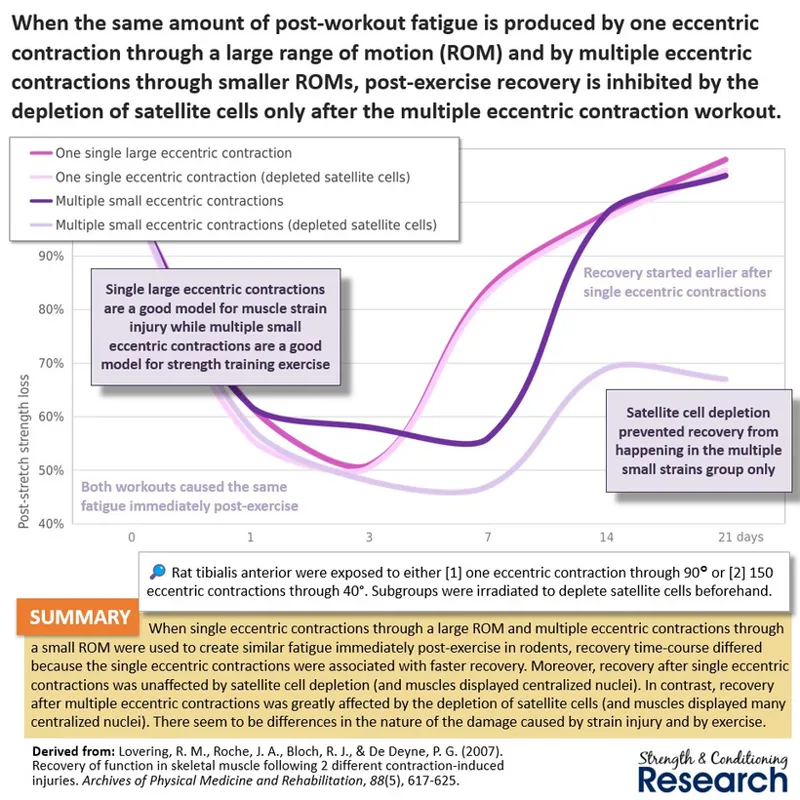
Generally speaking, the impact of a single eccentric contraction can be taken as a model for a muscle strain injury, while the impact of repeated eccentric contractions can be taken as a model for strength training exercise. Studies have shown that a single eccentric contraction to an extremely long length leads to a qualitatively different type of muscle damage and repair process compared to multiple eccentric contractions reaching shorter muscle lengths. Muscle damage caused by multiple eccentric contractions requires myonuclei from satellite cells. In contrast, resolving the damage caused by a single eccentric contraction does not require any satellite cells whatsoever.
Other research has cast light on why this might be the case. Indeed, when multiple eccentric contractions are performed with short rest periods between them, this produces strong signs of muscle fiber damage and inflammatory repair processes. When the same number of eccentric contractions are performed with long rest periods (to allow accumulating calcium ions to disperse), this does not cause the same signs of muscle fiber damage.
Investigations testing single eccentric contractions have suggested that loss of dystrophin within the cell membrane might be the reason why muscle fibers loss their force-producing capacities during a muscle strain injury. Dystrophin is a key element within the costameres that permit force transmission between the sarcolemma and the endomysium. Potentially, the sudden and unexpected stretch of the muscle fiber through a very large excursion could result in the shearing of these costameres and the mechanical failure of the muscle fiber.
Conclusions
Muscle strain injuries are sometimes treated as more extreme versions of exercise-induced muscle damage (EIMD). Indeed, the severity of both muscle strain injuries and of EIMD is greatly influenced by the maximum muscle length that is reached in a movement or workout. However, there are key differences between the two phenomena. Firstly, muscle strain injuries are tears that occur during single eccentric contractions or passive stretches, while EIMD occurs in response to multiple eccentric contractions. Secondly, muscle strain injuries almost always occur at a muscle-tendon junction (MTJ), while EIMD occurs in the middle of the muscle. Thirdly, while both muscle strain injuries and EIMD produce an immediate loss of strength, muscle strain injuries do not generate the common indications of muscle fiber damage that occur after eccentric exercise (such as the loss of desmin, the presence of inflammatory markers such as neutrophils and macrophages, centralized nuclei, and necrosis). Instead, they display a preferential loss of dystrophin (which is central to lateral force transmission) from muscle cell membranes. Also, while muscle strain injuries can recover post-stretch reductions in strength without the presence of satellite cells, EIMD cannot. Overall, it seems likely that a muscle strain injury involves mechanical failure of muscle fibers during an extreme stretch (possibly by means of a loss of lateral force transmission capacity), while EIMD involves calcium ion-related processes that cause biochemical damage and inflammation in the post-exercise period.