





Muscle strain injury factors
In the two previous articles in this series, we have looked at muscle strain injuries and how they are different from exercise-induced muscle damage (EIMD). In this article, we are going to consider what factors might be able to reduce the risk of a muscle strain injury (and whether these factors might similarly reduce the amount of post-workout fatigue and EIMD).
.
#1. What causes a muscle strain injury?
Muscle strain injuries seem to occur at the point when single muscle fibers lose their ability to transmit force laterally while they are experiencing a passive stretch or eccentric contraction involving a large range of motion. This loss of lateral force transmission capacity occurs because of the loss of dystrophin, which connects the sarcolemma with the endomysium. While we do not know why dystrophin is lost, the absence of calcium ion accumulation implicates a mechanical shearing force. Losing the ability to transmit force laterally greatly reduces the ability of the muscle fiber to contribute to whole muscle force and this allows the muscle to be torn apart (read more).
.
#2. When do muscle strain injuries happen?
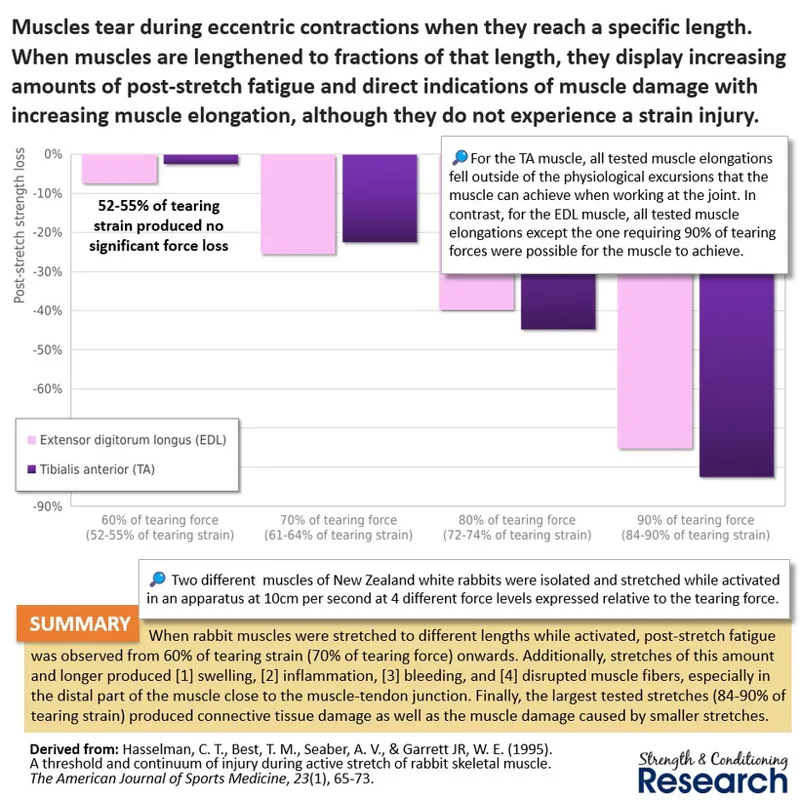
Muscle strain injuries happen when the muscle fibers within a muscle are elongated past a key threshold length. This tells us that anything that can help us stop a muscle being elongated unnecessarily might be useful for reducing the risk of a strain injury.
.
#3. Absence of muscle activation reduces the kinetic energy needed to produce a muscle tear
Given that muscle strain injuries occur when the muscle fibers are stretched to a certain threshold length, we can deduce that they will be less likely to occur when the muscle resists being lengthened. Indeed, when a muscle produces a greater force because it is more highly activated, much more external kinetic energy will be required to take the muscle to the tearing length.
.
In contrast, since muscle damage is caused by calcium ion accumulation, and since calcium ions enter muscle fibers through [1] stretch-activated ion channels in response to the stretching of the muscle fiber, and [2] the sarcoplasmic reticulum in response to the activation of the muscle fiber, eccentric contractions involving higher levels of muscle activation cause much more muscle damage than those that involve lower levels of muscle activation.
.
#4. Colder temperature reduces the kinetic energy needed to produce a muscle tear
The maximum amount of kinetic energy required to reach the threshold muscle length for a tear is reduced when muscles are elongated passively (without any muscle activation) at colder temperatures.
.
Logically, this effect should be even larger when testing the effect of single eccentric contractions that produce strain injuries, because active muscle force is also increased when muscle temperatures are higher (read more).
.
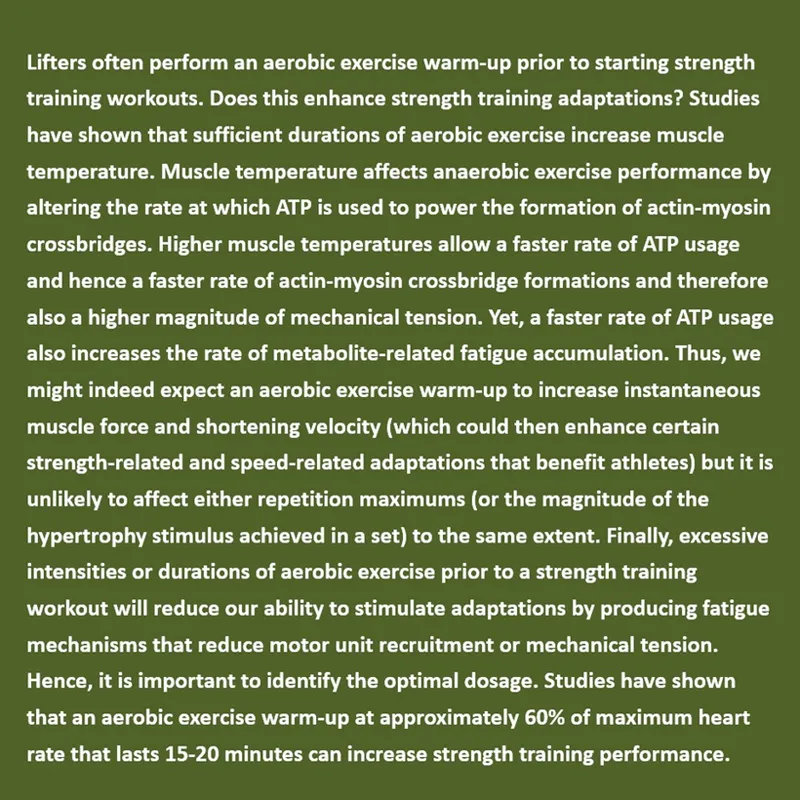
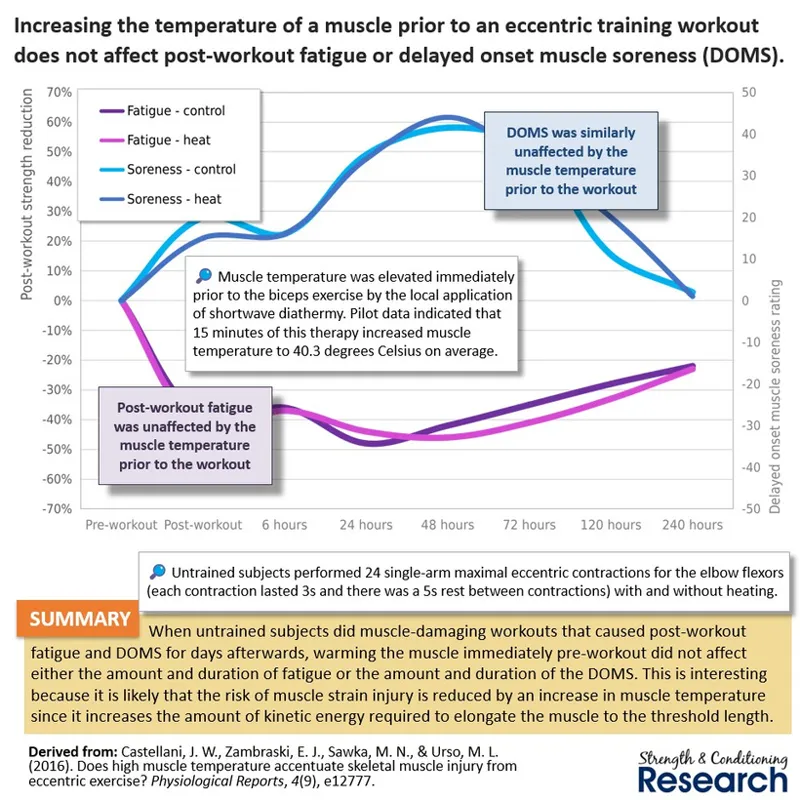
Nevertheless, research has shown that post-workout muscle damage after a bout of eccentric contractions is NOT affected by the muscle temperature in the workout itself (which can be altered by pre-workout warming methods). This discrepancy can be explained once again by recognising the key difference between muscle strain injury and muscle damage produced by exercise.
.
#5. Fatigue reduces the kinetic energy needed to produce a muscle tear
In the same way as reduced muscle activation and a colder muscle temperature, the maximum amount of kinetic energy required to reach the threshold muscle length for a tear is reduced by the presence of fatigue.
.
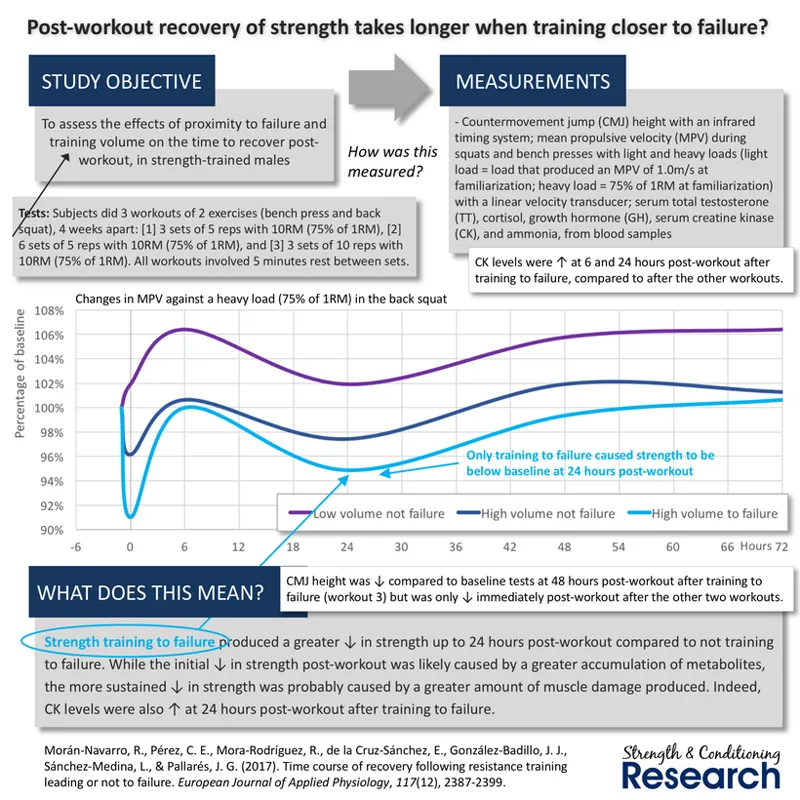
Similarly, when two different strength training workouts are performed that involve the same total workload but one involves experiencing more fatigue due to training closer to failure, the more fatiguing workout produces more post-workout fatigue.
.
Conclusions
Muscle strain injuries involve the mechanical failure of muscle fibers near the muscle-tendon junction (MTJ) during an extreme stretch. Three factors have been found to affect the risk of a muscle strain injury by altering the amount of kinetic energy that is required to reach the threshold muscle length that permits a tear to occur: [1] the state of muscle activation (maximal eccentric contractions require more kinetic energy to tear the MTJ than submaximal eccentric contractions or passive stretches); [2] muscle temperature (warmer temperatures require more kinetic energy to tear the MTJ than colder temperatures); and [3] fatigue (less fatigued muscles require more kinetic energy to tear the MTJ than more fatigued muscles). Thus, we can reduce the risk of muscle strain injuries by increasing eccentric strength, by ensuring that muscles are warm before exercise, and by avoiding eccentric loading while fatigued. Even so, since exercise-induced muscle damage (EIMD) is the result of calcium ion-related processes leading to enzyme-induced damage and inflammation-induced damage in the post-exercise period, it is not similarly affected. Higher muscle activation increases EIMD rather than reduces it (because of greater calcium ion influx). Warmer temperatures do not have any effect on EIMD because they do not alter calcium ion influx, they just allow crossbridges to form more quickly. Only fatigue increases EIMD in the same way as it increases the risk of a muscle strain injury (since calcium ion accumulation is the main form of peripheral fatigue in eccentric contractions).

