






Fatigue resistance adaptations
Fatigue is a temporary reduction in exercise performance that is caused by individual fatigue mechanisms. When adaptations take place as a result of exercise help us resist these fatigue mechanisms, muscular endurance increases. So which fatigue mechanisms are affected?
.
#1. How do we measure fatigue resistance?
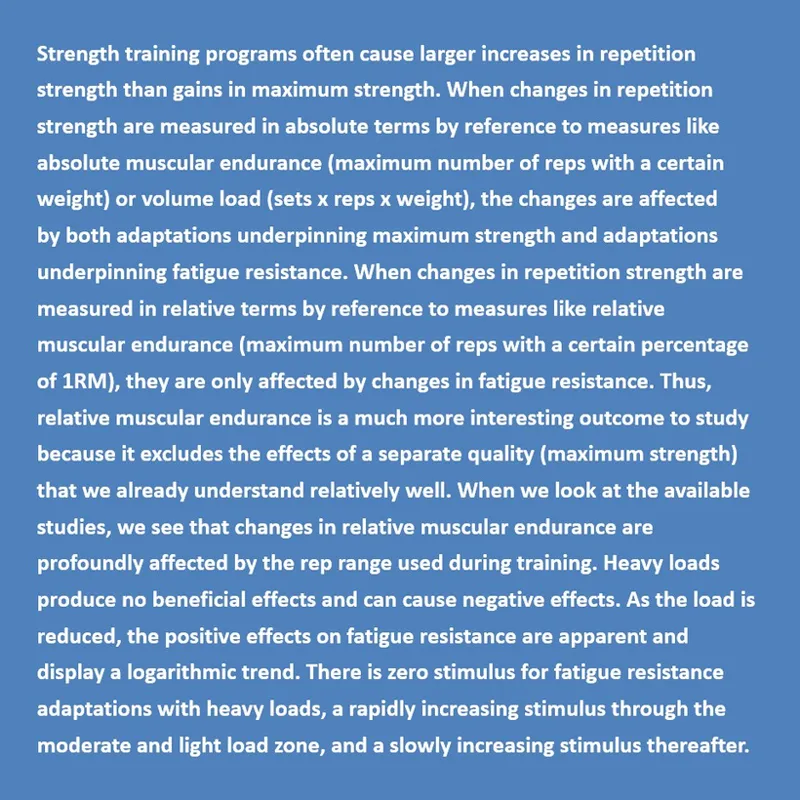
Fatigue resistance is conventionally measured by relative muscular endurance. This accounts for any changes in maximum strength, allowing us to examine only the effects of adaptations affecting fatigue (read more).
.
Changes in fatigue resistance that exclude the effects of changes in maximum strength can also be seen by assessing percentage losses in strength from set to set over the workout. This data is particularly interesting because it shows that changes in fatigue resistance that exclude maximum strength are relatively short-lived and only improve for about 4 weeks.
.
#2. To which fatigue mechanisms can we develop resistance?
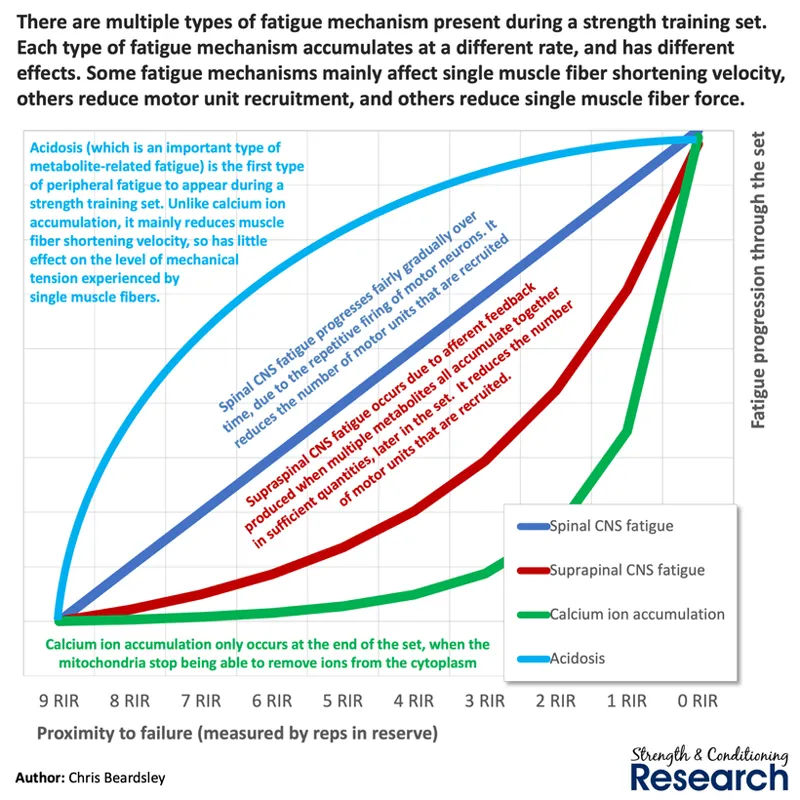
Changes in fatigue resistance must arise due to adaptations that affect fatigue mechanisms. There are multiple fatigue mechanisms during exercise, including [1] supraspinal CNS fatigue, [2] spinal CNS fatigue, [3] calcium ion-related fatigue, and [4] metabolite-related fatigue.
.
#3. Can we increase resistance to CNS fatigue mechanisms?
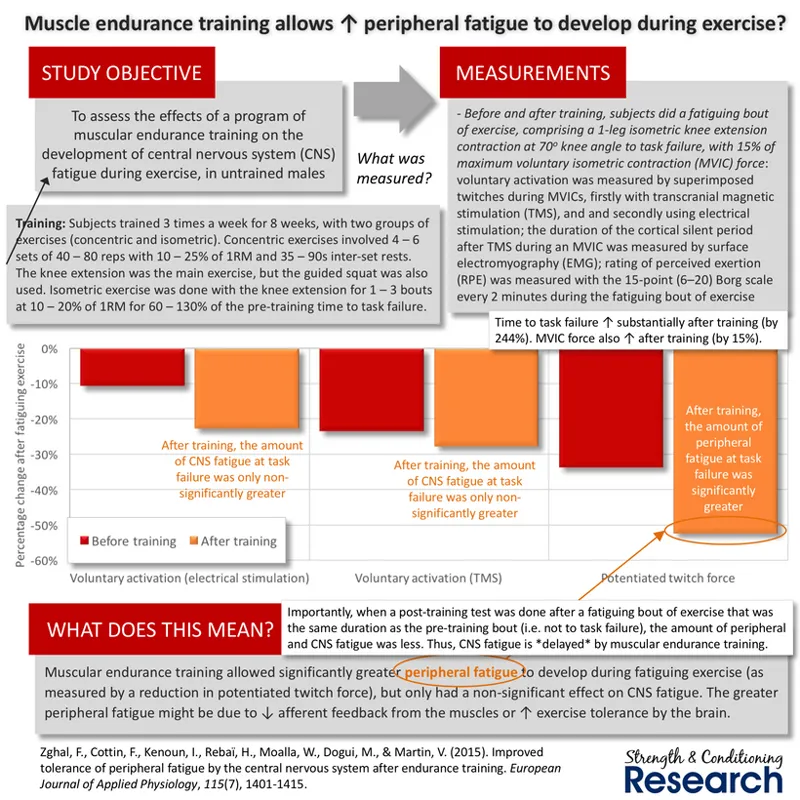
When muscular endurance training with very light loads is performed, this causes an increase in the total magnitude of peripheral fatigue experienced at muscular failure in a repetition strength test. The capacity to tolerate peripheral fatigue is indicative of the degree to which the brain is capable of withstanding discomforting sensations (which produce supraspinal CNS fatigue). Thus, when peripheral fatigue at muscular failure is increased, this suggests that supraspinal CNS fatigue resistance has been developed. Whether spinal CNS fatigue can be altered over time is unknown.
.
#4. Can we increase resistance to calcium ion-related fatigue mechanisms?
Improved resistance to calcium ion-related fatigue is the repeated bout effect (RBE). The RBE describes how post-workout fatigue is reduced by sequential workouts, especially those that involve a large amount of calcium ion accumulation, such as eccentric-only contractions. Since all post-workout fatigue is produced by calcium ion-related fatigue mechanisms, any change in calcium ion-related fatigue causes a change in post-workout fatigue (read more).
.
Nevertheless, the effect of the RBE is extremely rapid and the vast majority of its impact occurs from workout one to workout two. Further changes are described by the multiple RBE and these changes are extremely small by comparison (read more).
.
#5. Can we increase resistance to metabolite-related fatigue mechanisms?
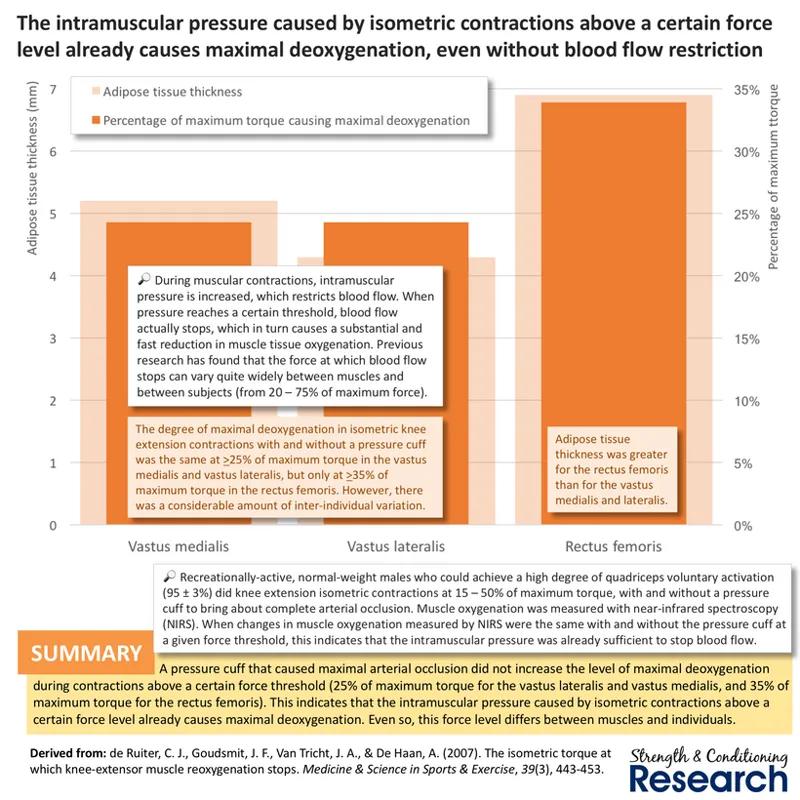
Metabolites accumulate inside comparatively glycolytic muscle fibers when they use energy in the form of ATP rapidly during high-intensity exercise. While the metabolites can leave the muscle fiber, they are prevented from doing so when vascular occlusion is present, which is the case whenever whole muscle force exceeds 25-30% of maximum levels.
.
Yet, whenever the muscle relaxes, the metabolites can be carried away by the bloodstream. For this reason, it has been proposed that increasing the level of muscle capillarization could contribute to increases in fatigue resistance. However, reviewing the capillarization literature shows that is almost certainly does not (read more).
.
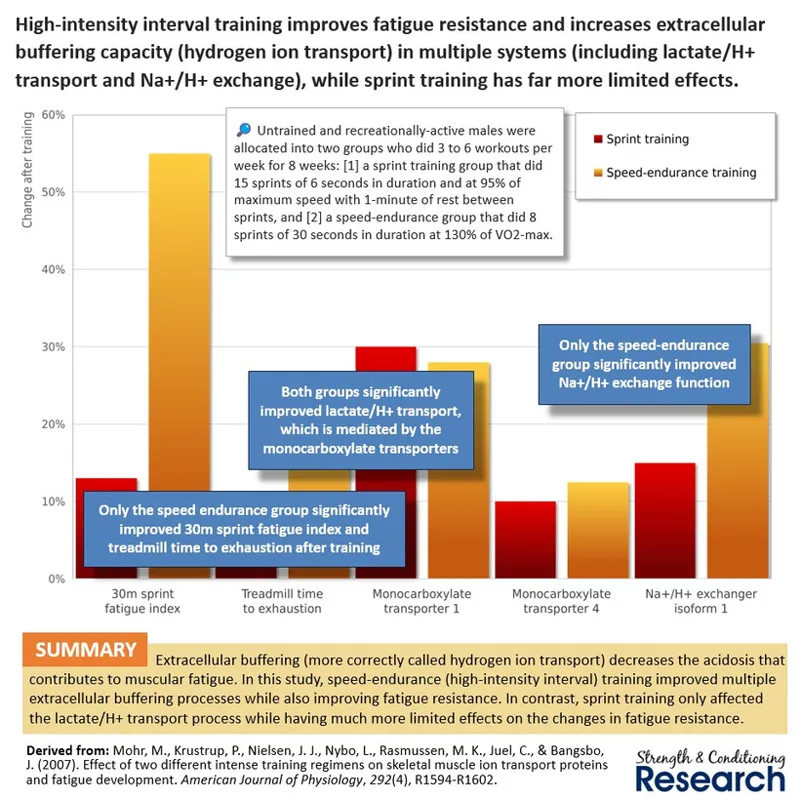
More likely to contribute to increases in muscular endurance are increases in either intracellular or extracellular buffering capacity (more correctly called hydrogen ion transport). Buffering capacity and hydrogen ion transport both involve the removal of hydrogen ions from inside the muscle fiber (acidosis). Acidosis is a metabolite-related fatigue mechanism. Reducing the build-up of hydrogen ions will reduce fatigue and increase relative muscular endurance. Studies have shown that training above the lactate threshold such that muscle fibers create acidosis will stimulate an adaptation in intracellular buffering capacity.
.
Studies have also shown that training above the lactate threshold such that muscle fibers create sustained periods of acidosis stimulates multiple adaptation in extracellular buffering capacity (hydrogen ion transport). There are various processes that remove hydrogen ions from inside the muscle fiber, including lactate/H+ transport and sodium+/H+ ion exchange. This study showed that both of these processes are enhanced after speed-endurance training and that this was linked to improvements in fatigue resistance.
.
Conclusions
Fatigue resistance can be improved during strength training programs independently of changes in maximum strength, as shown by increases in relative muscular endurance. For fatigue resistance to change, we must produce adaptations that alter fatigue mechanisms. There are four main categories of fatigue mechanisms during exercise: [1] supraspinal CNS fatigue, [2] spinal CNS fatigue, [3] calcium ion-related fatigue, and [4] metabolite-related fatigue. Whether spinal CNS fatigue can be altered is unclear. However, it seems likely that we can reduce the degree of supraspinal CNS fatigue during exercise by developing an increased tolerance to the discomforting sensations that produce this effect. When calcium ion-related fatigue mechanisms are reduced, a repeated bout effect (RBE) is generated. Thus, we know that such adaptations are very limited in nature and only occur after the first couple of workouts of a training program. Therefore, it seems likely that adaptations affecting metabolite-related fatigue mechanisms are the major contributor to increases in relative muscular endurance. Increases in capillarization probably do not contribute since they are unaffected by rep range while increases in relative muscular endurance are greatly affected by rep range. Increases in intracellular and extracellular buffering capacity in contrast likely do contribute because they appear to be linked to either the workload or the magnitude of the acidosis experienced during training, both of which are higher in higher rep ranges.


Comments (4)
Fatigue literature is really and interesting and a prolific scientific field. We can reduce fatigue accumulation to get more net stimulus for Hypertrophy. Could we further manage fatigue with resistance fatigue protocols, getting more resilient to central and peripheral fatigue mechanisms? The other side of the coin: Potentiation. PAP and PAPE effects. Will we have new scientific insights about Potentiation Mechanisms in the near future? How to implement them efficiently in Hypertrophy training?
Thank you for your clear answer! Heavy load training do increase MUR. But what is your opinion with regard to fast-speed training (ie conventional submaximal-load lifts with explosive reps) to get this neural adaptation? Does it make sense as a potential neural training method to increase strength and possible further size gains?
Thanks Chris for this interesting post. Neural priming with high loads or high-speed training might increase MUR as an adaptation to indirectly achieve more size gains. But, in contrast, is it worth training with high rep sets in order to get relative muscular endurance if your main objective is Hypertrophy?
Heavy load training blocks do increase MUR, which has benefits in subsequent training blocks with moderate or light loads because the MUR adaptation does not dissipate. The problem with peripheral adaptations is that they dissipate once we stop training with the stimulus that caused them to appear. So IMO, it doesn't make sense to seek increases in fatigue resistance unless we are planning to continue maintaining the adaptation long-term.