



Caloric restriction and atrophy
Caloric restriction is used to produce weight loss and the desired outcome is typically to reduce fat mass while retaining as much lean body mass as possible, usually by including a suitable strength training program into the weight loss plan.
.
#1. Does caloric restriction cause muscle atrophy?
One of the challenges that arises when assessing the effects of caloric restriction on the rate of muscle atrophy is that the resulting weight loss affects the levels of effort required during normal physical activity. An animal or a human who previously required a high effort to carry their own bodyweight up the stairs now requires much less effort. Since effort determines the level of motor unit recruitment in unfatigued situations, this has a confounding effect. Thus, paradoxically, it is more useful to look at the effects of caloric restriction during cases of immobilization, where physical activity is essentially zero. While atrophy of course arises due to the immobilization, it occurs more quickly when calories are also restricted.
.
#2. Does caloric restriction cause type I and type II muscle fiber atrophy?
One of the interesting features of sleep deprivation and traumatic injury is that they cause elevated levels of cortisol, which can reach extreme levels (hypercortisolemia). This then leads to preferential type II muscle fiber atrophy, while leaving the type I muscle fibers largely the same size. In contrast, caloric restriction causes reductions in the muscle fiber sizes of both the slow twitch (type I) and fast twitch (type II) muscle fibers.
.
#3. How does caloric restriction cause muscle fiber atrophy?
Muscle fiber size is maintained by a net protein balance caused by the rates of muscle protein synthesis and muscle protein breakdown. While insufficient sleep and trauma leading to hypercortisolemia seem to involve both reductions in muscle protein synthesis and also increases in muscle protein breakdown, research into immobilization has found that the rate of muscle protein synthesis is greatly reduced by inactivity, while the rate of muscle protein breakdown is not substantially altered.
.
Similarly, caloric restriction also appears to have a bigger effect on muscle protein synthesis than on muscle protein breakdown, albeit this may change with the magnitude of the caloric deficit and its duration. Indeed, some data have reported that the initial changes in muscle mass during an extreme caloric deficit are caused by reductions in muscle protein synthesis rates, while later reductions involve a contribution from increased muscle protein breakdown (probably because the caloric deficit turns into a stressor at this point). And, most likely, this pattern would change with a smaller caloric deficit, probably with the onset of muscle protein breakdown being delayed even further.
.
#4. How does caloric restriction affect muscle fiber glycogen?
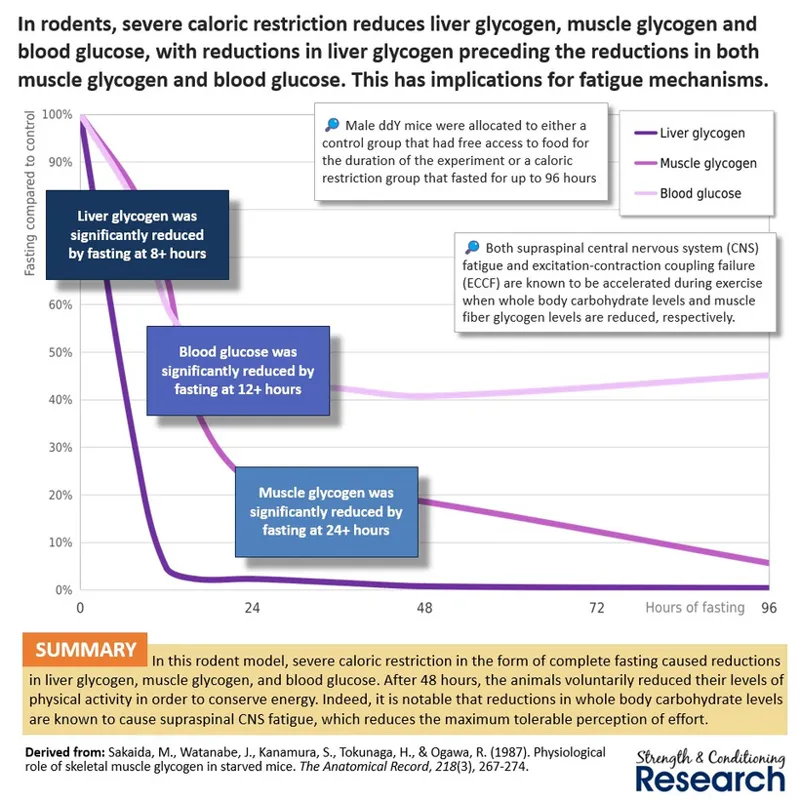
Caloric restriction does appear to reduce whole body levels of carbohydrate including the levels of muscle fiber glycogen (to what extent this can be avoided with nutritional strategies is not entirely clear).
.
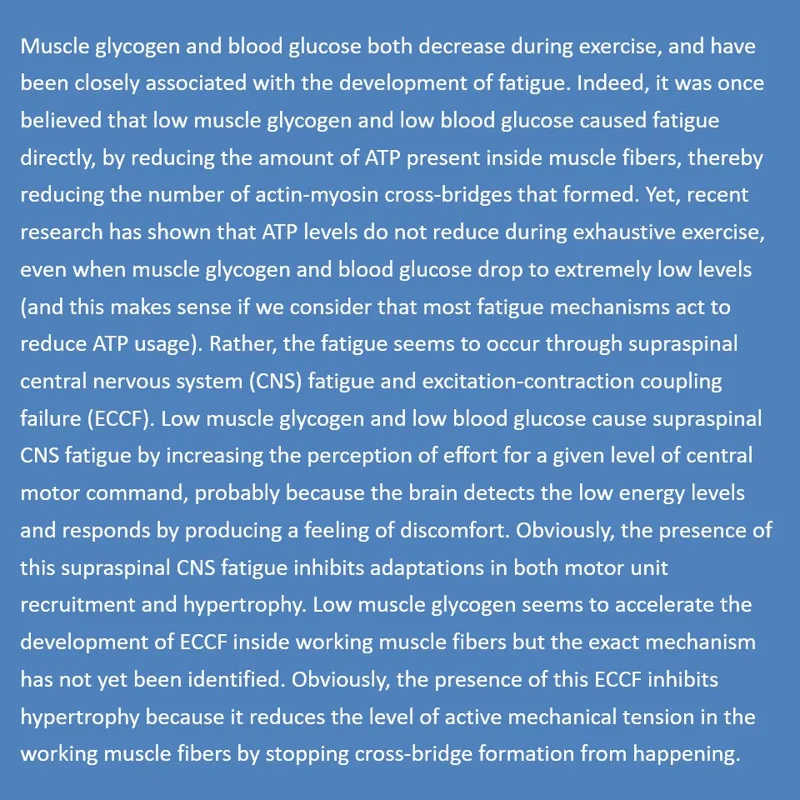
Reductions in muscle fiber glycogen would be expected to cause an accelerated occurrence of excitation-contraction coupling failure and suprapsinal central nervous system fatigue during exercise, which would in turn reduce the hypertrophy stimulus achieved (read more).
.
#5. How does strength training affect the negative impact of caloric restriction on muscle fiber size?
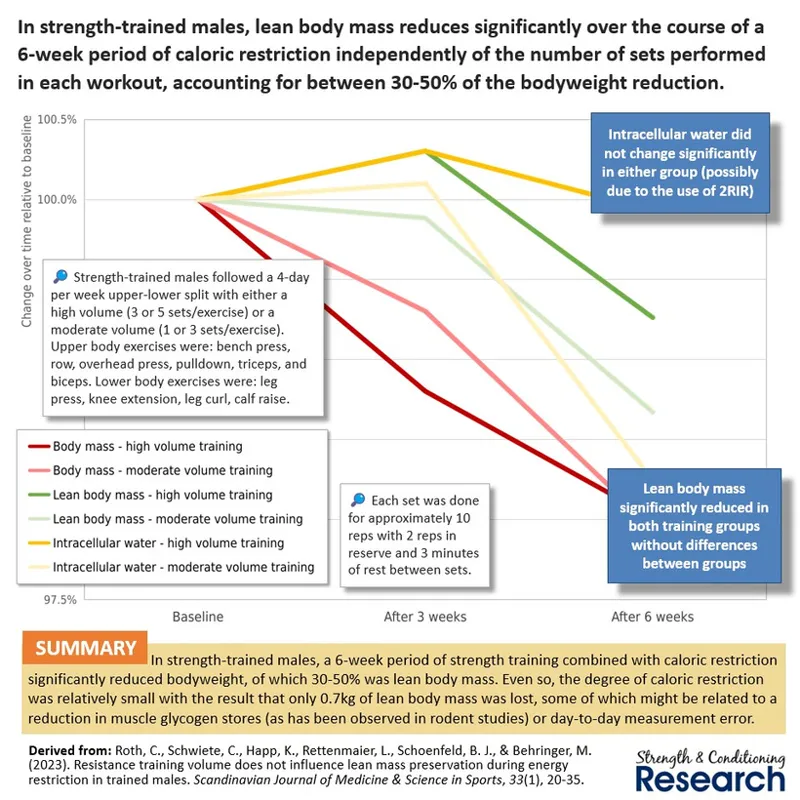
Strength training is often programmed in order to help to reduce losses in muscle fiber size during periods of caloric restriction. Even so, many studies have found that muscle mass still reduces during a caloric deficit even when strength training is performed.
.
Conclusions
Caloric restriction is used to produce weight loss. The desired outcome is usually to reduce fat mass while retaining as much lean body mass as possible. But does it cause muscular atrophy directly? Controlling for the baseline hypertrophy stimulus is challenging because reducing bodyweight reduces the required level of motor unit recruitment for the same physical activity. Fortunately, human immobilization studies show that caloric restriction during bed rest does accelerate atrophy, which confirms that it does have a direct negative impact.Also, animal research shows that this atrophy [1] occurs in both the slow and fast twitch muscle fibers, and that [2] it results mainly from reductions in muscle protein synthesis rates rather than increases in muscle protein breakdown rates (unless the calorie deficit or duration of the deficit become extreme). In both of these respects, caloric restriction causes atrophy more like limb immobilization and less like hypercortisolemia (as occurs during sleep deprivation or after traumatic injury). Even so, caloric restriction has the unique effect of reducing the availability of energy substrates, which depletes muscle fiber glycogen, which would be expected to provoke both excitation-contraction coupling failure and supraspinal central nervous system fatigue mechanisms during exercise, thereby reducing the effectiveness of strength training for stimulating hypertrophy (and hence preventing atrophy). Indeed, while strength training does appear to have a protective effect on muscle size in periods of caloric restriction, it does not always seem to be 100% effective.
Comments (1)
Strength training does appear to have a protective effect on muscle size in periods of caloric restriction, but it does not always seem to be 100% effective. According to this fact, does it make much more sense to implement measures like avoiding extreme caloric deficit and carbs restriction or consuming pre-workout carbs before a suitable strength training program including clusters (to reduce supraspinal fatigue) or going 2-3 reps shy to failure (to reduce calcium ion related fatigue)?