


Exercise is not a recovery modality
Strength and conditioning coaches often program recovery workouts. However, the research literature generally indicates that exercise does not function as a recovery modality, no matter how many times commenters mention increasing "blood flow" as if that is some kind of argument.
.
#1. Light exercise for the same muscle group does not accelerate recovery
The most basic test of whether exercise can function as a recovery modality is to do multiple workouts in the recovery period involving light concentric-only exercise for a muscle group that previously did a muscle-damaging workout. When researchers have carried out exactly this experiment, the multiple workouts of light concentric-only exercise have no beneficial effect.
.
#2. Light exercise for a different muscle group does not accelerate recovery
A slightly different test of whether exercise can function as a recovery modality is to perform multiple workouts in the recovery period involving light exercise for a different muscle group from the one that did a muscle-damaging workout, in case there is a systemic effect. Nevertheless, when researchers have carried out exactly this experiment, it has no effect.
.
#3. Static stretching for the same muscle group does not accelerate recovery
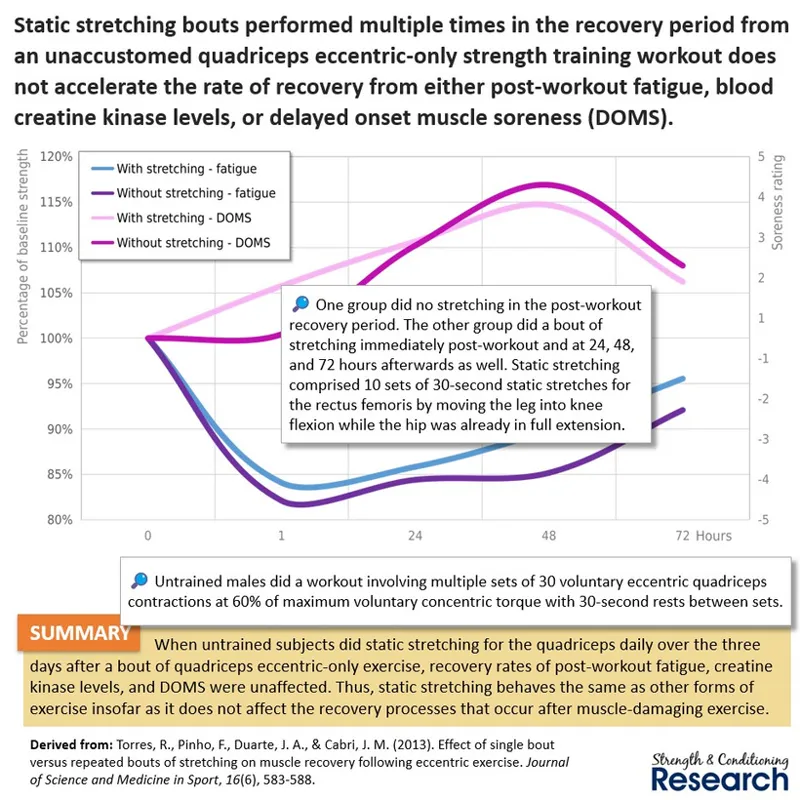
Sometimes, static stretching is treated as something separate from exercise (but in reality it causes very similar fatigue effects and stimulates quite similar muscular adaptations). Nevertheless, it also has no beneficial effect on the rate of recovery after a muscle-damaging workout when static stretching bouts are performed multiple times throughout the post-workout recovery period.
.
Conclusions
Strength and conditioning coaches often program recovery workouts with the goal of accelerating the rate at which post-workout fatigue dissipates. Various rationales have been provided for this practice, although they tend to be based on outdated post-workout fatigue models. Our current best model of post-workout fatigue involves a biochemical process that starts with calcium ion accumulation during the workout, which stimulates the release of damaging enzymes called calpains and subsequently an inflammatory process that causes secondary damage. Once the calcium ions have entered the muscle fibers, there is nothing that we can do to alter the process that then ensues. Neither increasing blood flow nor clearing metabolites will affect the amount of muscle damage or the subsequent inflammatory process. Several studies have tested the effects of doing multiple recovery workouts in the post-workout period after a muscle-damaging eccentric training workout. They have reported that neither [1] light exercise for the eccentrically-trained muscle, nor [2] light exercise for a different muscle from the one that was damaged eccentric training, nor [3] static stretching have any beneficial effects on the recovery rate when carried out in the post-workout period.
Comments (2)
In the world of endurance training, some people say that recovery runs speed up recovery since slow runs do not deplete glycogen stores much, but allow for a high rate of blood flow through the body. This would be outdated correct?
Hi Chris, Thank you for this. I understand that programming recovery workouts would not “speed up” recovery in any way. However, would the neurological benefits - like pain relief be worth it to program said recovery workouts? Kind regards