



Creatine supplementation
It is often claimed that dietary supplementation with creatine monohydrate can enhance the gains in muscle size achieved during strength training. But does this supplement really cause an increase in myofibrillar number or does it just cause a transitory increase in muscle fiber water content instead?
.
#1. Does creatine contribute to gains in muscle size?
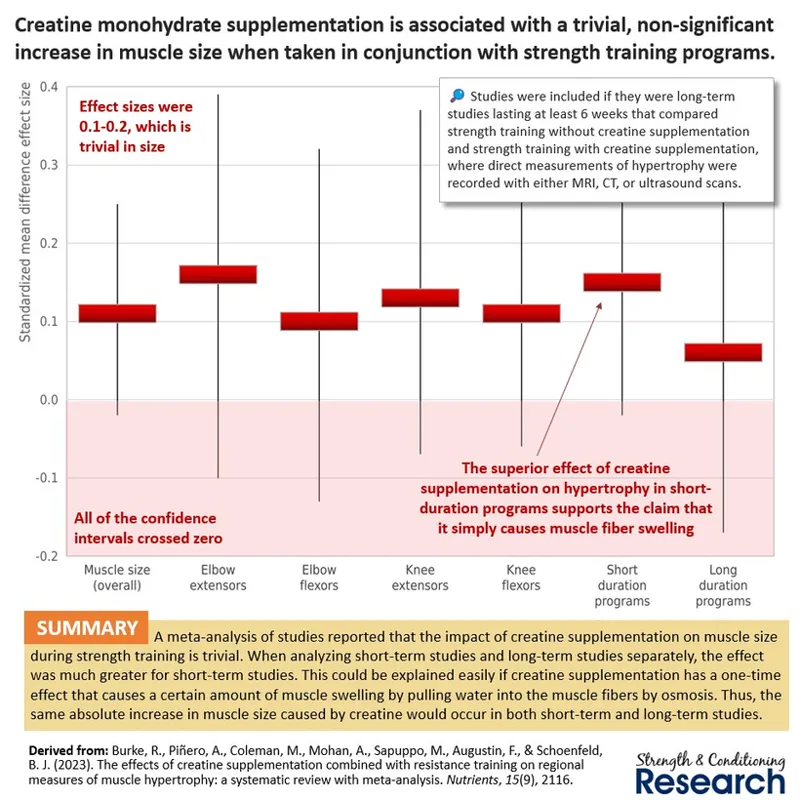
Recent meta-analysis of longitudinal trials have reported that creatine produces a very small and probably not statistically significant increase in muscle size when taken as a supplement in conjunction with a strength training program.
.
#2. Creatine does not prevent atrophy during immobilization
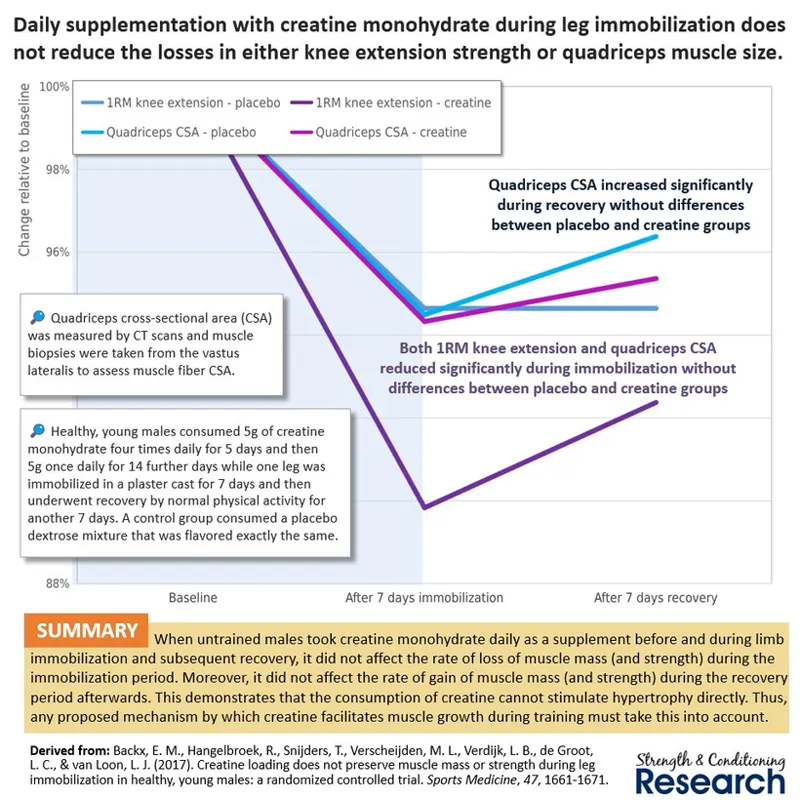
Importantly, creatine supplementation does not prevent muscle loss or the loss of strength during periods of immobilization (meanwhile no strength training is performed, obviously). Therefore, it definitely does not stimulate hypertrophy by any direct mechanism.
.
#3. Creatine increases repetition strength by increasing resistance to fatigue mechanisms
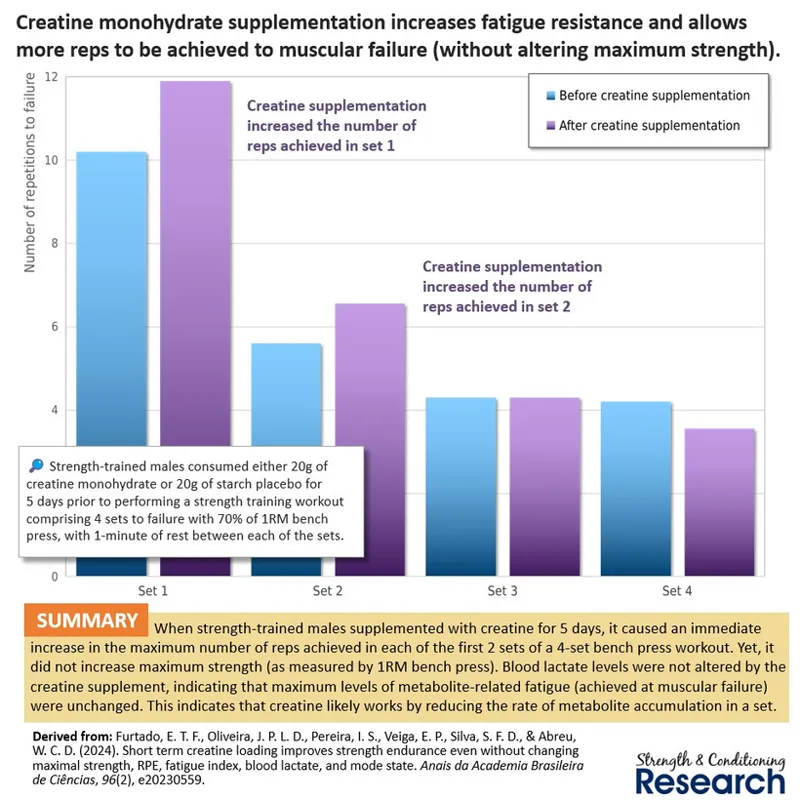
How does creatine supplementation affect progressive overload during strength training? It does it primarily by increasing fatigue resistance, especially in the early sets of the workout. This is accomplished by its effects on the creatine phosphate system.
.
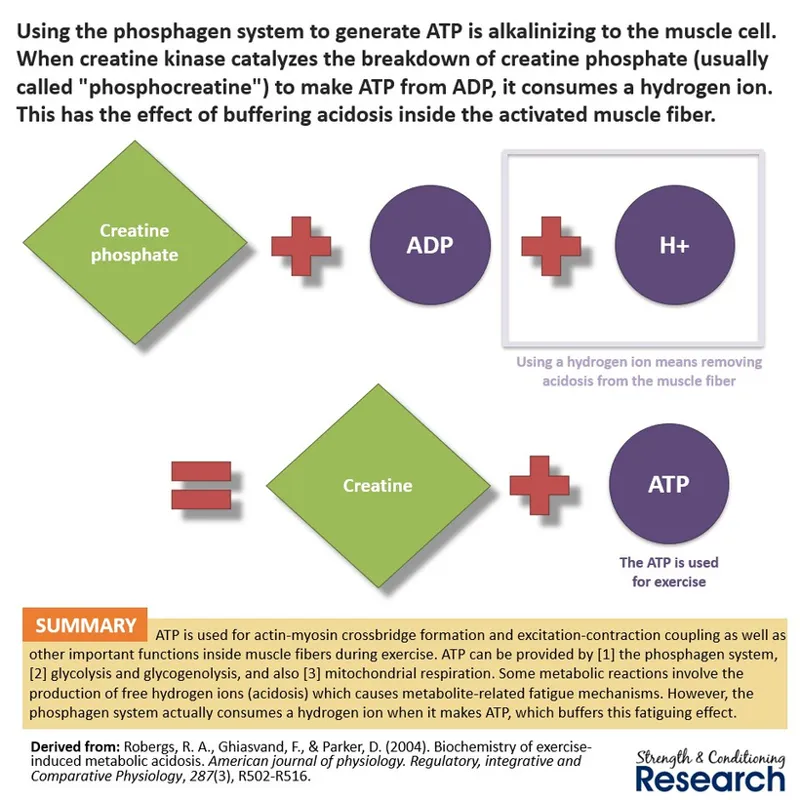
The reaction by which creatine phosphate provides ATP to the muscle fibers is interesting because it actually consumes a hydrogen ion. Consequently, it paradoxically reduces the metabolite-related fatigue mechanism of acidosis despite being a metabolic reaction. The process of reducing acidosis is known as "buffering" and therefore we can say that the action of creatine on fatigue resistance is to increase muscle buffering capacity.
.
Importantly, it is certainly not correct to say that creatine supplementation reduces fatigue by increasing the availability of ATP because ATP does not deplete during exercise (read more).
.
#4. Creatine just causes muscle fibers to swell
Dietary supplementation with creatine increases body mass, lean body mass, and total body water even when no strength training is performed. Moreover, muscle fiber cross-sectional area is also increased, indicating that the presence of more creatine inside muscle fibers alters their osmotic balance and pulls in water from the extracellular space.
.
#5. Muscle swelling does not stimulate hypertrophy
Although hypertrophy researchers keep returning to the idea that muscle fibers swelling could cause them to grow because of the increase in internal pressure, the current research does not support this idea. Indeed, when investigating the effects of muscle fiber swelling in the context of the pump, studies have shown that there is no beneficial effect (read more).
.
Conclusions
It is often claimed that dietary supplementation with creatine monohydrate can enhance the gains in muscle size achieved during strength training. Yet, it seems more likely that the supplement simply stimulates an increase in intracellular water (water inside muscle fibers) because the presence of creatine inside the muscle cells pulls in water from the extracellular space by osmosis. Indeed, we know that creatine supplementation does not stimulate muscle growth directly because it fails to reduce losses in muscle mass and strength during periods of immobilization. Thus, the only feasible mechanism by which creatine could enhance gains in muscle size must be by altering exercise performance. During exercise, creatine increases resistance to metabolite-related fatigue by increasing cellular buffering capacity. This means that metabolite accumulation is delayed and we can do more repetitions to failure for a given percentage of 1RM. However, despite doing more repetitions, there is not an increase in the number of stimulating reps achieved because the absence of fatigue means that either [1] motor unit recruitment can remain lower for longer (if using a self-selected or slow tempo), or [2] muscle fiber shortening velocity can remain higher for longer (if using a maximal tempo). In either scenario, the reduced motor unit recruitment level or reduced single muscle fiber mechanical tension mean that the additional reps do not stimulate muscle growth. This is similar to what happens when we use an external focus of attention to increase coordination in a movement. The number of reps immediately increases (because of increased efficiency) but these additional reps do not contribute to greater gains in muscle size.


Comments (1)
Will the creatine suplementation be useful to obtain better gains in speed? as you will have lower velocity loss between repetitions