



ATP does not deplete during exercise
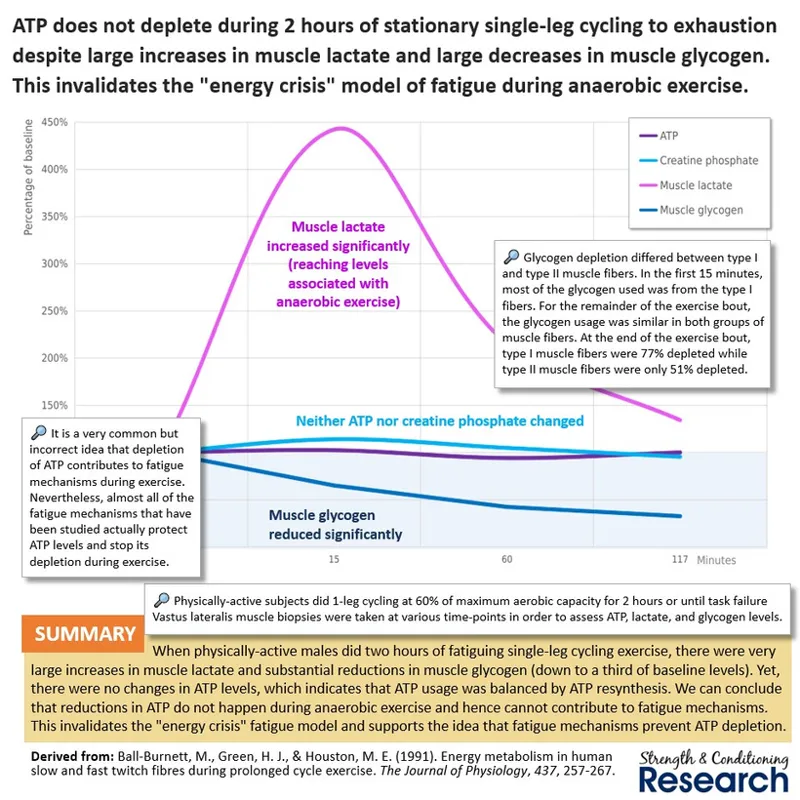
Perhaps owing to the delay in updating exercise physiology textbooks, many people still argue that ATP depletes during exercise and that the lack of ATP impairs exercise performance (which is what we refer to as fatigue). This hypothesis is known as the "energy crisis" model of fatigue. It has been rejected now for many years (ever since we had the ability to see the behavior of ATP inside muscle fibers and observe that the levels of ATP do not change).
.
#1. ATP levels do not change during aerobic exercise
Originally, it was believed that ATP levels reduced during aerobic exercise and that such reductions were partially responsible for the reductions in exercise performance over time. Yet, it has become clear in more recent studies that ATP levels do not change and that the connection between reduced energy stores and fatigue is produced largely by means of the central nervous system.
#2. ATP levels do not change during anaerobic exercise
In line with research in aerobic exercise, researchers have confirmed that ATP does not deplete during more intense anaerobic exercise that depletes muscle glycogen effectively.
#3. ATP levels do not change during strength training exercise
Faced with the rejection of the energy crisis hypothesis in endurance exercise, some commentators have attempted to keep it going in the context of strength training by arguing that the much higher intensity of exercise causes fast twitch fibers to deplete ATP more rapidly than is possible during aerobic exercise. Yet, we have data showing that ATP levels do not change during repeated bouts of maximal isometric contractions with and without BFR.
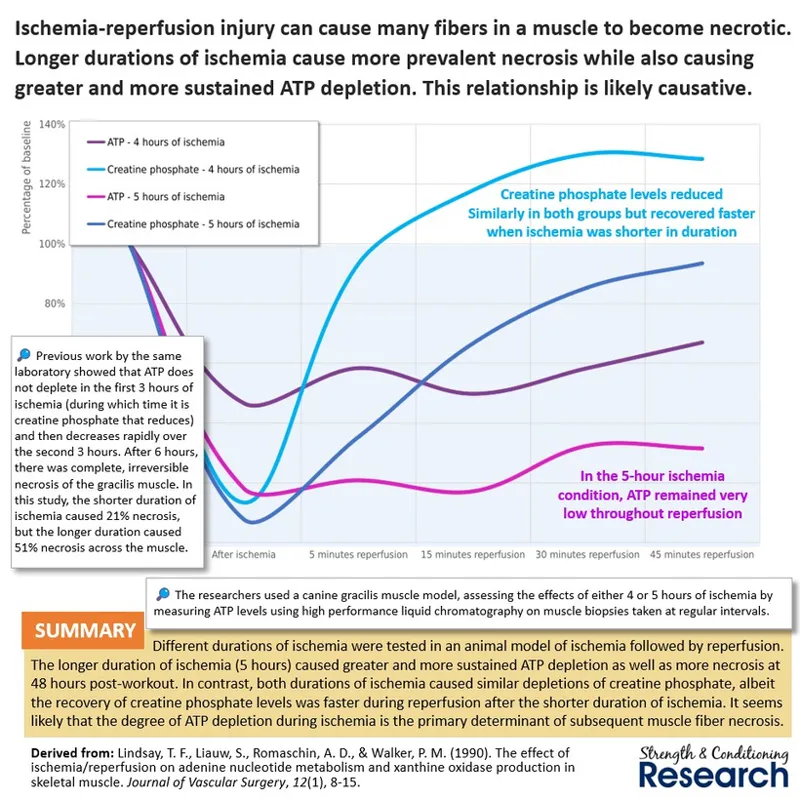
#4. Why do ATP levels not change during exercise? (what is the purpose)
Running out of ATP causes muscle fibers to turn necrotic and die. Muscle fibers need a certain amount of energy supply in the form of ATP in order to continue functioning. Ischemia studies comparing different durations of time spent in an hypoxic state show us that substantial loss of ATP causes muscle cells to die.
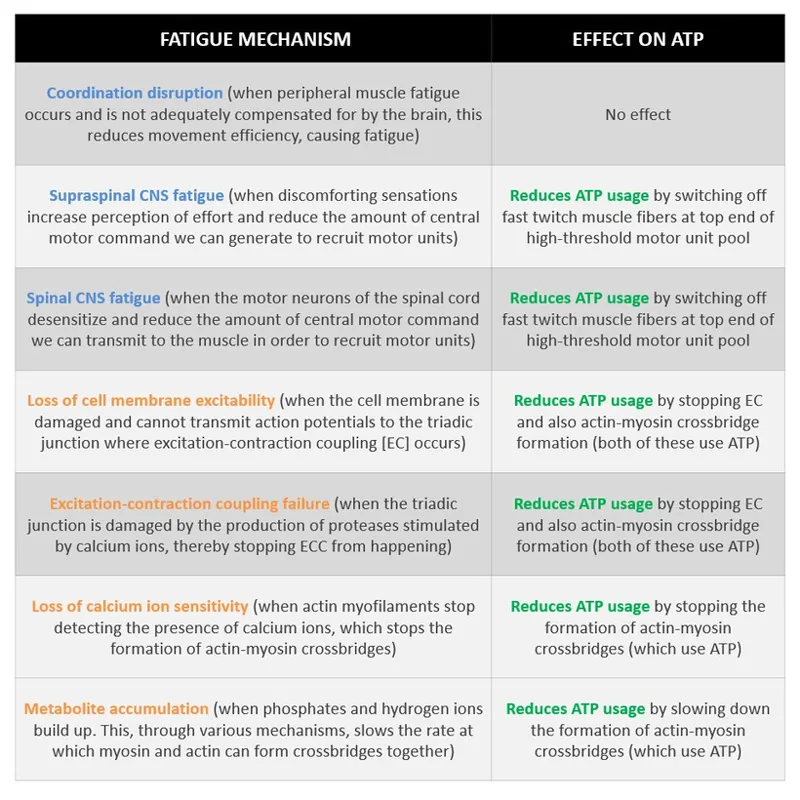
#5. Why do ATP levels not change during exercise? (how does this happen)
ATP levels do not reduce during exercise because the majority of fatigue mechanisms actually stop the usage of ATP by either stopping or slowing down the biological processes that use it.
Conclusions
Once, it was believed that ATP levels reduced during exercise and that such reductions contributed to the development of fatigue. This is now known as the "energy crisis hypothesis" and it has been overturned by data showing that ATP levels do not change during aerobic exercise bouts or during strength training exercise. In fact, it was never a logical idea since it does not fit with the behavior of the other fatigue mechanisms. Indeed, most fatigue mechanisms prevent the loss of ATP during exercise, which is mainly used for crossbridge formation or for excitation-contraction coupling. For example, [1] acidosis reduces the rate of formation of crossbridges, [2] phosphate accumulation stops ATP from being converted into ADP and a phosphate, [3] excitation-contraction coupling failure, reductions in sarcolemmal excitability, and reductions in myofibrillar calcium ion sensitivity all stop crossbridges from forming, [4] excitation-contraction coupling failure and reductions in sarcolemmal excitability stop excitation-contraction coupling from happening, and finally [5] supraspinal and spinal central nervous system fatigue mechanisms reduce the recruitment of motor units and therefore reduce the number of activated fast twitch muscle fibers that are most likely to deplete ATP the most rapidly. Since ATP depletion has been associated with cell necrosis, it seems plausible that many fatigue mechanisms are specifically intended to prevent this from happening, as otherwise exercise would often cause the loss of many muscle fibers, which would not be very adaptive.