




Strength recovery and rep ranges
Everywhere in the fitness industry, popular commentators claim that workouts comprising heavier loads take longer to recover from than similar workouts comprising lighter loads. Yet, this is untrue. In fact, the research is very clear that training with lighter loads causes more post-workout fatigue.
.
#1. Comparing moderate and heavy loads
Generally, unless the moderate load workout is performed substantially further from failure than the heavy load workout, moderate load workouts take longer to recover from than heavy loads. For example, this study compared the exact same number of sets of heavy loads (3 reps with 90% of 1RM) and moderate loads (10 reps with 70% of 1RM) and found that the moderate loads required far longer recovery times. These longer recovery times occurred despite the early sets of the moderate load workout being performed with 4-5RIR.
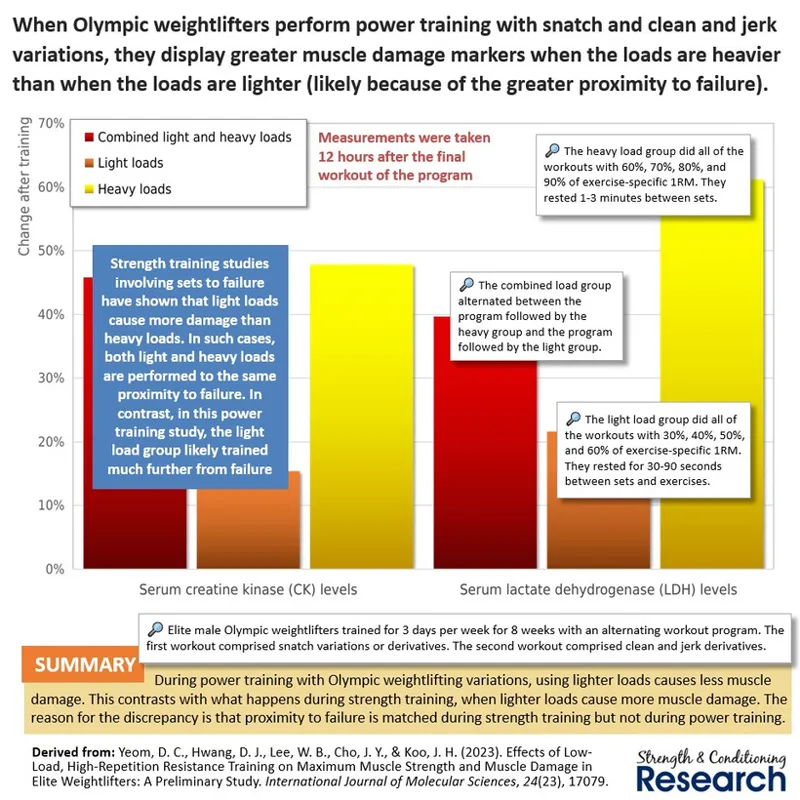
Some commentators assert that the opposite is true based on studies that have compared heavy and moderate loads with very big differences in the proximities to failure of the two conditions. For example, in this study, the exact same sets and reps were performed in the heavy and moderate load groups and the only thing that varied was the weight on the bar. Obviously, in such cases, the lighter load groups will display less post-workout fatigue as a result of training further from failure.
Similarly, in this study, the exact same sets and reps were performed in the heavy and moderate load groups and the only thing that varied was the weight on the bar. Obviously, again, the lighter load group displayed less post-workout fatigue as a result of training much further from failure.
#2. Comparing light and moderate loads
In exactly the same way, the research is clear that moderate loads require shorter post-workout recovery times than light loads in strength-trained lifters. For example, this study compared the same total volume load of light (approximately 30RM) and moderate (approximately 15RM) loads and showed substantially more post-workout fatigue in the light load condition.
Similar results have been observed in strength-trained lifters when comparing the same total number of sets (thereby equating total volume instead of equating the total volume load).
#3. Why do higher rep ranges cause more post-workout fatigue?
Post-workout fatigue is caused by calcium ion accumulation inside muscle fibers during a workout. This calcium ion accumulation is greater when muscle fibers are activated for a longer period of time because the primary way in which calcium ions enter a muscle fiber is through the sarcoplasmic reticulum in response to being activated by action potentials. Thus, we see greater low-frequency fatigue (an index of excitation-contraction coupling failure) after training with longer duration, low force isometric contractions compared to after training with shorter duration, high force isometric contractions.
Conclusions
Everywhere in the fitness industry, there are commentators claiming that workouts comprising heavier loads take longer to recover from than similar workouts comprising lighter loads. Yet, this is untrue. In fact, the research is very clear that training with lighter loads causes more post-workout fatigue. When strength-trained lifters do similar workouts with heavy or moderate loads, the moderate load workouts cause much more post-workout fatigue (even when the moderate load sets involve leaving a few more reps in reserve on early sets). And, when strength-trained lifters do similar workouts with moderate or light loads, light load workouts cause more post-workout fatigue than moderate load workouts (whether matching volume or volume load). The only time when lighter load workouts cause less post-workout fatigue than heavier load workouts is when the proximity to failure of each load is substantially different. For example, some studies have tested post-workout fatigue after workouts comprising exactly the same number of sets and reps of heavier and lighter loads. In such cases, the heavier load workouts cause more post-workout fatigue because the heavy load sets involve training much closer to failure. Clearly, however, such comparisons are not relevant for bodybuilding because the lighter load workouts would stimulate little hypertrophy.
Comments (4)
Would it be accurate to say that all post-workout fatigue that lasts longer than 24 hours is a result of calcium-ion related fatigue? (Assuming no non-local CNS fatigue is present)
All post-workout fatigue is ultimately caused by calcium ion accumulation during the workout (including the CNS fatigue). I don't think you can have muscle damage without an inflammatory response that causes CNS fatigue. There's a few FAQ posts on how post-workout fatigue happens.
In the Bartolomei study (2017), the high-volume group got only 1.25 minutes of rest while the high-intensity group got 3 minutes. With approximately the same proximity to failure how can those different rest periods be argumented for? The authors don't offer an explanation so I'd be really interesting to hear your opinion on this
You have to look at the way in which fatigue mechanisms differ between workouts that use different rest periods. Since CNS fatigue and metabolite-related fatigue mechanisms recover quickest between sets, using shorter rest periods probably has a slightly protective effect against calcium ion-related fatigue mechanisms (which is what causes post-workout fatigue). So I would imagine that using shorter rest periods allowed the high-volume group to limit post-workout fatigue slightly.