



Spinal CNS fatigue during exercise
Historically, central nervous system (CNS) fatigue during exercise has been very poorly explained by fitness influencers and experts. We now understand that there are two totally different CNS fatigue mechanisms that occur during exercise, being [1] supraspinal (brain) CNS fatigue, and [2] spinal CNS fatigue.
.
#1. Supraspinal CNS fatigue happens at the brain level
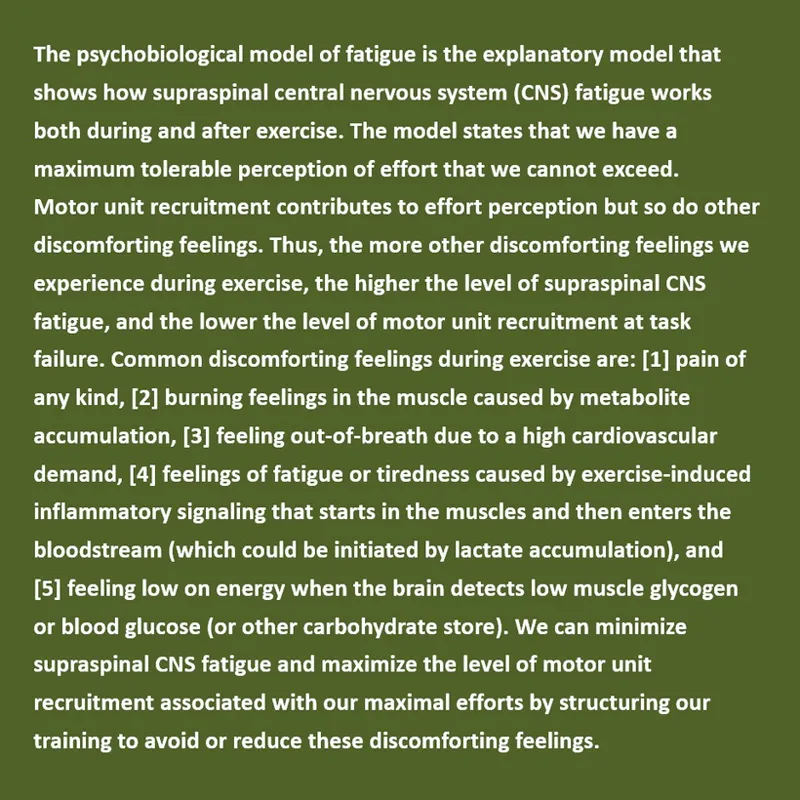
Supraspinal CNS fatigue causes a reduction in motor unit recruitment at the level of the motor cortex and thereby applies to all muscles in the body, even when the exercise only involves a single working muscle. It is created by the discomforting feelings experienced during exercise (read more).
.
#2. Spinal CNS fatigue happens in the spinal cord
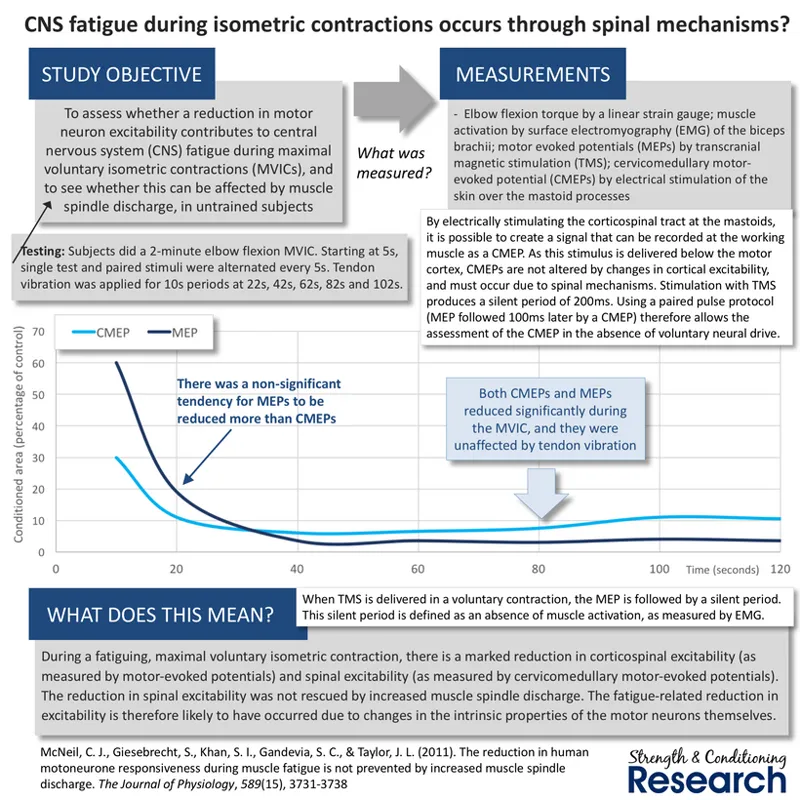
In contrast, to supraspinal CNS fatigue, spinal CNS fatigue occurs in the spinal cord. While supraspinal CNS fatigue reduces the magnitude of the central motor command that is generated in the motor cortex of the brain, spinal CNS fatigue reduces the amount of central motor command that reaches the muscle after being sent down the motor neurons of the spinal cord. In other words, it does not change how much neural drive is created, only how much reaches the muscle fibers.
.
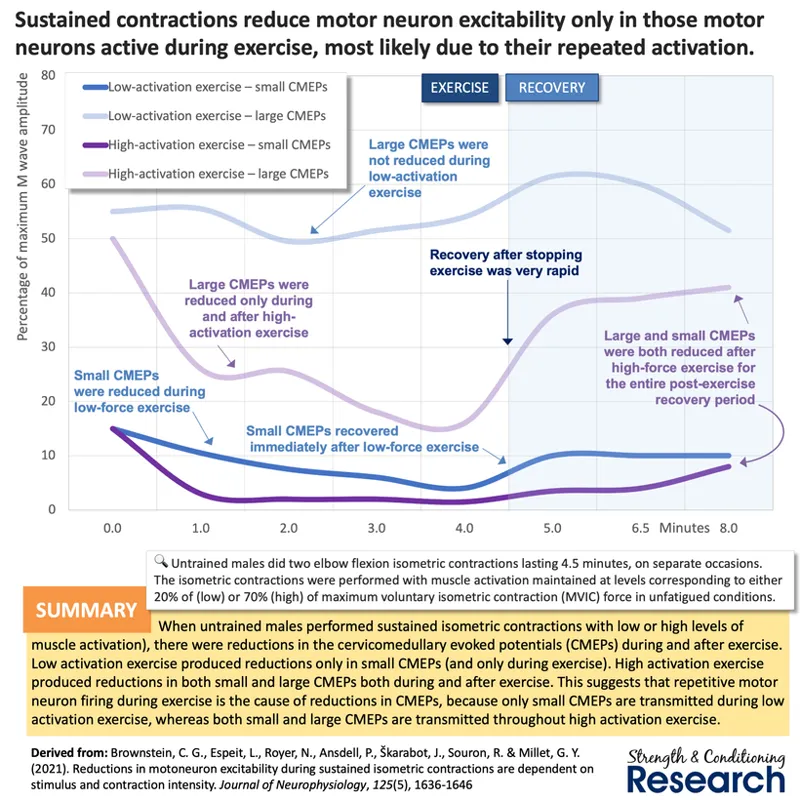
While several promising hypotheses about how spinal CNS fatigue occurs have been tested, none have been supported. All we currently know is that repeatedly sending central motor command down the spinal motor neurons in order to produce sustained recruitment of a motor unit is what causes the fatigue mechanism to happen.
.
In line with this observation, research has shown that CNS fatigue develops more rapidly in a bout of isometric contractions (without any breaks) compared to in concentric or eccentric contractions that have short breaks between each contraction by necessity. This may imply that maintaining a motor unit recruited constantly is a key driver of spinal CNS fatigue, since supraspinal CNS fatigue is unlikely to be higher in isometric contractions compared to in concentric or eccentric contractions.
.
#3. What can cross-over fatigue and non-local fatigue tell us about spinal CNS fatigue?
While direct studies into spinal CNS fatigue have not produced much usable information, the non-local fatigue literature is more promising. The term "non-local fatigue" is a phenomenon involving fatigue recorded in parts of the body other than the one used during exercise. As a phenomenon, it does not provide a mechanism but rather only describes a customary result. Non-local fatigue can be subdivided into the cross-over fatigue phenomenon and the more general non-local fatigue phenomenon. Cross-over fatigue refers to fatigue in the exact contralateral muscle from the one fatigued during exercise, while general non-local fatigue can be measured in every other muscle.
.
Studies have repeatedly shown that cross-over fatigue in the exact contralateral muscle from the one fatigued during exercise is much greater than the more general non-local fatigue that occurs in other muscles. It is possible that this phenomenon may reflect a role of spinal CNS fatigue in cross-over fatigue that does not exist in more general non-local fatigue. Even so, this hypothesis remains to be tested.
.
Conclusions
Historically, central nervous system (CNS) fatigue during exercise has been very poorly explained by fitness experts. We now understand that there are two different CNS fatigue mechanisms during exercise: [1] supraspinal CNS fatigue, and [2] spinal CNS fatigue. Supraspinal CNS fatigue reduces the magnitude of the central motor created by the motor cortex of the brain, while spinal CNS fatigue reduces the amount of central motor command that reaches the muscle after being sent down the motor neurons of the spinal cord. It does not alter how much neural drive is created, only how much reaches the muscle fibers. It appears that repeatedly sending central motor command down a spinal motor neuron in order to produce sustained recruitment of a motor unit gradually reduces the amount of neural drive that is transmitted, thereby causing fatigue. In line with this observation, CNS fatigue develops faster in a bout of sustained isometric contractions compared to in concentric or eccentric contractions (which obviously have short breaks between contractions). It seems that maintaining a motor unit recruited constantly is a key driver of spinal CNS fatigue, since supraspinal CNS fatigue is unlikely to be much higher in isometric contractions compared to in concentric or eccentric contractions.

Comments (1)
Could cross-over fatigue impair the efficacy of unilateral training? Sufficient rest between one size and the other size is mandatory, but is it enough to maximize contralateral hypertrophy ?