

Recovery made simple
S&C coaches frequently complain that fatigue and recovery are difficult to understand. In reality, fatigue and recovery are straightforward when we use a physiological model. They are only complicated when we try and force physiological reality to fit into the general adaptation syndrome by insisting that exercise is a stressor, when it is not.
.
#1. What is post-workout fatigue?
Post-workout fatigue is a temporary reduction in exercise performance following a bout of exercise that lasts for more than a couple of hours. Fatigue is an objective, external measurement, often recorded as strength loss relative to pre-workout levels. The recovery process can be tracked by the return of this external measurement to baseline. The fatigue measurement is caused by multiple, underlying fatigue mechanisms (read more).
.
#2. How does stress affect post-workout fatigue and recovery?
One of the most persistent myths in S&C is that exercise is a stressor. Frequently, we hear strength coaches referring to balancing multiple stressors, with exercise being one of them. This is not a valid model. Physiologists have confirmed that since exercise is usually neither unpredictable nor uncontrollable, it cannot be judged to be a stressor (read more).
.
Nevertheless, genuine stressors (like sleep loss, excessive caloric restriction, traumatic injury, and major life events) do have physiological effects that impair the rate of recovery. The release of stress hormones like glucocorticoids suppress the inflammatory process and also reduce rates of muscle protein synthesis. This makes damage take longer to fix (read more).
.
Here is a simple illustration of the impact of stressors in the post-workout period, showing how they can reduce the rate of recovery after a workout or competition.
.
#3. How does exercise affect post-workout fatigue and recovery?
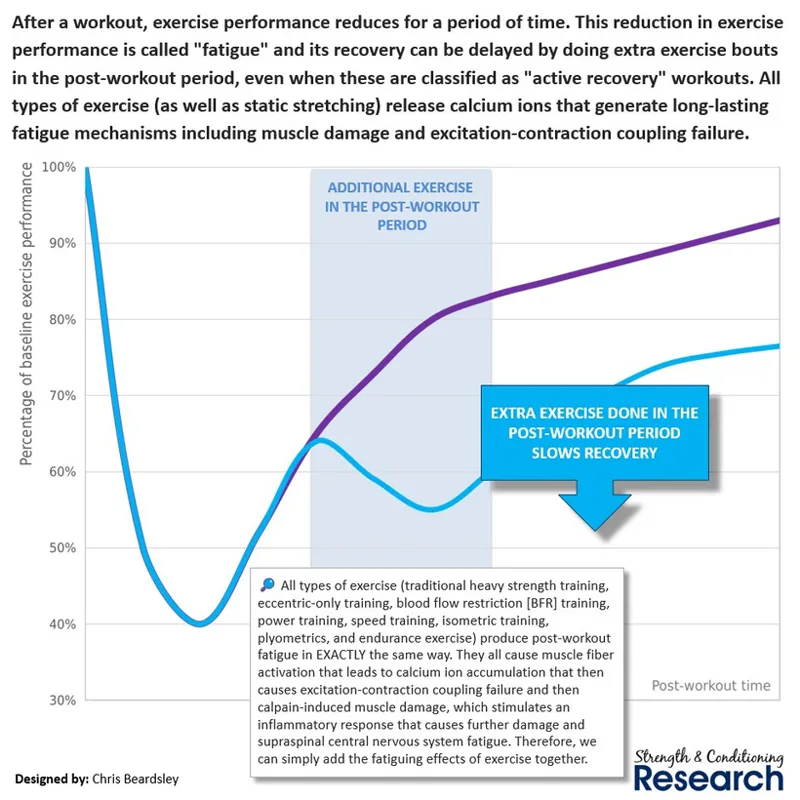
Another common myth (and a contradictory myth at that) is that exercise can be used to reduce post-workout fatigue by being classified as "active recovery". Apparently, by changing the terminology of a workout, we can change its function. Of course, this is nonsense. Both exercise and static stretching cause further muscle damage that subsequently prolongs the post-workout recovery timeline (read more).
.
Here is a simple illustration of the impact of extra exercise in the post-workout period, showing how such workouts can reduce the rate of recovery after a workout or competition.
.
Some influencers have argued that exercise can reduce post-workout fatigue by reducing stress. While it is technically correct that exercise does function as a stress reliever when compared to staring at a blank wall, it is almost certainly not better than engaging in stress-relieving activities that do not involve exercise, such as sleep, playing games, and socialising. Thus, to argue that "active recovery" exercise is a necessary stress reliever is disingenuous.
.
Conclusions
S&C coaches often complain that recovery is complex. However, recovery from post-exercise fatigue is straightforward when we use a physiological model in which fatigue is defined as a temporary reduction in exercise performance and recovery is the reversal of this temporary reduction back to baseline. Now, we have a clearly-defined set of fatigue mechanisms that reduce exercise performance, including [1] excitation-contraction coupling failure, [2] muscle damage, and [3] supraspinal central nervous system (CNS) fatigue resulting from the inflammation caused by muscle damage. Moreover, we can see that stressors (such as from major life events, sleep loss, traumatic injury, or severe caloric restriction) delay the resolution of two of these fatigue mechanisms by suppressing and prolonging the inflammation process that is responsible for dealing with muscle damage and which provokes supraspinal CNS fatigue. And,we can see that avoiding and reducing stress is key to ensuring rapid recovery from exercise. Also, we can see that active recovery in the form of light exercise or static stretching is not an ideal strategy for speeding up recovery, even if it is intended as a stress-reliever. Every single type of exercise causes post-workout fatigue through the same mechanistic pathways. Thus, doing extra exercise after a fatiguing workout just adds more fatigue on top of the fatigue that was already present. Thus, unless exercise is literally the only stress-relieving activity available to an athlete (which hopefully it is not), other options (like sleep,playing games, or socializing) are likely to function much more effectively.