




Insufficient sleep reduces adaptations
Sleep deprivation generally refers to one or more nights without any sleep. Partial sleep deprivation (also called sleep restriction) refers to one or more nights with substantially less than the normal amount of sleep. When either sleep deprivation or sleep restriction are carried out for more than one night, this is often described as "persistent" sleep deprivation or restriction. But what effect does insufficient sleep have on a workout and how does that affect the adaptations that we can stimulate?
.
#1. Effects of insufficient sleep on exercise performance
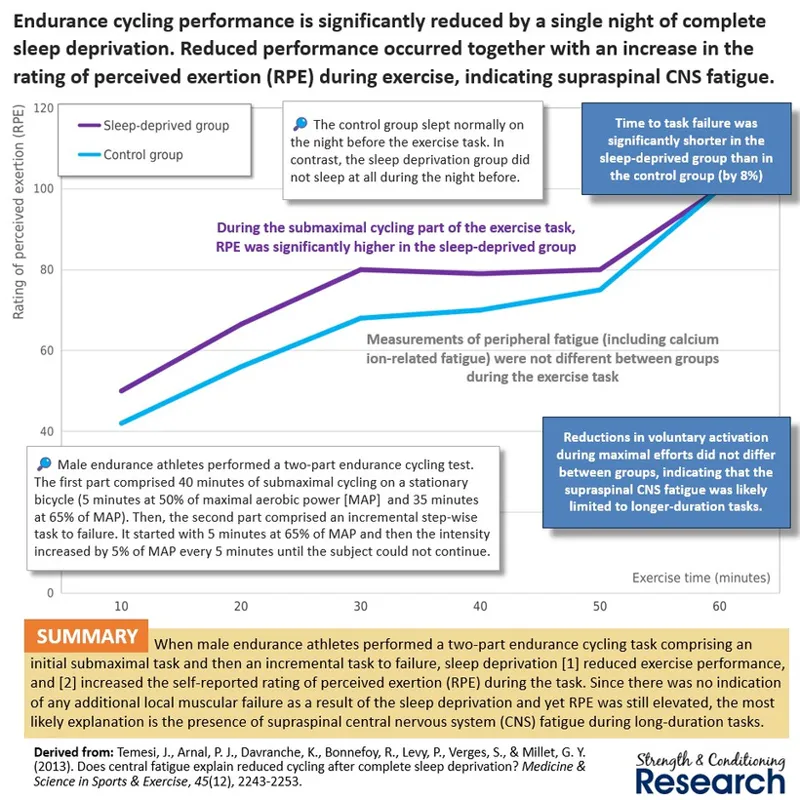
Sleep deprivation reduces endurance, maximum strength, and power in trained athletes as per a recent meta-analysis. Yet, it has minimal effects on anaerobic performance. Why this discrepancy exists is unclear.
.
Importantly, persistent partial sleep deprivation (or persistent sleep restriction) also reduces strength training performance during strength training workouts performed by trained lifters. Thus, sleep deprivation for single nights seems to produce similar effects to persistent partial sleep deprivation (also called sleep restriction) for multiple nights.
.
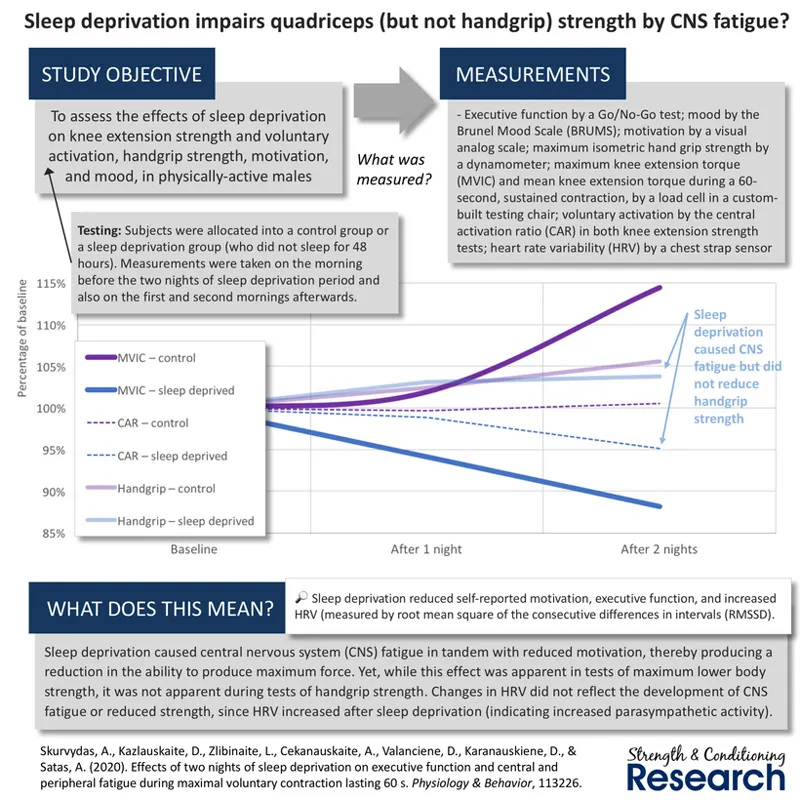
#2. Insufficient sleep reduces motor unit recruitment levels
Sleep deprivation increases the rating of perceived exertion associated with a given intensity of exercise, which fits the description of supraspinal central nervous system (CNS) fatigue. It leads to a reduced level of motor unit recruitment at maximal effort levels.
.
In confirmation of this observation, sleep deprivation reduces voluntary activation as measured by the central activation ratio, which is a method of assessing CNS fatigue.
.
We can see how insufficient sleep produces this supraspinal CNS fatigue effect by looking at the effects of sleep deprivation on pain. Insufficient sleep reduces pain tolerance threshold, which suggests that it will similarly reduce the maximum tolerable perception of effort, directly producing supraspinal CNS fatigue. It will also increase the sensitivity to any other discomforting sensation (like the perception of feeling out of breath), thereby amplifying the negative effects of common sources of supraspinal CNS fatigue during exercise.
.
#3. Insufficient sleep reduces coordination levels
Persistent partial sleep deprivation (also called sleep restriction) reduces the level of coordination that can be achieved in a movement, thereby reducing exercise performance.
.
Conclusions
Insufficient sleep can involve sleep deprivation or sleep restriction. Sleep deprivation refers to one or more nights without sleep. Sleep restriction (also called partial sleep deprivation) refers to one or more nights with less than the normal amount of sleep. When sleep deprivation or sleep restriction occur for more than one night, this is called "persistent" sleep deprivation or restriction. It is likely that sleep deprivation for one night has similarly negative effects on strength training and athletic performance as persistent sleep restriction for multiple nights. So what are the mechanisms by which exercise performance is reduced? Firstly, motor unit recruitment is reduced by an increase in effort perception because of an increase in pain sensitivity. Secondly, coordination is reduced, perhaps due to reductions in cognitive performance. Achieving maximal levels of motor unit recruitment and performing movements with the highest levels of coordination are necessary for adaptations in motor unit recruitment and coordination, respectively. We would therefore expect that performing workouts after achieving insufficient sleep would prevent adaptations in [1] the ability to recruit high-threshold motor units, and also in [2] motor learning. Also, insufficient sleep would be expected to reduce the amount of hypertrophy that could be stimulated due to the reduced motor unit recruitment levels corresponding to maximum effort.
Comments (3)
These studies and infographics are so enlightening. Thank you very much!
So if you have had a really bad nights sleep and feel pretty washed out, should you basically not train? wait another day and train when you feel rested ? I hav eliterally just done this today, slept awful, feel off and don't think I would have the best workout, normally I would have forced myself to go but today I just thought, take an extra day and train tomorrow.
When that happens you don't stop working out. You change training intensity. Low to moderate training usually stays unaffected but always try to get your sleep back on track after it. So on low sleep, drop intensity, fix sleep schedule. Don't just stop working out unless it's really bad like below 4 hours of sleep