



Vertical jump countermovement depths
Looking at vertical jump countermovement depths in various different situations can teach us quite a lot about how vertical jumping works.
.
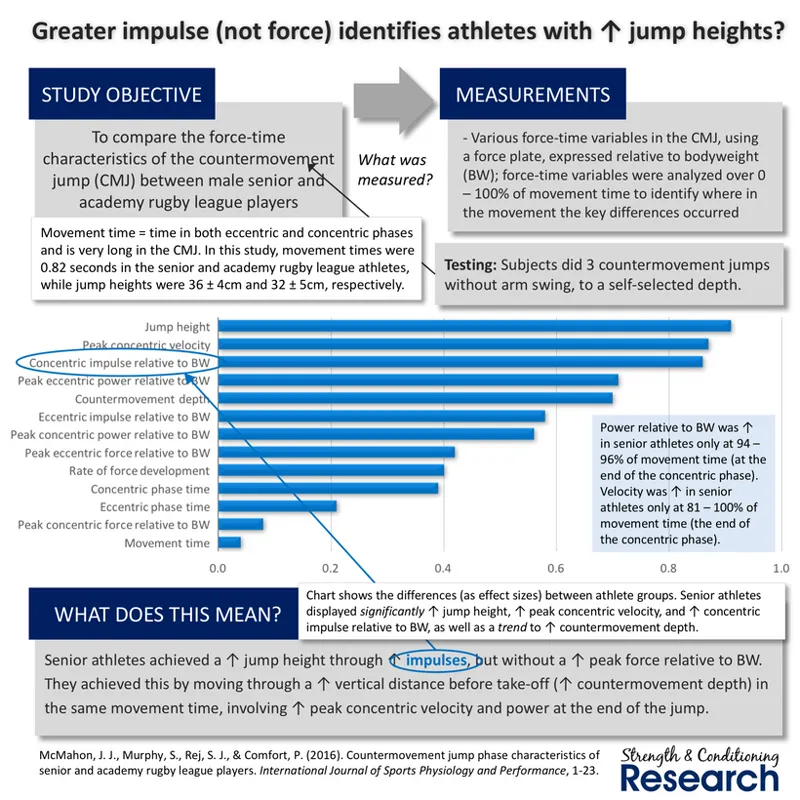
#1. Relative vertical impulse determines vertical jump height
Jump height is determined by the vertical impulse in the concentric phase of the movement relative to bodyweight. Vertical impulse is calculated as force multiplied by time, so both greater force and also a greater time spent producing that force (by using a deeper countermovement depth) will enhance vertical jump heights.
#2. Athletes have an optimal countermovement depth in the vertical jump
Since vertical impulse is the biomechanical determinant of jump height, we might expect that using a maximal countermovement depth (by dropping all the way down into a deep squat position) would maximize jumping performance. Even so, athletes appear to have an optimal vertical jump height, such that using an excessive countermovement depth appears to be unhelpful.
#3. High-velocity movement training increases countermovement depth in the vertical jump
We can see why athletes have an optimal countermovement depth even though theoretically it would be better to use a deep squat position by looking at the effects of assisted jump training. When assisted jump training increases vertical jump height, it does so by increasing countermovement depth. Since we know that assisted jump training only increases speed and not strength, this tells us that countermovement depth is automatically adjusted such that we reach our maximum possible take-off velocity at the end of the concentric phase of a jump (and so increasing this maximum take-off velocity therefore increases countermovement depth).
#4. Calcium ion-related fatigue leads to an increase in countermovement depth in the vertical jump
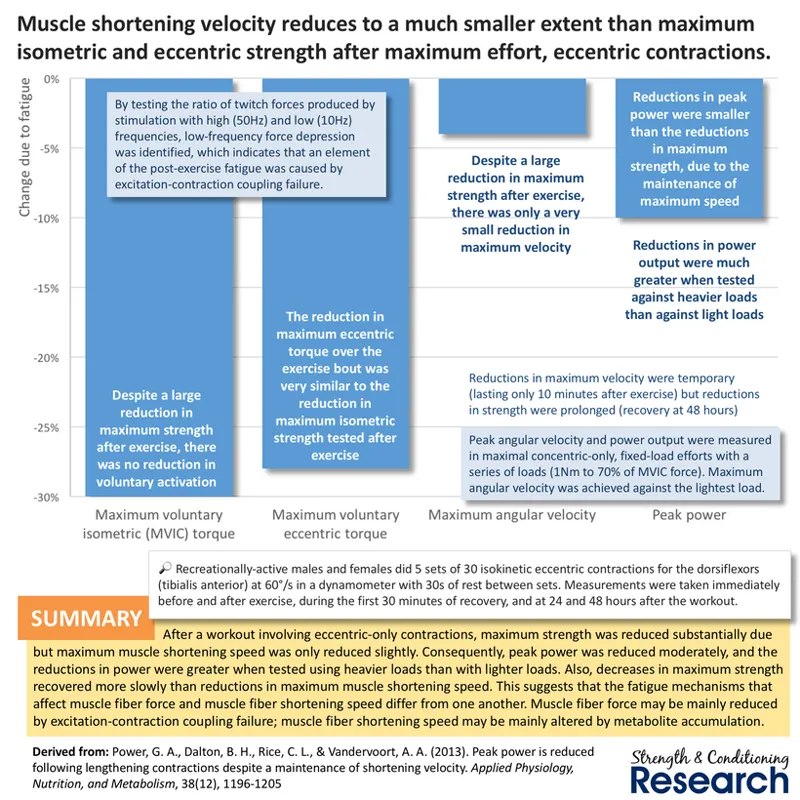
The exact same phenomenon occurs when athletes experience calcium ion-related fatigue in the leg muscles. Countermovement depth increases because strength has reduced but speed has not greatly reduced. Therefore, the athlete automatically increases the countermovement to permit maximum velocity to be reached at the end of the concentric phase despite reduced force production.
We know that calcium ion-related fatigue preferentially affects force over velocity from the research into the fatiguing effects of eccentric contractions.
Conclusions
Vertical jump height (VJH) is determined by concentric phase vertical impulse relative to bodyweight. Vertical impulse is calculated as force multiplied by time. Thus, a deeper countermovement depth (CMD) has the potential to enhance VJH. At first glance, we might therefore expect that a maximal CMD (by dropping all the way down into a deep squat position) would maximize VJH. Even so, athletes appear to have an optimal VJH, such that using an excessive CMD appears to be unhelpful. Interestingly, when assisted jump training increases VJH, it does so by increasing CMD. Since we know that assisted jump training only increases speed and not strength, this tells us that CMD is automatically adjusted such that we reach our maximum possible take-off velocity at the end of the concentric phase of a jump (and so increasing this maximum take-off velocity therefore increases CMD). This exact same phenomenon can be seen when athletes experience calcium ion-related fatigue in the leg muscles. CMD temporarily increases in the fatigued state because strength has reduced to a much greater extent that speed. Hence, the athlete automatically increases CMD to permit maximum velocity to be reached at the end of the concentric phase despite reduced force production.