






Maintenance of fascicle length by strength training
The volume and frequency needed to maintain muscle mass during strength training is relatively clear because the majority of studies have reported very similar findings. In contrast, the volume and frequency of eccentric-only training necessary to maintain muscle fascicle lengths is much less clear.
.
#1. Maintenance of muscle size by low-volume strength training
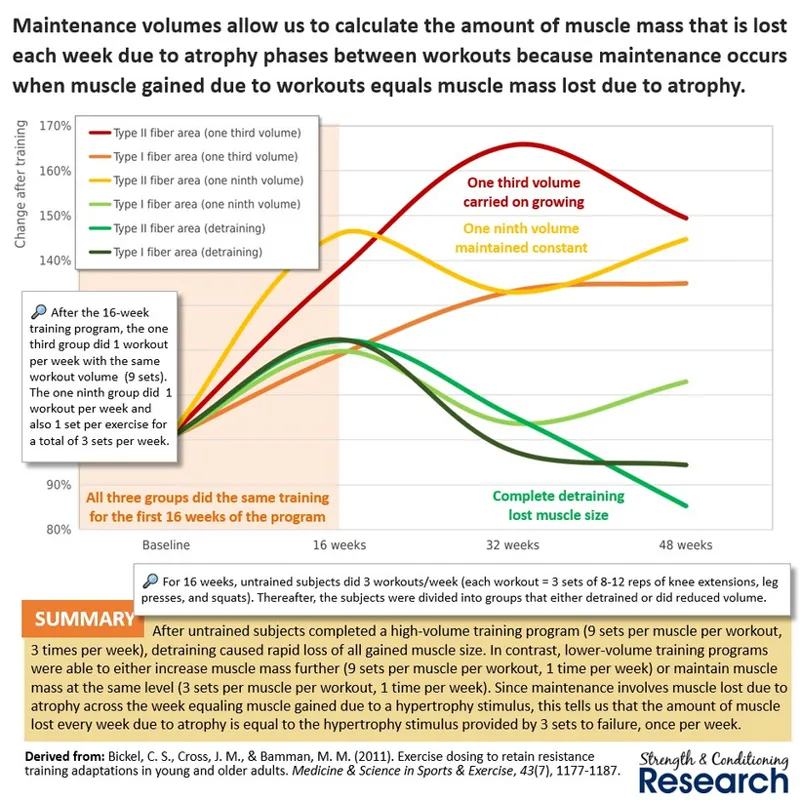
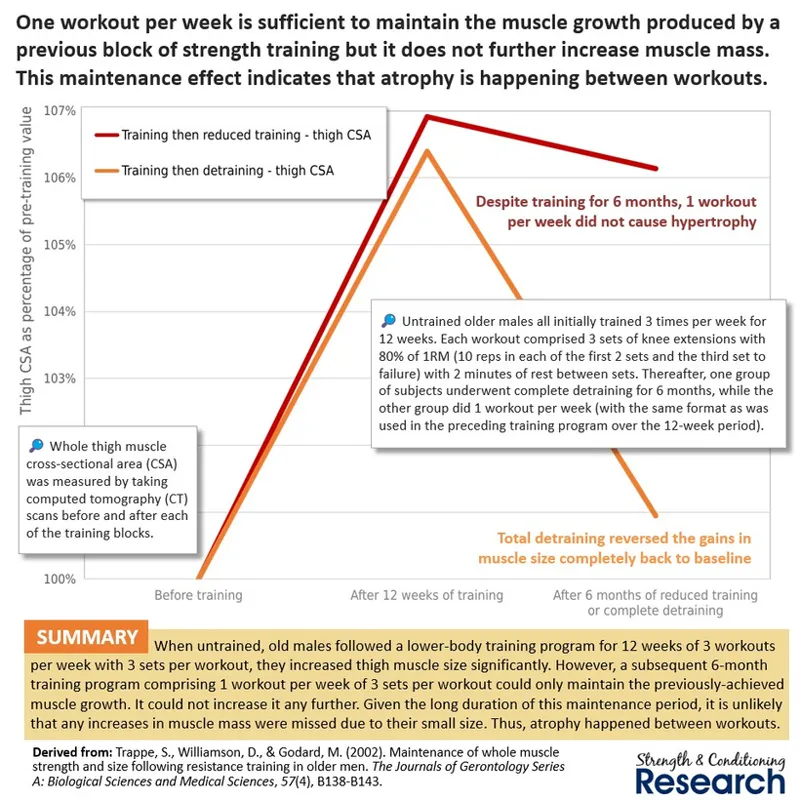
A small number of researchers have measured the amount of strength training that is necessary to maintain muscle size. Almost all of the currently available studies have reported that 3-4 sets, once per week is sufficient to retain previously-achieved levels of muscle size.
.
Critically, a reasonable proportion of these studies have used quite long durations of time for the maintenance test period. This means that we can discard the possibility that growth was happening, albeit very slowly.
.
Indeed, it is a very repeatable finding that one workout per week of 3-4 sets to failure is only enough to maintain muscle mass (by causing hypertrophy to equal atrophy over the week).
.
#2. Sarcomeres are lost more quickly than myofibrils during detraining
Detraining studies typically report that losses in muscle fascicle length are extremely fast after finishing an eccentric-only training program in which large improvements in sarcomere number were achieved.
.
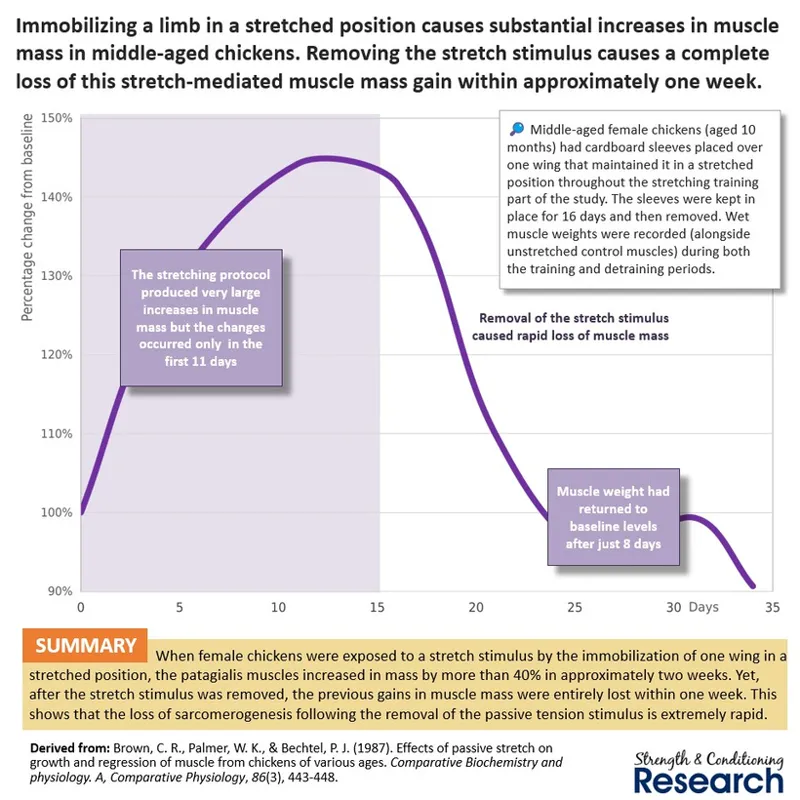
Similar findings can be observed in animal models of stretch-induced muscle growth, where all stretch-mediated gains in muscle mass are completely lost within a couple of weeks of removing the stretch stimulus.
.
Other studies have shown similar findings, with complete losses of the stretch-induced muscle mass gains happening extremely quickly.
.
#3. Maintenance volumes during eccentric-only training are still somewhat unclear
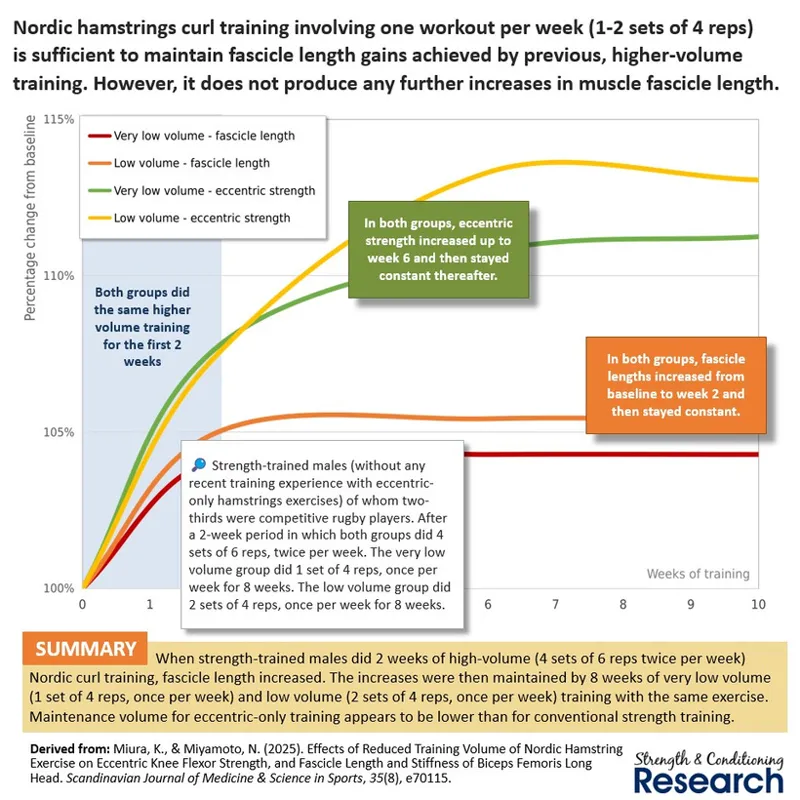
The maintenance volume for eccentric-only training to keep the muscle fascicle length gains achieved by a previous higher volume eccentric-only training block appears to be lower than that for hypertrophy maintained by conventional strength training. In this recent study, either one or two sets per week comprising 4 repetitions was sufficient to achieve maintenance.
.
A similar previous study also showed that two sets of 4 reps, once per week was sufficient to achieve maintenance in muscle fascicle length following an initial period of growth. Yet, it also found that two sets of 4 reps, once per week was not enough to stimulate growth on its own.
.
In contrast, other similar research has shown that just two sets per week can increase muscle fascicle length during eccentric-only training. Even so, there was still a tendency for most of the growth to occur in the first two weeks in which training volume was higher. Therefore, it is likely that this study also demonstrates that maintenance levels are around 1-2 sets of 4 reps, once per week.
.
Conclusions
The combination of volume and frequency needed to maintain muscle mass by strength training is relatively clear because the majority of studies have reported very similar findings. Indeed, researchers have routinely recorded that 3-4 sets to failure of conventional strength training, once per week maintains but does not increase muscle mass, even over 6-month training periods. During maintenance training periods, the small muscle mass increases stimulated by each workout are lost by the following week. In contrast, combination of volume and frequency of eccentric-only training needed to maintain fascicle lengths is somewhat less clear, mainly because there are no maintenance studies that have tested the effects of different combinations of volume and frequency of eccentric-only training over long periods of time. Nevertheless, the currently available data indicate that 1-2 sets of 4 maximal effort eccentric-only reps performed once per week is sufficient to maintain previously-achieved increases in muscle fascicle length. This is very interesting because muscle fascicle length typically reduces faster during detraining periods than other measures of muscle size. Thus, even though sarcomeres in series are likely lost more quickly than myofibrils in parallel, the volume necessary to maintain them seems to be somewhat smaller.