




Static stretching and flexibility
Static stretching is known to improve flexibility both immediately post-stretch (acutely) and also after multiple sessions of stretching per week for several weeks (chronically). Even so, the underlying mechanism by which flexibility is improved has historically been contentious and even now is not well-known in the fitness industry.
.
#1. How does flexibility increase immediately post-stretch?
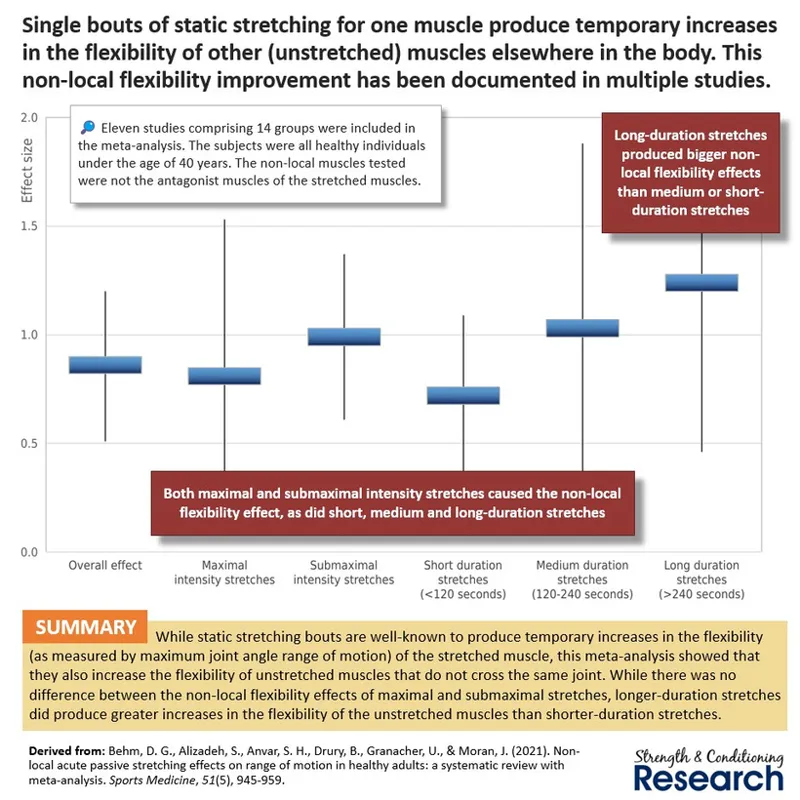
Static stretching causes not only immediate increases in the flexibility of the stretched muscle but also of other, unstretched muscles elsewhere in the body. This phenomenon is known as "non-local flexibility" and has been documented in multiple studies. The existence of non-local flexibility increases immediately post-stretch supports the hypothesis that the increases in flexibility observed after static stretching are caused by a reduction in stretch tolerance or the ability to tolerate the pain of stretching.
.
Building on this observation, researchers have found that temporarily manipulating pain sensitivity by using cold application to a completely different part of the body can instantly increase flexibility in a stretched muscle.
.
#2. How does flexibility increase after long-term stretching?
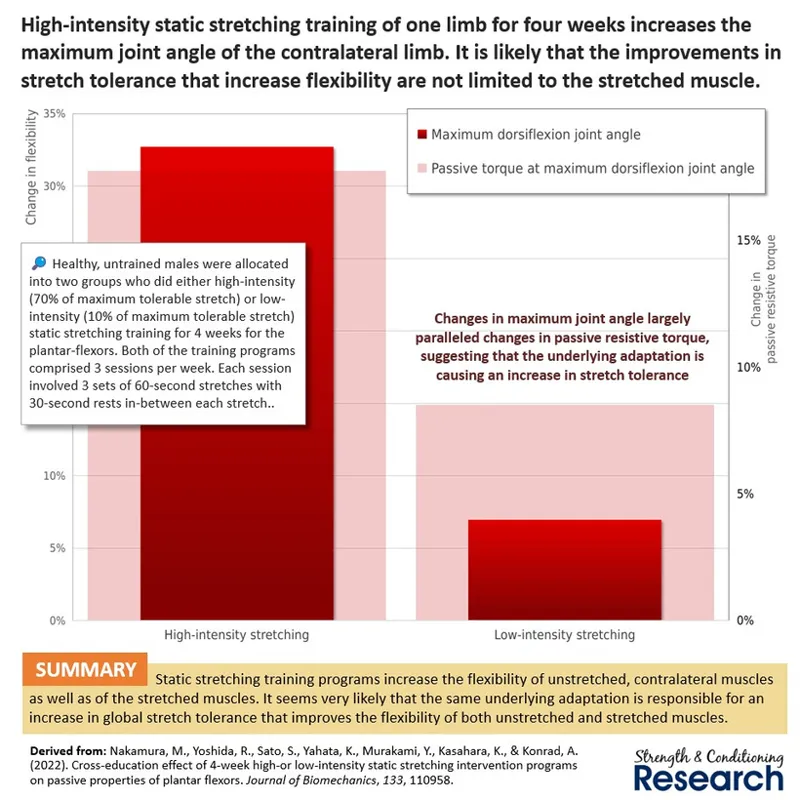
Long-term programs of static stretching also cause not only increases in the flexibility of the stretched muscle but also of other, unstretched muscles elsewhere in the body. Moreover, such increases in non-local flexibility are linked to increases in the passive resistive torque, which indicates that the improvement is due to increased stretch tolerance rather than any reduction in the stiffness of the muscle-tendon unit.
.
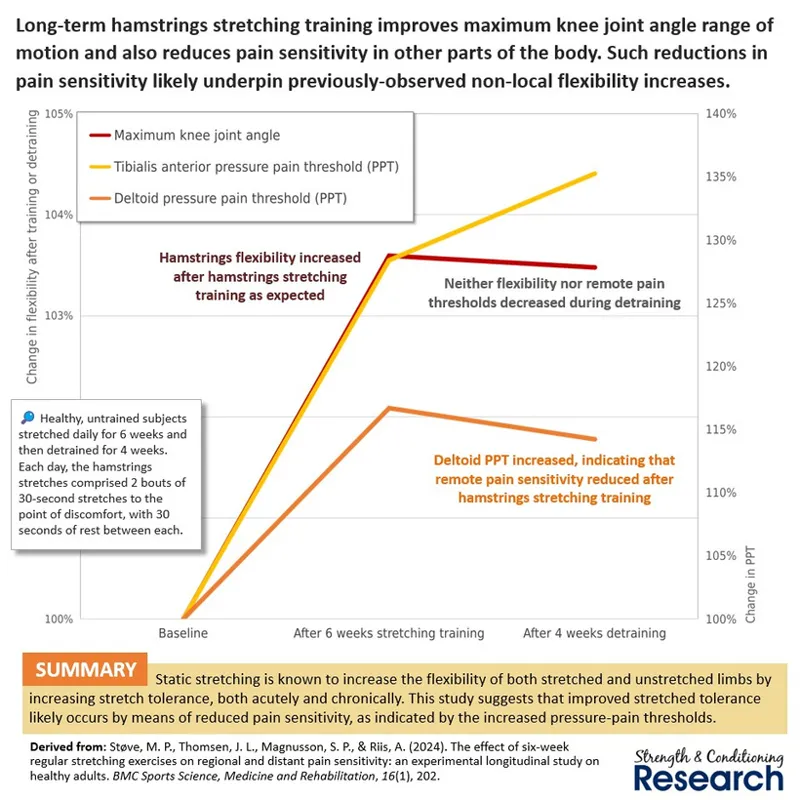
Building on this observation, researchers have found that long-term increases in the flexibility of a stretched muscle occur in tandem with reductions in pain sensitivity elsewhere in the body. Such global reductions in pain sensitivity likely underpin the increases in non-local flexibility reported elsewhere.
.
#3. How does flexibility decrease with decreasing stretch tolerance?
The detraining of flexibility after static stretching programs is not as rapid as the loss of many strength training-related adaptations and outcomes. Nevertheless, when tracked across a long-enough period of time and across enough studies, we can observe a detraining-induced loss of flexibility of the previously-stretched muscle.
.
Importantly, the loss of flexibility during detraining is linked to a similar loss in the amount of passive resistive torque that can be achieved at the maximum joint angle range of motion. This indicates that the reduced flexibility is caused by a loss of stretch tolerance and not by a change in the properties of the muscle-tendon unit.
.
Conclusions
Static stretching bouts can instantly increase flexibility of both the stretched limb and also of other, remote limbs (by means of a non-local effect). Similarly, long-term programs of static stretching can also increase flexibility of both the stretched limb and also of other, remote limbs (by means of a non-local effect). In all cases (both acutely and chronically and in both stretched and unstretched muscles), the improved flexibility is accompanied by an increase in passive resistive torque at maximum joint angle range of motion (ROM), indicating that the increased flexibility is due to improved stretch tolerance rather than any local, muscle-tendon changes. Even so, recent research suggests that this improved stretch tolerance is the result of internal processes that inhibit pain more generally. Indeed, when cold water is applied to a remote limb to reduce pain sensitivity globally, this instantly increases ROM of a stretched muscle, indicating that stretch and pain are treated similarly by the brain. Moreover, when long-term static stretching increases ROM of a joint, this is accompanied by reductions in pressure pain sensitivity of other parts of the body. All in all, it seems likely that increasing flexibility by static stretching relies upon increasing pain tolerance in more general terms.
Comments (2)
Really nicely sampled and put together. Thanks for that 🙏🏽! I have made a similar conclusion but from a combined scientific and mostly accumulated practical experience the last 30 years of practice. When we really need a combination of muscle/fascia/tendon/joint capsule etc to upgrade and alter towards more elongation ability/capacity, then static stretching (i.e. longer static holds) is more effective (than dynamic) and accumulates a substantial change over time (I often see this unfolding during one or two makro periods 4-8 weeks or longer of pin pointed stretch programs along several strength programs). To hinder and maintain the potential “loss of gains”, I also use added (and in latter parts of the periodization plan, maintaining) mobilization exercises (i.e. movement over several joins and in the motion) that integrate (stimulate the meaning of the allowed elongation) the increased “local” elongation allowance in a functional pattern. This, I think 🤔 , creates a combination of continuous stimuli/demand/maintenance and an obvious functional advantage for the organism to keep and build upon the gains. Thanks for the angle 📐 of the “increase in stretch tolerance” and “the increased in passive resistive torque at end ROM”, that alone gave me new inout and further thoughts 💭. Nice job putting this together 👍🏼 /Joakim D
In «#1. How does flexibility increase immediately post-stretch?", instead of "... are caused by a reduction in stretch tolerance or the ability to tolerate the pain of stretching.", I think it should say "... are caused by an increase in stretch tolerance or the ability to tolerate the pain of stretching." I apologize if I'm wrong.