


Growth does not happen during exercise
We commonly hear it stated that muscles do not grow in the gym but rather when we are resting at home. There is an interesting element of truth in this statement that is worth exploring.
.
#1. Muscle protein synthesis is suppressed during exercise
For decades, it has been known that muscle protein synthesis (MPS) rates are suppressed during exercise, especially in respect of the fast twitch muscle fibers that are most prone to hypertrophy. Generally, there is a fairly close correspondence between metabolic activity during exercise (including lactate production) and the suppression of MPS rates, which has given rise to various hypotheses that try to explain why and how hypertrophy is prevented from happening while muscle fibers are engaged in contractile activity. For example, some researchers suggested that reductions in energy availability detected by AMPK might be instrumental in switching off MPS.
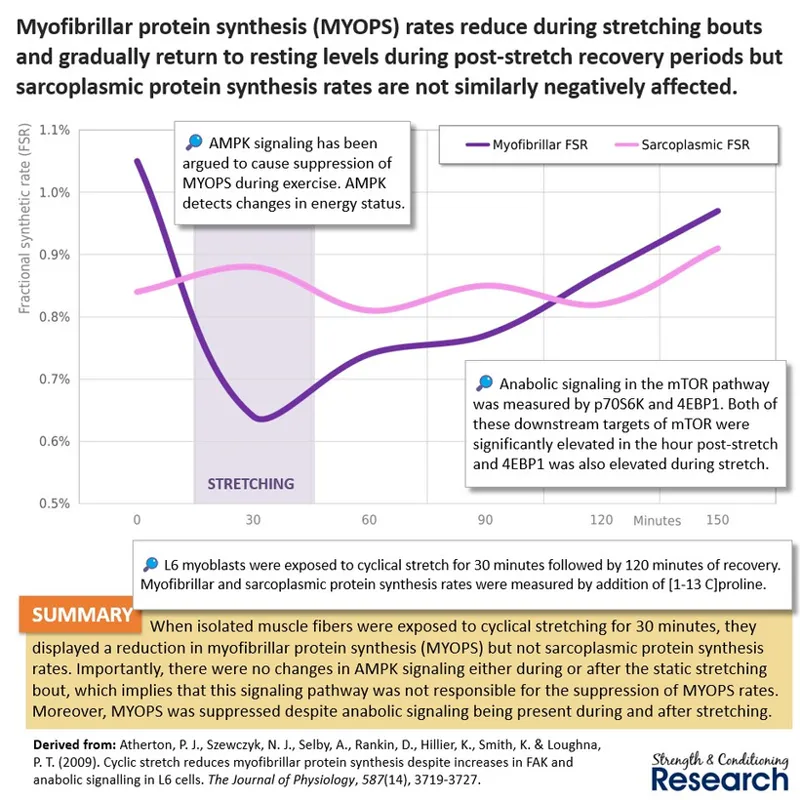
Nevertheless, such proposals did not make sense because MPS rates are also switched off during bouts of static stretching, which obviously does not involve any metabolic activity. Moreover, when AMPK is measured during a bout of static stretching, it does not change, which further confirms that the energy status of a muscle fiber does not affect MPS rates.
#2. Muscle protein synthesis is suppressed during exercise by calcium ion signaling
When the effects of exercise on MPS rates have been studied mechanistically, there have been some interesting discoveries. Most importantly, researchers have found that exercise transiently reduces MPS rates by means of the activity of eEF2 kinase, which is known to be controlled by calcium ion signaling. This ties together the effects of exercise and the effects of stretch, since both of these produce calcium ion accumulation, albeit through different channels.
Conclusions
We commonly hear it stated that muscles do not grow in the gym but rather when we are resting at home. There is an interesting element of truth in this statement that is worth exploring. Specifically, muscle protein synthesis (MPS) rates are suppressed during exercise (especially in fast twitch muscle fibers) and they are also suppressed during static stretching. Of course, once the exercise or static stretching bout is completed, MPS rates are subsequently elevated in order to process the muscular adaptations. Initially, it was proposed that the energy status of the muscle fiber would affect its MPS rate by means of AMPK signaling. However, stretching does not affect energy status or AMPK signaling and yet it still suppresses MPS rates. Some research has shown that when eEF2 kinase signaling inside muscle fibers is experimentally inhibited, this reduces but does not completely prevent the reduction in MPS rates during a bout of exercise. Since eEF2 kinase signaling is likely instigated by calcium ions, this provides an explanation for how both exercise and static stretching can similarly affect MPS rates. Exercise produces calcium ion influx through the sarcoplasmic reticulum, while stretching causes calcium ion influx through stretch-activated ion channels.