Paveway II Delivery Profiles - Introduction (1/25)
While many of you are likely proficient in employing Paveway II LGBs in DCS World, a deeper understanding of their attack profiles can significantly enhance your effectiveness. Let's explore the specificity of these profiles, trying to uncover details that will elevate your employment of this weapon, an essential element in conflicts such as those in Iraq and Afghanistan.
The set of all kneeboards detailed in these articles is available here; updates and future additions (buddy-lasing) will be accessible at the same place.
Let's first list all the possibilities that are offered to you:
1. High/Medium Altitude Delivery
These are the profiles that are the most commonly described in video tutorials, because they are easy to execute. They should be employed in a low to medium threat environment.
1.1 Level Delivery
Level delivery involves a horizontal approach to the target, maintaining a relatively constant altitude. This method can be employed from medium or high altitudes and offers a stable platform for weapon release.
It is often favored when standoff is desired, allowing the aircraft to remain at a safer distance from the target area. It also simplifies target acquisition and designation, as the aircraft's orientation provides a stable platform for laser targeting.
The most common PWY-II profile is high altitude level delivery.
1.2 Dive Delivery
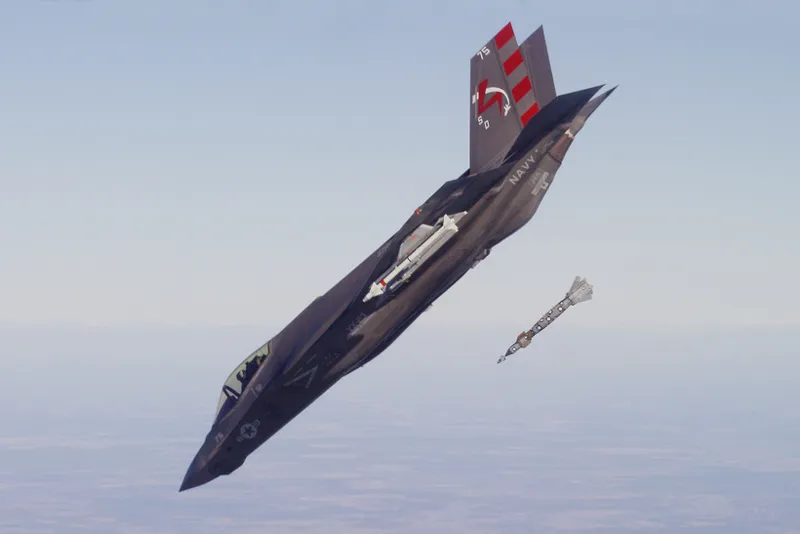
Dive delivery involves an initial level approach of the target area and the transition at a given distance to a steep dive towards the target. This method provides the weapon with additional energy. The time of flight is also shorter, which can be interesting when targeting a moving target.
F-35C Lightning II during a 45° PWY-II dive delivery. Source.
2. Low Altitude Delivery
Low-altitude delivery profiles are employed when operating in high-threat environments or when specific operational characteristics necessitate a low-level approach (e.g. weather). These profiles demand higher piloting skills and a thorough understanding of the weapon's capabilities.
2.1 - Loft Delivery
The loft delivery is a low-altitude tactic designed to extend the weapon's range and increase the aircraft's standoff distance from the target. The aircraft initially approaches the target at a low altitude to avoid detection and minimize exposure to threats. At a predetermined point, the pilot executes an abrupt pull-up, lofting the weapon towards the target. This lofted trajectory allows the weapon to cover a greater distance than in a direct low-level attack.
For LGB delivery, pure "loft" delivery (i.e. constant climb angle, 1G) is more common than "toss" (i.e. constant pull, 4 to 6 G), especially in self-lasing configuration, because target tracking is very difficult under heavy G load. Moreover, the bomb's time of flight will be shorter, making mask management during the escape turn easier.
The various toss delivery profiles
2.2 Pop-Up Delivery
The pop-up delivery is another common low-altitude tactic used to evade threats and achieve surprise. Similar to the loft delivery, the aircraft initially approaches the target at a low level. At a calculated distance, the aircraft performs a rapid ascent or "pop-up" maneuver. At apex, the aircraft reverse towards the target, and ends up in a dive similar to the medium/high altitude dive delivery, but at a much lower altitude.
The sudden pop-up can catch defenders off guard, providing a brief window of opportunity to engage the target before the aircraft is exposed to significant risk, but heavy maneuvering can make target tracking and acquisition difficult.
Example of pop-up attack trajectory.
Note: before engaging into a PWY-II pop-up profile, make sure that you master the attack parameters with dumb bombs: the LGB profile adds extra work-load in the cockpit before and after bomb release. It's certainly one of the most difficult attack profile to execute. You'll find several pop-up attack planers in ED's user files, like this one by Savvy-BVR.
3. Types of Target Designation
Effective employment of laser-guided munitions relies on accurate target designation. This can be achieved through two main methods, each with its own set of advantages and considerations.
3.1 Self Lasing
Self lasing refers to the capability of the attacking aircraft to designate the target with its own laser designator. The main benefit is that the aircraft operates independently, hence removing the difficulty of coordination between different actors. As a result, it's possible to respond more quickly to the operational environment.
The self lasing capability generally relies on additional external targeting pods, like the LITENING, the ATFLIR or the Sniper ATP in DCS World.
Buddy lasing involves the coordination of two or more actors, where one actor designates the target while another delivers the weapon.
This cooperative approach can offer enhanced accuracy, by separating the designation and delivery functions. For example, the designating aircraft can focus solely on maintaining a stable laser spot on the target, while the delivery aircraft can concentrate on weapon release parameters. It can also offer increased standoff, both for the LASER and the shooter.
One of the most commonly known buddy-lasing situation in DCS World is the use of the JTAC's lasing capability in CAS scenarios.
You should keep in mind that if buddy-lasing removes the difficulty or responsibility of bomb guidance, it nevertheless adds an additional level of complexity, by necessitating a greater coordination with external actors who might be in a very different environment (situational awareness, threat, communication capabilities, etc...), which can lead to an increased rate of failure of your attacks.
In conclusion, a comprehensive understanding of Paveway II delivery profiles and target designation methods is essential for maximizing the effectiveness of these laser-guided munitions. Careful consideration of the tactical situation, threat environment, and target characteristics will allow you to select the optimal delivery profile and designation technique, ensuring mission success while minimizing risks.
In the upcoming posts, I will try to provide an in-depth look at each of these delivery profiles, hoping that you'll want to try and explore them, and ultimately elevate your expertise in DCS World.
Again a very thorough article. Thank you for sharing. A while ago I did a lot of 2-ship LGB pop-up with the Hornet. I didn’t had the right parameters, so I use the one who Notso made for the F15E. Which worked but would love to get some parameters for the F18 as well.
G
Graveyard of Empires · March 18, 2025
Yes, I will make specific articles for buddy-lasing. But at the end of the series, I'll start with self-lasing profiles first.