Paveway II Delivery Profiles - Introduction to Buddy-Lasing (11/25)
As you're certainly aware, Laser-Guided Bombs (LGBs), such as those in the Paveway II family, are precision-guided munitions that require, depending on the variant, either partial or continuous laser designation from release to impact. While these weapons are typically employed with self-designation via a targeting pod, numerous tactical scenarios call for an alternative method: buddy-lasing.
Buddy lasing is the employment technique where one platform delivers the munition, while another, either airborne or ground-based, provides terminal laser guidance. This tactic becomes essential in situations where the shooter lacks a targeting system, has no line-of-sight to the target (due to distance, weather, or lack of situational awareness), or when coordinated multi-ship tactics are used to enhance survivability or flexibility.
"Buddy-lasing" as defined in ATP 1-02.2 (US) and APP-7 (NATO) Brevity.
Two primary forms of buddy lasing are employed in operational contexts:
Ground-based lasing, typically executed by Joint Terminal Attack Controllers (JTACs) or Special Operations Forces (SOF). It allows for precise terminal guidance, generally in support of Close Air Support (CAS), but also sometimes for other types of offensive missions.
Airborne buddy lasing, which can be conducted:
Within the same flight, where a wingman designates for the shooter.
Across flights, involving separate units such as FAC-A, ISR assets (like UAVs), or coordinated multi-flight packages.
In all cases, success depends on a solid understanding of geometry, timing, laser codes, and especially communication protocols. Improper attack heading, deconfliction failures, or timing errors can lead to a failed strike or worse, fratricide.
In this post, you will discover a real-world example of buddy lasing in combat: the first-ever GBU-12 release by a French Air Force Rafale in Afghanistan, April 2007. By examining the tactical context, execution, and analysis from this strike, you will get a glimpse of how buddy-lasing can fit into your mission profiles.
I. The Rafale Fighter Aircraft: Origins and Evolution to 2007
I.1 - Development
The Rafale program was initiated in the early 1980s, during the final decade of the Cold War. It was conceived as a response to the need for a modern, multirole fighter capable of replacing a diverse fleet of aging French Air Force and Navy aircraft. The design emphasis reflected the strategic environment of the time: high-intensity, force-on-force engagements against a near-peer adversary.
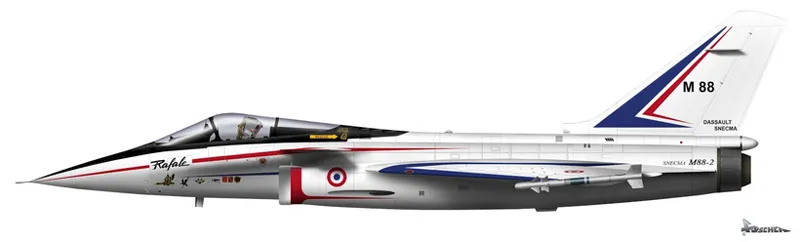
The Rafale A technology demonstrator first flew on July 4th, 1986, showcasing innovations such as a delta-canard configuration, fly-by-wire controls, and a high degree of agility. From the outset, Rafale was intended to be multirole.
Given this context, the aircraft was not originally designed for counter-insurgency operations like those that would characterize Afghanistan. Its precision strike capability was planned around GNSS-guided munitions, notably the AASM (Armement Air-Sol Modulaire), rather than laser-guided bombs. As such, a targeting pod (TGP) was not part of the initial system architecture. Instead, the onboard OSF (Optronique Secteur Frontal) sensor suite was expected to provide sufficient visual and infrared tracking capability for long-range identification and passive targeting.
Ultimately, the evolving nature of coalition operations in the early 2000s led to a shift in priorities. By the time the Rafale entered operational service with the French Air Force in June 2005, it was still an air-to-air only "F1" variant. The first upgraded "F2" aircraft incorporating air-to-ground capability will be received in 2006,. Full compatibility with targeting pods such as Damocles, enabling self laser-guided munitions employment, came even later.
Example of weapons load now available on the Rafale. In 2006, the AASM was not ready and a "crash program" was launched to enable the use of the GBU-12.
I.2 - First Operational Missions
Since French Navy urgently needed a replacement for its ageing Super Etendard aircraft, it was the first to receive the Rafale at the end of the year 2000. It rapidly entenered into service and was deployed for its first operational engagements began in 2001.
The Rafale M (naval variant) was deployed aboard the aircraft carrier Charles de Gaulle during Mission Héraclès in late 2001, in support of Operation Enduring Freedom over Afghanistan. Although the F1 standard Rafale was limited to air-to-air missions, its deployment validated its ability to operate in a combat theater. This included real-time alert postures and tactical integration with the carrier air group. It was a crucial milestone in proving the platform’s naval compatibility and reliability at sea.
Its first true operational deployment occurred during Operation Agapanthe, in 2006, aboard the aircraft carrier Charles de Gaulle. As part of this mission, the Carrier Air Group deployed to the Indian Ocean in support of Operation Enduring Freedom over Afghanistan.
While the Rafale M F1 still lacked air-to-ground capabilities, it played a crucial role in fleet air defense and tactical air superiority missions alongside the more mature Super Étendard Modernisé (SEM), which handled the precision strike component. Once again, Rafales provided combat air patrol (CAP), tactical air escort, and alert posture missions
II. Rafale in Combat - Operation Héraclès in Afghanistan (2007)
II.1 - The Deployment
In early 2007, France decided a significant expansion of its airpower contribution to NATO’s campaign in Afghanistan. Both the French Air Force and French Navy were preparing to deploy Rafale aircraft into theater, but this time in a real strike configuration.
This deployment followed years of parallel but separate development tracks within the two branches of the French armed forces, each pushing to bring the Rafale to combat maturity on its own timeline. It's only by mid-2006, once the Rafale F2 version was introduced, bringing an initial air-to-ground capacity, that a real deployment could be considered.
By late winter 2006–2007, both services were rapidly accelerating preparations to achieve the first employment of a Rafale in combat. A subtle but real interservice rivalry emerged, a race to see which component would be the first to deliver ordnance in an operational theater.
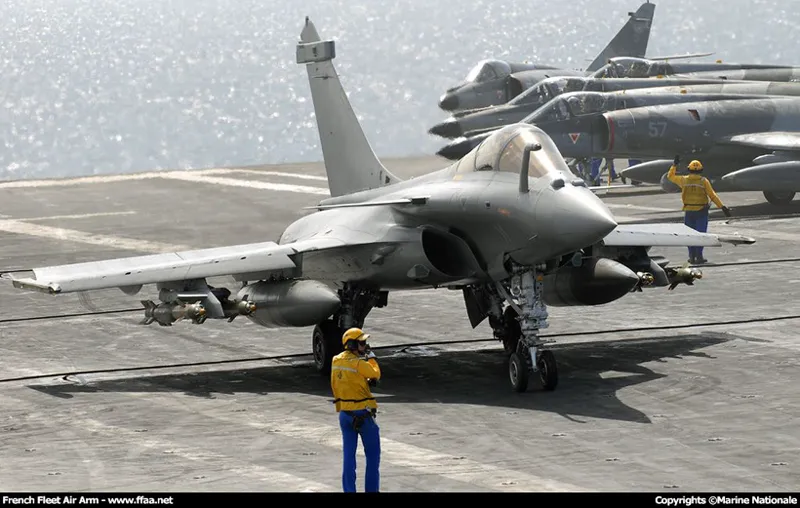
French Navy Rafale M equipped with 4 x GBU-12 in 2007.
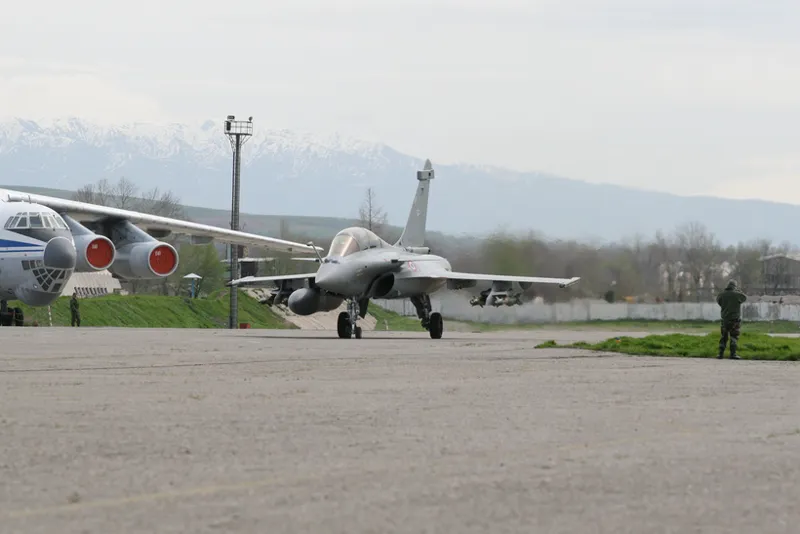
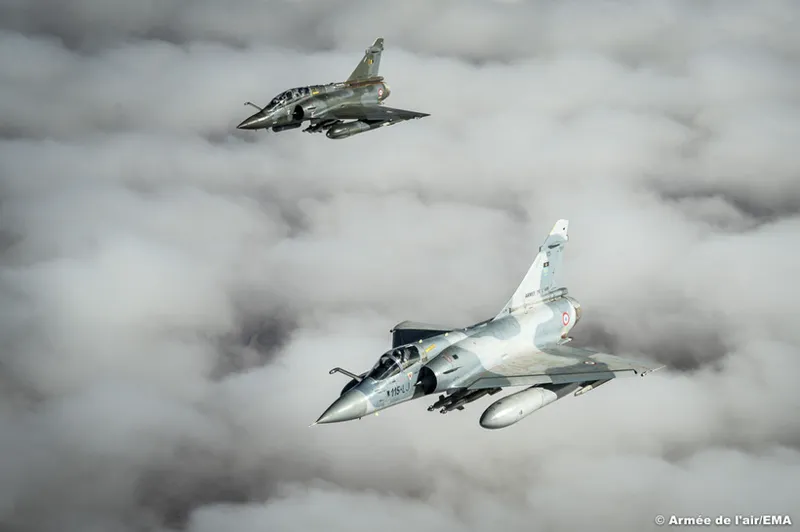
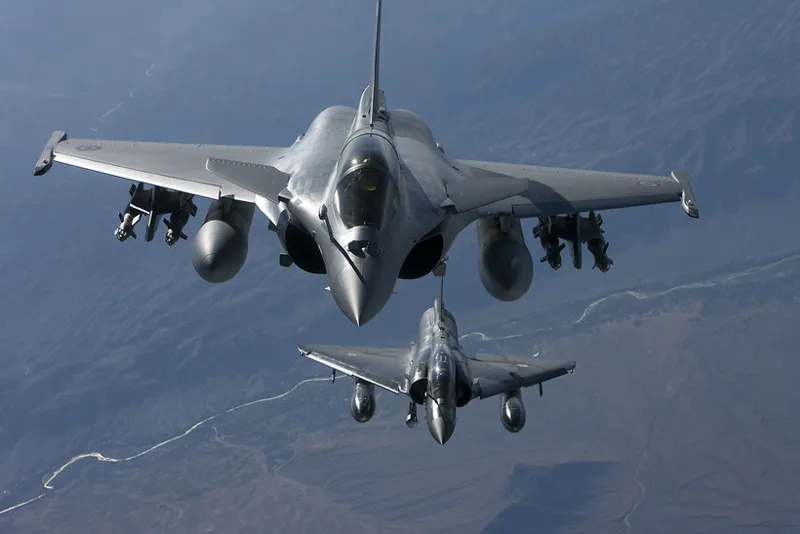
In March 2007, the French Air Force deployed a detachment of three Rafale B aircraft from EC 1/7 “Provence” to Dushanbe, Tajikistan. The deployment was notable for the speed with which it was organized. Crews had only recently qualified on GBU-12. The Rafales conducted day-only combat sorties accompanied by Mirage 2000D who would lead the missions. The Navy made a similar move, deploying the Rafale M in pairs with SEM (Super Etendard Marine).
French Air Force Rafale B taxiing at Dushambe in 2007.
II.2 - Combat Configuration
In early 2007, the Rafale B deployed to Afghanistan in a configuration that reflected both its early developmental stage and the tactical constraints of the theater. Although technically operating under the F2 standard, the aircraft's multirole potential was still limited by key capability gaps, especially in precision strike.
At the time of deployment, the Damocles targeting pod was still undergoing operational testing. As a result, the Rafale was unable to self-designate for laser-guided munitions. The aircraft carried two pairs of GBU-12 Paveway II bombs (mounted under each wing) and two external fuel tanks, but no targeting pod. This made it effectively a “bomb truck”, capable of delivering precision ordnance, but entirely dependent on external laser designation.
This doctrinally mirrored earlier configurations in the French Air Force:
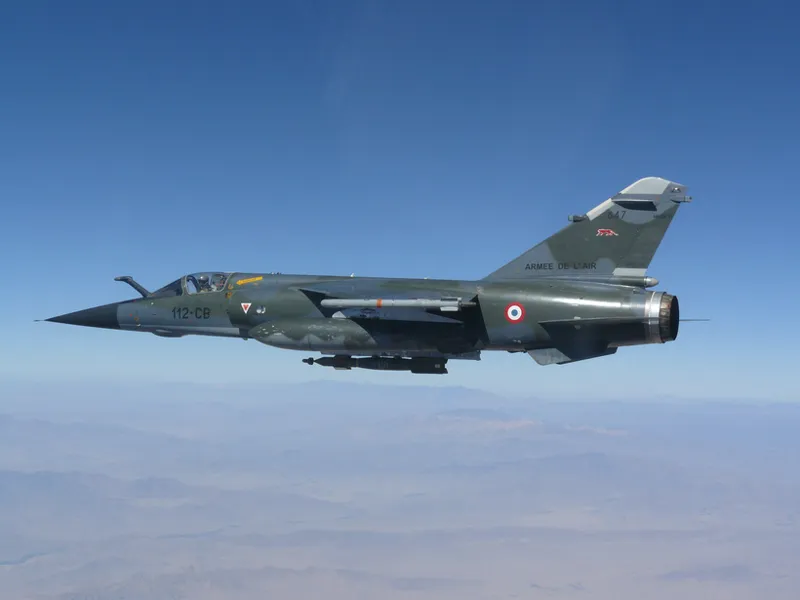
The Mirage F1 was unable to carry a pod but could still carry LGBs.
The same “bomb truck” principle would resurface later in Libya with the Mirage 2000N and again in the Sahel with Mirage 2000C aircraft during Operation Barkhane.
Mirage F1 CT carrying a GBU-12 over Afghanistan. This aircraft cannot carry a TGP.
Mirage 2000C carrying two GBU-12 over Sahel during Operation Barkhane. This aircraft cannot carry a TGP.
Mirage 2000N carrying two GBU-12 during Operation Harmattan. This aircraft cannot carry a TGP.
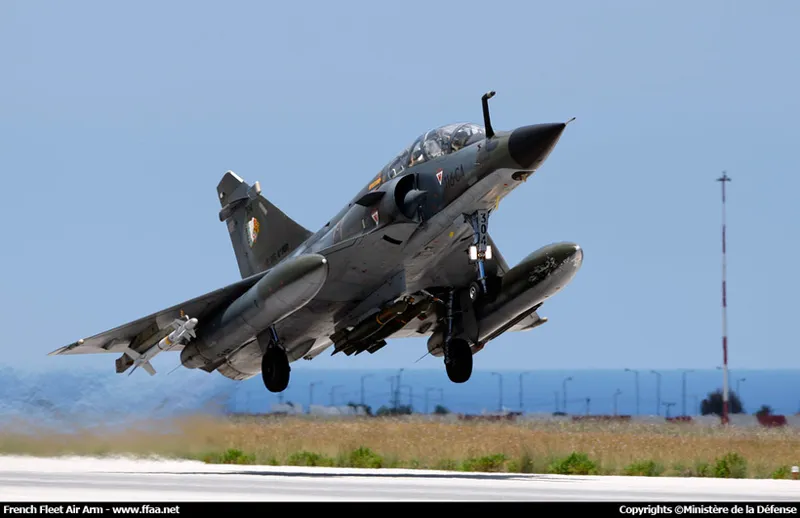
As a consequence, during the 2007 deployment, buddy-lasing was the only viable method for precision strike. For the Air Force Rafales in Tajikistan, this role was fulfilled by Mirage 2000D aircraft equipped with ATLIS II or PDL-CTS pods. For the Navy, the Super Étendard Modernisé (SEM) performed the designation for Rafale M aircraft operating from Charles de Gaulle.
Thanks to its TGP capacity, the Mirage 2000D was the lead aircraft during operations in Afghanistan in 2007.
The Rafale’s RBE2 radar provided a significant advantage in terms of airspace deconfliction and situational awareness, particularly in dense coalition airspace over southern Afghanistan. However, this was partially offset by major limitations in radio communication reliability. The aircraft suffered from antenna masking, especially during certain bank angles or attitudes. As a result, inter-flight communications were frequently unreliable, leading to situations where Rafale crews missed critical radio calls, or their own transmissions were not received by other players. This presented a non-negligible operational risk...
Another serious limitation was the lack of an integrated weapon system mode for GBU-12 employment. Unlike later iterations, the 2007 Rafale F2 had no automatic CCRP (Continuously Computed Release Point) mode for LGBs. Instead, GBU-12s had to be released manually, following pre-computed parameters based on abacuses, a legacy technique dating back to the Jaguar and Mirage F1 era. The pilot had to release the bomb in level flight at a predetermined range and speed, assuming the buddy laser was properly positioned and tracking, with no feedback loop from the munition or pod.
Example of ballistic calculator used to determine a manual release point.
Taken together, the 2007 Rafale configuration was a hybrid solution: a cutting-edge multirole platform employed under interim constraints, made combat-relevant by tactical improvisation and doctrinal adaptability...
As you’ve seen, buddy-lasing was not just a tactical option but a necessary procedure for the Rafale during its early deployments. Its inability to self-designate made coordination with laser-equipped platforms an essential part of every strike mission. In Part III, you will discover in detail the first operational release of a GBU-12 by a French Air Force Rafale, offering insight into how these procedures were executed in a real-world combat scenario!