Paveway II Delivery Profiles - Introduction to Buddy-Lasing (12/25)
First Rafale combat strike: a joint Mirage-Rafale buddy-lase mission in Afghanistan, blending precision, pressure, and first-time lessons!
As we’ve seen it on a previous post, by early 2007, the Rafale had entered the Afghan theater with limited strike autonomy but high expectations. Armed with GBU-12s and supported by experienced Mirage 2000D crews, the aircraft was ready to fight, but within strict tactical constraints. What follows is the live account of the first operational GBU-12 release by a French Air Force Rafale.
III. The First Strike: The April 1, 2007 Mission
III.1 - Ground Situation
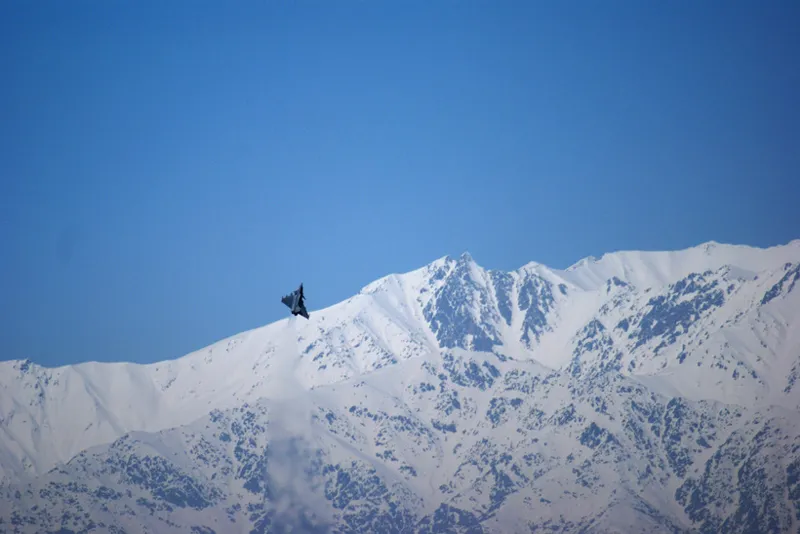
The events of April 1st, 2007, took place in one of Afghanistan’s most volatile corridors: the Chow Kay (or Chawkay) Valley in Kunar Province, a region bordering Pakistan, known for its mountainous terrain and persistent insurgent activity. The area formed a well-known infiltration route for anti-coalition forces, often using the natural cover of caves and ridgelines to stage ambushes and move undetected.
Chawkay Valley is perpendicular to Kunar Valley, close to the Pakistani border.
Thanks to Wikileak's War Diaries, we can easily understand the sequence of events.
Mission report of the involved ground forces.
At 08:10 Zulu (12:40 Local), Task Force Chosin, part of the U.S. Army’s 10th Mountain Division, came under small arms fire approximately seven kilometers northwest of Fire Base Fortress. The initial contact involved an enemy force of unknown size, engaging friendly elements with automatic fire from elevated terrain. TF Chosin responded with both direct small arms fire and indirect fire (IDF) onto the suspected enemy positions.
As the engagement escalated, reports of rocket-propelled grenades (RPGs) and continued small arms fire indicated a well-positioned and mobile enemy force. Notably, at 11:31 Zulu, TF Chosin positively identified several enemy fighters entering a cave located on the northern face of a mountainside. This observation marked a shift in the tactical picture: the fight was no longer limited to dispersed skirmishing, since it now centered around a single stronghold.
At this point, a decision was made to strike the cave itself with CAS assets already working overhead, and at 11:31Z, under JTAC control and after positive identification of the target, the cave was engaged using three GBU-12 laser-guided bombs. Despite efforts by to conduct a battle damage assessment (BDA), the difficult terrain prevented immediate access. However, ISR assets and subsequent ground reports indicated a probable cave collapse—suggesting a successful strike.
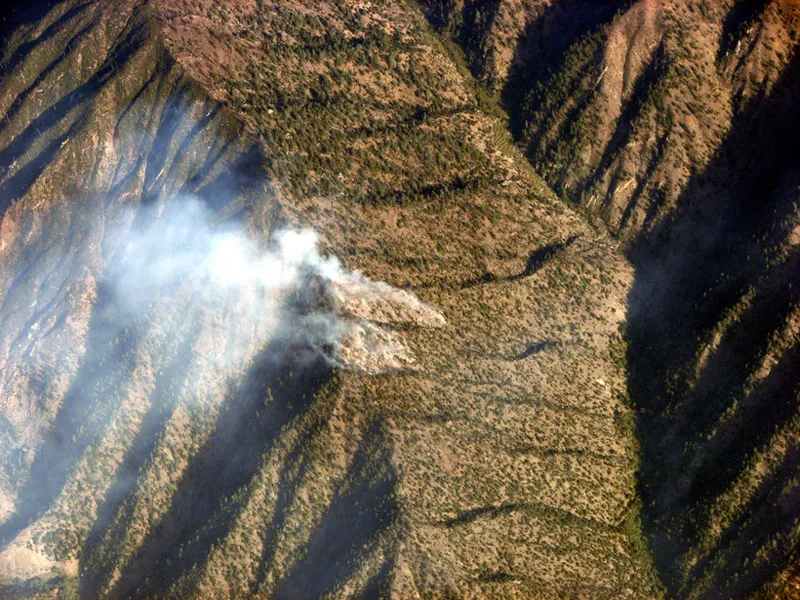
The cave was located on the mountain side, a few hundred meters above the main road in the Chawkay Valley.
III. The Aircrew Perspective
That morning, Simca 31, a mixed two-ship of one Mirage 2000D and one Rafale B, took off from Dushanbe, Tajikistan at approximately 06:30Z. The pair had been assigned a pre-planned Close Air Support (CAS) tasking in coordination with Venom 42, a U.S. JTAC team operating in eastern Afghanistan, within grids 91/92CT (cf. the CGRS grid article).
location of grids 91/92CT.
Their mission was to conduct armed overwatch in a mountainous region east of Assadâbâd. The initial flight plan took them south, to PINAX, the IFR waypoint that marked the entrance in the Afghan AO (Area of Operation). Shortly after, around 07:00Z, they executed a first refueling before reaching out with their JTAC.
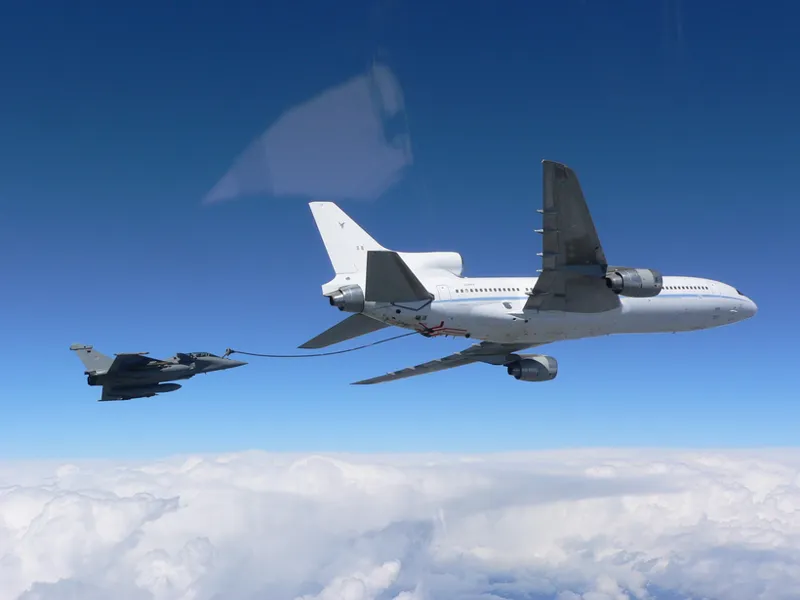
A RAF Tristar refuelling a Rafale B over Afghanistan in 2007.
The crew’s first task was overwatch a small village for human activity or vehicle movement, then patrol the Shuryak valley, and later observe the stretch of road running from Asadabad to Korenghal, looking for jingle trucks along a known insurgent supply route. But early on, the mission was hindered by persistent cloud cover, which made optical detection difficult and limited pod effectiveness. No suspicious activity was detected during this early phase.
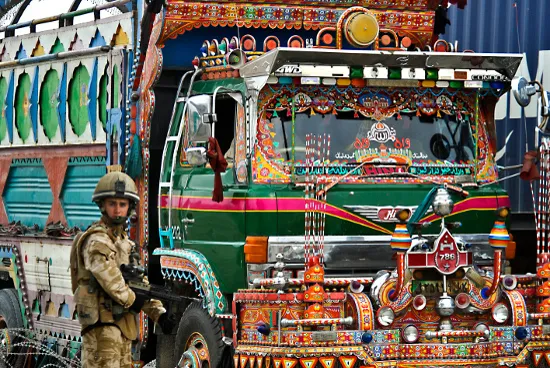
The jingle truck is a typical Afghan or Pakistani truck.
Around 08:30Z, as scheduled, Simca 31 conducted a mid-mission aerial refueling, extending their loiter time for another hour. Upon returning to station shortly thereafter, the mission dynamic shifted abruptly: Venom 42 radioed that their ground element, part of TF Chosin, was now receiving small arms fire in the southern part of a valley. The JTAC requested aerial surveillance of the ridgelines and surrounding mountain flanks.
Indirect fire (IDF) were already being directed onto the general enemy location. These artillery strikes were deconflicted with air assets by remaining west of a given grid line (i.e. an MGRS coordinate), and the impact of rounds confirmed visually by the Mirage’s targeting pod. This was a key moment: the aircrew now had visual correlation with ground intent. The JTAC asked the flight to extend observation beyond that area, across nearby mountain flanks, scattered houses, and eventually the crest line of the ridge.
Example of artillery marking a point of interest with white phosphorus rounds (a.k.a. WP or "Willie Pete").
At that point, with no follow-on air support scheduled, Venom 42 requested an extension of Simca 31’s playtime. It was coordinated directly with "Trinity" (the ASOC) via "Trumpcard" (the CRC). The aircrew, calculating fuel reserves, responded they could remain on station until 10:30Z, later updating that to 11:00Z after post-AAR review.
In the final minutes on station, with fuel running low, the JTAC transmitted precise coordinates for the cave. Using the Mirage 2000D’s ATLIS pod, the crew confirmed visual acquisition: a distinctive star-shaped entrance nestled against the rock face. Two mortar impacts were observed striking just outside the cave mouth, visually and via the targeting pod, providing final confirmation of the target.
The cave entrance as seen in the TGP. The very specific star shape was used to confirm the target's identification with the JTAC.
Now approaching Bingo fuel, Simca 31 advised the JTAC that any strike decision had to be made immediately. The Mirage crew explained that authorizing weapons release at this point would force the flight to divert from base due to fuel constraints. After a tense five-minute wait, the JTAC passed a 9-line CAS briefing. The target was cleared: the cave entrance sheltering enemy fighters.
The target met all the ideal conditions for a buddy-lasing strike by the Rafale: it was a stationary objective, precisely geolocated, and isolated from any structures that might raise collateral damage concerns. With the Mirage 2000D designating the cave entrance using its laser pod, the Rafale B released its first GBU-12, scoring a direct hit as confirmed by Venom 42 on the ground. However, despite the successful strike, the JTAC immediately requested a re-attack to ensure full target neutralization.
Now low on fuel, the Rafale was forced to return to base without delay. The Mirage 2000D remained alone on station and prepared for a second strike run. As it maneuvered into position, a two-ship of F-15Es, recently re-tasked, began checking in with Venom 42. Unaware that a live strike was already underway, the newcomers occupied the radio net, disrupting the mandatory clearance and coordination between the Mirage and JTAC. Despite this last-minute complication, the Mirage crew managed to complete the strike, delivering a second GBU-12 into the target. Minutes later, the F-15Es, now fully briefed, added a third GBU-12, bringing the total to three bombs on the cave entrance, all observed to impact successfully.
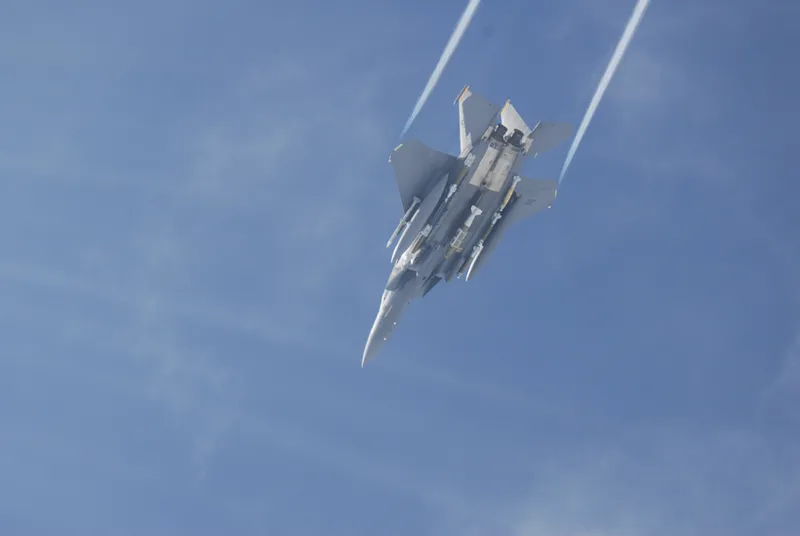
An F-15E showing off its standard A/G load for CAS in Afghanistan: a mix of PWII and JDAMs, with a Sniper TGP and a LANTIRN pod.
With their extended playtime exhausted and no tanker available, Simca 31 began the transit out of the area. Returning to Dushanbe was no longer viable due to fuel constraints, and the flight diverted to Kabul, where a permanent French detachment could provide logistical support. Despite the heavy coalition presence at Bagram, Kabul International was the more practical option, ensuring both crew and aircraft could be recovered without delay.
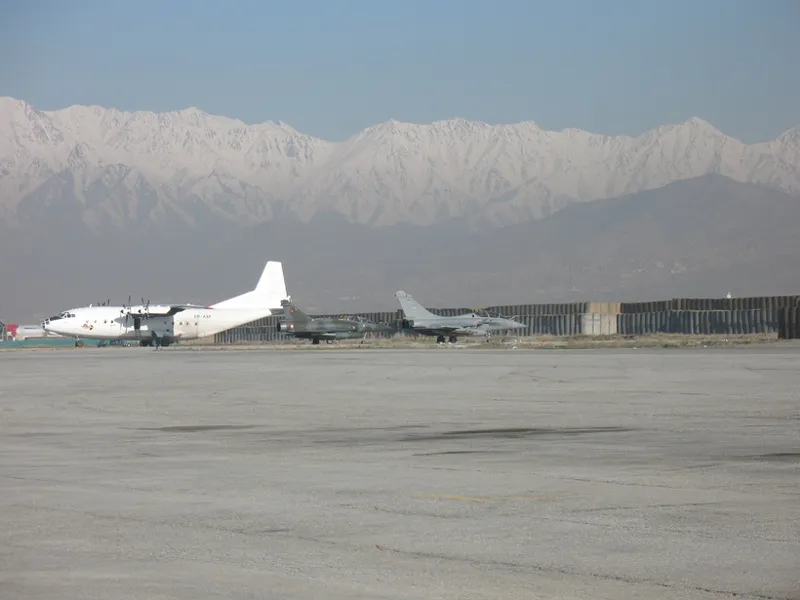
Simca 31 parked at Kabul, a few hours before returning to Dushambe.
As you may have realized by now, this was far from just another mission. For the French Air Force, it marked an important milestone: the first operational air-to-ground weapon release by a Rafale in combat. What began as a routine overwatch sortie evolved into a live precision strike. Despite lacking targeting pod, the Rafale’s GBU-12 release was made possible thanks to buddy-lasing with the Mirage 2000D. It was a mission that tested emerging capabilities under real conditions, and proved them.
III.3 - Tactical Analysis of the Buddy-Lasing Profile
Mission Workflow and Execution
The buddy-lase strike was built on precise timing and clear crew coordination between the Rafale and Mirage 2000D. Despite its ultimate success, this first-ever operational execution of the tactic exposed some tactical gaps, mostly stemming from unfamiliarity, time pressure, and terrain misjudgment.
Once the 9-line was transmitted by the JTAC, the Rafale crew entered the coordinates into its weapon system. The Mirage and Rafale crews then confirmed the location visually and cross-checked it against the coordinates to prevent any discrepancy between the two aircraft. With the Rafale lacking a targeting pod at the time, it relied entirely on the Mirage for laser designation.
The Rafale computed its release parameters using abacus, taking into account the target’s elevation, and its own planned release airspeed and altitude. The Mirage’s system, in contrast, had built-in release calculations, allowing it to monitor the strike in parallel and verify the Rafale’s parameters.
Then the strike sequence unfolded as follows:
Rafale called “In hot” to the JTAC, who authorized the attack with a "Cleared hot";
Mirage 2000D called “Captured” once the target was acquired in the pod;
Rafale called “Bomb’s away” both to the JTAC and the Mirage;
Mirage confirmed “Lasing” when itiating guidance;
Rafale egressed aggressively to the right; the Mirage peeled softly left at around 30° angle of bank, maintaining line-of-sight for laser designation.
"Captured" as defined in NATO's APP-7.
This flow, while well-drilled, was challenged by the formation setup and terrain orientation.
Formation and Geometry Challenges
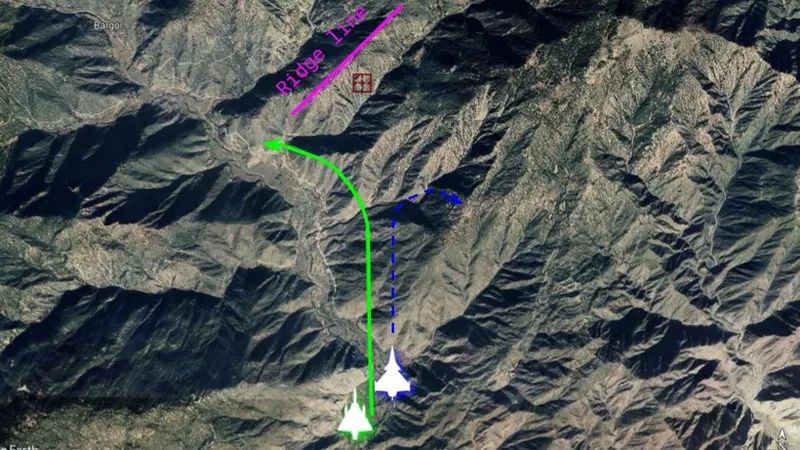
The chosen formation was a fighting wing, with the Mirage positioned about 0.5 NM left and slightly above the Rafale. This had key advantages: the Mirage crew could visually confirm the Rafale's position, monitor the moment of weapon release even in case of comm failures (common at the time), and double-check the computed release point.
The chosen attack formation.
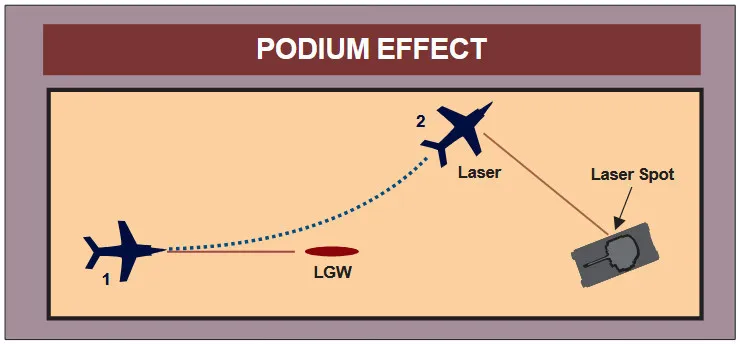
However, this formation was suboptimal for laser geometry, given the nature of the target—a vertical cave entrance cut into a mountainside. Since the cave could only be illuminated effectively from the front, flying on the wrong side of its 3/9 line meant the risk of laser masking (the so-called “podium effect").
This is exactly the risk the Mirage encountered. During its gentle left-hand egress, the designator aircraft flew very close to the target’s 3/9 line. At the end of the attack, the laser was fired from a narrow angle, very close to the edge of effective reflection, and nearly resulted in loss of guidance.
A more tactically sound setup would have been to position the Mirage in trail, about 1 NM behind the Rafale. That geometry would have preserved visibility while maintaining a broader lasing angle. Even a 2 NM trail would have been possible, provided that the Rafale executed a sharp and visible turn on egress to cue the moment of weapon release in case of degraded radios.
A trail formation would have increased the margins, giving less chances of flying behind the target's 3/9 line.
Egress and Heading Considerations
Another limitation stemmed from the choice of egress side. Left-hand egress was doctrinally preferred for the Mirage due to the right-mounted targeting pod, thus giving the pod better clearance. But in this case, the attack heading was northbound (360°), and the mountain ridge ran roughly 040°/220°, meaning the left-hand egress placed the pod near the wrong side of the vertical target.
The TGP is located on the right side of the Mirage 2000D.
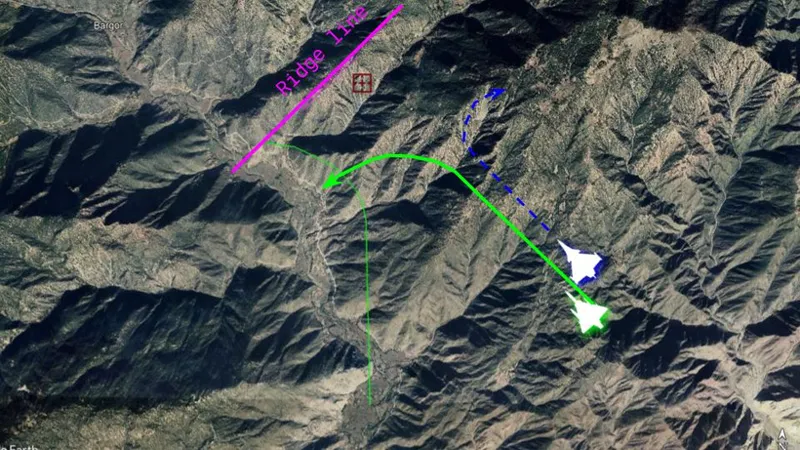
A better option would have been to request a different attack heading, such as 310°, or to conduct a right-hand egress, which would have aligned better with the cave’s orientation and minimized terrain masking.
Right-hand egress would have increased margins.
A different attack heading would also have increased margins.
Analysis and Takeaways
Ultimately, the mission was successful, since the bomb hit the cave entrance precisely and was followed by a second successful strike from the Mirage. But that success was fragile. The lasing geometry was far from optimal, and failure was only narrowly avoided.
The main factors behind this flawed geometry were:
The novelty of the tactic, since this was the first operational buddy-lase strike for the Rafale, and the Mirage crew had never practiced the scenario in training;
Time pressure, due to fuel constraints and a limited playtime extension;
A strong emphasis on giving priority to the Rafale’s first combat weapon release, with limited tactical flexibility allowed.
Despite those constraints, alternate solutions existed, like trail formation, better heading selection, or alternative egress direction. Any of those could have significantly improved the lasing geometry and reduced risk.
In the end, the mission set a milestone, but it also serves as a case study in tactical improvisation, showing that operational firsts often come with invisible friction. This buddy-lase worked, but as usual a deeper debrief shows how to do it better next time...
Conclusion
This operational buddy-lase strike offered a clear demonstration of the method’s potential, as well as its demands. The geometry of the pass, far from a simple formation choice, is the decisive tactical factor. Selecting the optimal approach and egress based on terrain, target orientation, and laser line-of-sight is not optional: it's what makes the difference between a hit and a miss. Understanding the trade-offs of each option (visibility, masking risk, bomb fall line, laser angle, etc...) is critical.
Equally important was the communication flow between the shooter and the designator. Even with well-rehearsed comms calls, degraded radios and unfamiliar profiles introduce friction. Synchronizing the release and laser cue, especially when one crew has no visual on the target, is what turns a technical possibility into a tactical success.
As for the crews, the story didn’t end over the target. Low on fuel and unable to return to Dushanbe, both aircraft safely diverted to Kabul. However, because each jet now carried a dissimilar configuration (one GBU-12 missing per aircraft), they were temporarily stranded... According to operational regulations, they could not take off in this state.
The missing bomb on the Rafale's wing: it was now in a dissimilar configuration, that was not allowed for take-off.
Support came quickly. A mechanical team from Dushanbe, deployed by a C-160 crew, came and transfered a GBU-12 from the Mirage to the Rafale, restoring a symmetrical configuration. Thanks to the responsiveness and skill of both the aircraft technicians and weapon specialists (PÉTAF), the operation was completed by the next morning. By early afternoon, both jets were airborne again, and flew another combat mission before sunset.
The Rafale taking-off from Kabul, on its way to home plate at Dushambe.
In our next posts, you will be introduced with ground and airborne buddy-lasing profiles. Stay tuned!