Who’s in Charge? Air C2 and Close Air Support in Afghanistan (1/3)
Over the past few months, many of you have asked me variations of the same question: “Between aircrew, C2, and JTAC—who’s doing what during a CAS mission?”
It’s a fair question—and not an easy one to answer.
In counterinsurgency (COIN) warfare like in Afghanistan, Close Air Support isn’t just about firepower—it’s about timing and coordination. When air assets are limited, the challenge is assigning the right aircraft, in the right place, at exactly the right moment. And yet, for most civilians (and sim pilots), the command structure behind a single strike can seem like an invisible maze of acronyms and radio calls.
The following articles have been written to try to break that system down, using real-world doctrine, war stories from Afghanistan, and lessons from the field. Whether you’re flying a CAS mission in DCS, building a scenario, or just want to understand how modern warfare really works—this is for you.
1 . The Invisible Backbone of Close Air Support
Imagine this: a U.S. Army unit is pinned down in a narrow Afghan valley. Gunfire is coming from the ridgelines. A soldier picks up the radio: “Troops in contact—we need air support now!”.
A few minutes later, the familiar sound of jet engines echoes in the sky. An A-10 Thunderbolt II appears, ready to engage the enemy. But how did that aircraft get there? Who decided it was the right one to send? And who made sure it wouldn't hit friendly forces?
A-10s seen at Kandahar in November 2009.
The answer lies in the C2 (Command and Control) structure. It's the invisible system that connects aircrews, ground troops, and coordination centers.
In Operation Enduring Freedom (OEF), airpower played a major role in protecting ground forces. But especially in complex counterinsurgency operations, air support only works when it’s part of a well-organized chain of communication and decisions.
One of the clearest examples of this came during Operation Anaconda in March 2002. Dozens of aircraft were in the air: A-10s, F-15Es, helicopters, drones, and others. But something critical was missing—there was no Air Support Operations Center (ASOC) on the ground to manage them.
As a result, aircraft sometimes checked in over the target with no idea who else was there or what to do. Radio frequencies weren’t shared. There was no airspace plan. One A-10 pilot explained for example that he had once to take control of the situation himself. He started directing other aircraft in the air—acting as an airborne FAC, even though that wasn’t his task.
"Capt. Scott Campbell and his wingman found themselves in the Shahikot Valley with no airspace plan, no check-in order, no established communications frequencies, and no coordinated deconfliction procedures. They had to assume the role of forward air controllers (airborne) to prevent midair collisions and manage the fight." — Capt. Seth Spidahl, “The Once and Future ASOC”
That mission came close to disaster. But it also showed how important air C2 really is—and it pushed the military to fix the system.
Because in a real CAS mission, someone needs to:
Control who is in the airspace.
Match the right aircraft to the right JTAC on the ground.
Make quick decisions when multiple units call for help at once.
2. Key Players and Acronyms (Who’s Doing What?)
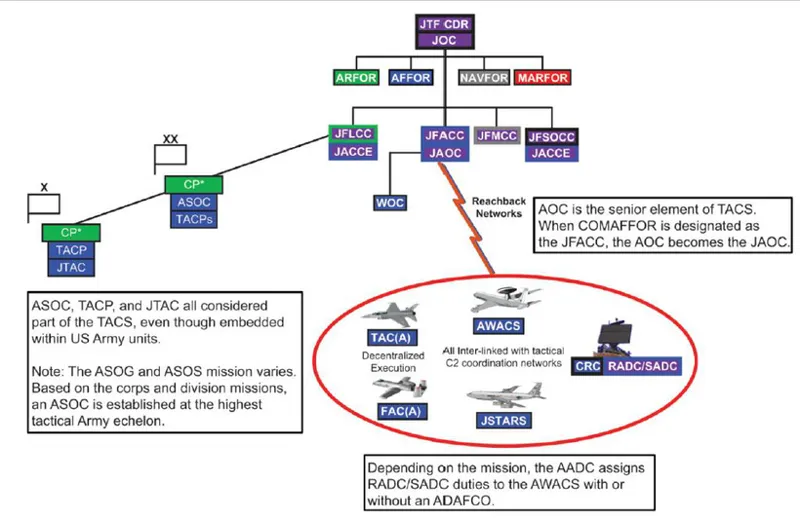
To understand how a CAS mission really works, we need to start with the people and organizations involved. Each one plays a specific role in planning, controlling, or executing air support. Here’s a breakdown of the key players—whether they’re on the ground, in the air, or managing the big picture behind the scenes.
You may already be familiar with the JTAC, since this role can be simulated in DCS World.
The JTAC is the person on the ground who talks directly to aircraft and gives the final clearance to release weapons—what is called “cleared hot.”
They can be embedded with infantry units, but also sometimes operate from fortified positions like forward operating bases (FOBs).
They provide target information, confirm that friendlies are clear, and use the 9-line format to request strikes.
JTACs are often part of the TACP (Tactical Air Control Party).
Think of the JTAC as the tip of the spear in the air support chain.
USAF JTAC in Afghanistan during OEF.
TOC – Tactical Operations Center
The TOC is the command post for a battalion, brigade, or higher Army unit. It’s the place where officers and staff coordinate the ground fight and track the battlefield picture.
JTACs often work inside or just outside the TOC, especially when not embedded directly with front-line units.
The TOC also handles fire support, logistics, and ground maneuver coordination.
It communicates with the ASOC to pass CAS requests and receive updates.
The TOC doesn't manage aircraft directly—but it's where air support requests often begin.
Inside the TOC of US Army's 3rd Brigade Combat Team based at FOB Lightning in Afghanistan.
ASOC – Air Support Operations Center
The ASOC is a tactical-level C2 node located with the senior Army headquarters—typically a corps or division—to coordinate air support with ground commanders.
In Afghanistan, the ASOC was located in Kabul, working alongside the Combined Joint Task Force (CJTF) headquarters to manage all CAS missions across the country.
It receives requests from JTACs (usually relayed through TOCs).
It matches those requests with available aircraft and prioritizes them when there are too many calls for support at the same time.
It communicates constantly with the CAOC, which runs the overall air war.
This is where Fighter Duty Officers (FDOs) work—Air Force personnel who juggle real-time requests, track playtime, fuel, weapons loadouts, and decide who gets what air support.
CRC – Control and Reporting Center
The CRC is a ground-based radar and air battle management center. It tracks and helps control all aircraft in its area of responsibility.
It uses radar and radios to manage airspace safety and deconfliction.
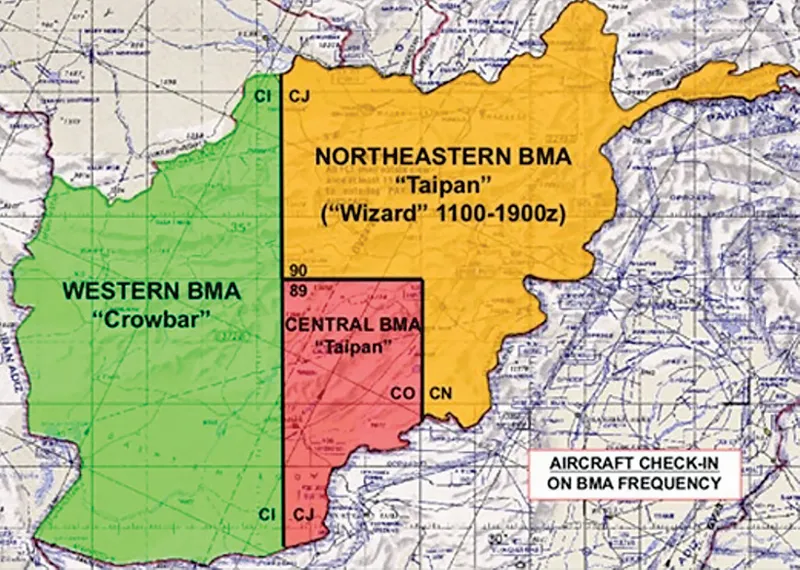
In OEF, there were multiple CRCs, for example:
Crowbar (RAF) – western Afghanistan
Taipan (RAAF) – central and eastern Afghanistan
CRCs often worked in coordination with AWACS aircraft or controlled the airspace alone when no AWACS was available.
They’re the ones making sure aircraft don’t run into each other, and they're the one who can pass real time tasking information from ASOC to aircrew.
The AWACS (like the E-3 Sentry, callsign Wizard) is essentially a flying CRC.
It provides long-range radar coverage and radio relay, especially over remote terrain.
It can help direct aircraft, stack them over killboxes, and pass them to JTACs.
When AWACS was not on station, the CRCs handled air control 24/7.
AWACS is especially useful when ground-based coverage is limited or during very complex CAS missions with multiple aircraft.
USAF AWACS over Afghanistan in 2021.
Aircrews – Fighter Jets, Helicopters, and UAVs
These are the people flying the missions—strike fighters, attack helicopters, drones, and ISR platforms.
Before beginning their mission, they check in with the CRC or AWACS, and then get passed to the JTAC (sometimes via the TOC).
Some aircraft (like the A-10) are trained to perform FAC(A) roles—helping coordinate CAS when JTACs are overwhelmed or unavailable.
CAOC – Combined Air Operations Center
The CAOC is the strategic-level headquarters that runs the overall air war.
It is responsible for producing the Air Tasking Order (ATO)—which says who flies where, with what weapons, and when.
It also creates the Airspace Control Order (ACO) to organize the airspace.
Located at Al Udeid Air Base in Qatar, the CAOC worked hand-in-hand with the ASOC in Kabul to manage all air missions over Afghanistan.
The CAOC plans the missions. The ASOC and CRC/AWACS execute them in real time.
inside view of the famous CAOC in Al Udeid, Qatar. It was in charge of all air operations in CENTCOM AOR.
Conclusion
Now that you’ve met the key players—JTACs, TOCs, ASOCs, CRCs, AWACS, and aircrews—you’ve got a clearer picture of who’s involved in a CAS mission, and what each one does.
But understanding the cast is only the beginning. The real challenge lies in how these actors work together when the pressure is on—when troops are in contact, when radios are busy, and when there’s only one flight of jets for five urgent requests.
We'll try to cover it next: into the real-world process of Close Air Support, starting on the ground with the JTAC and TOC. We’ll see how requests are made, approved, and passed along—step by step—until the aircraft is overhead. And we'll see the same from the opposite perspective in the air.