Paveway II Delivery Profiles: Dive Bombing - Geometry (5/25)
After reviewing the classical level delivery profile, we now move to a more challenging technique: dive bombing.
We can define dive bombing as an attack technique in which the aircraft descends at a steep angle toward its target before releasing a bomb, typically between 30° and 45° of dive angle for modern fighters. While dive bombing was widely used before the advent of precision-guided munitions, it remains highly effective with Paveway II and is the preferred profile in certain situations, which we will explore later.
Within the framework of dive bombing, we can make a distinction between direct dive and dive-toss, that are two different bomb release methods.
Direct Dive bombing (or simply "dive" ): the aircraft descends at a constant angle and releases the bomb while still in the dive. In general, it's associated with older aircraft with no or rudimentary bombing computer and using depression pipers, or some instances of CCIP bomb release.
Dive-toss bombing: the aircraft begins in a dive, makes (or confirms) target designation, then pulls up sharply before releasing the bomb, imparting additional upward velocity to extend the bomb’s trajectory. This method slightly increases stand-off distance, but more importantly increases the separation speed between the shooter and the weapon. This method is associated with more modern aircraft, since it's a CCRP release mode.
Geometry of Dive Bombing
In dive bombing profiles, the pilot will primarily choose a dive angle, often driven by the aircraft or the weapon system's performance, and a starting height above target. Once these two parameters have been defined, it's possible to determine with basic geometry the precise point/distance at which the dive must be initiated.
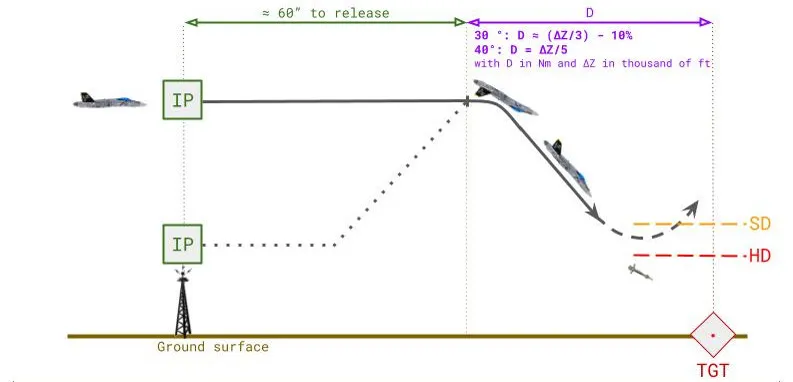
Geometry of a dive bombing: the desired dive angle and starting altitude will determine the distance to start the dive.
The only difficulty here is that the units used in aeronautics are not the SI units, and they must be transformed in order to make the calculation meaningful.
Using basic geometry, we derive the formula to calculate the dive distance (D) in Nm depending on the height above target (Z) in thousand of feet: D = 0.165 * Z / tan (γ), where γ is the desired dive angle (generally in degrees).
It's now possible to build a table, giving us all the dive distances for any dive angle and height. With the following table, you see that if you want to reach a 45° dive starting from 15.000' above target, you need to start the dive at 2,5 Nm.
Table of horizontal starting distances to reach desired dive angle from a given height above target.
Notes:
If you are doing a pre-planned attack, it is recommended to precisely determine your starting point before the flight. You can choose any set of dive angle and starting altitude.
If you are in a more dynamic scenario (like CAS), you will often have limited choice of attack parameters. For example, your starting altitude will be given by the JTAC for deconfliction purposes, and you discover it last minute. In that case, it is recommended to stick to a very limited set of dive angles or altitudes, in order to be able to easily calculate your starting distance in flight. The most common dive angles are 30° and 45°.
For 45°, the calculation is easy: starting distance is 1/5 of the starting altitude. If you are at 15.000' above target, you should start at 15/5 = 3 Nm (exact value: 2,9 Nm).
For 30°, the rule is 1/3 minus 10%: if you are at 15.000' above target, you should start at (15/3 = 5) - 10% = 4.5 Nm (exact value: 4,3 Nm).
For any other dive angle: you have the approximate formula in the above table. Stick to a very limited set of values that fit you best in order to master them easily.
Reaching the diving point
Now that you have identified your starting point, you need to decide how you will reach it. Three main methods are available: level flight, circling and pop-up.
Level flight and circling approaches to the diving point.
1. Level flight inbound target
This is the most common version, where you are in a situation similar to level bombing: you approach the target in straight and level flight at the chosen altitude. Upon reaching the calculated dive entry point, you roll inverted and pull down into the dive. It is recommended to slightly anticipate the dive (0,1 to 0,2 Nm) in order to be established more precisely on the desired dive angle.
The main advantage of this profile is that you can precisely manage your final attack heading during the flight from IP to diving point. The main drawback is that you will start from a longer distance from target. In a CAS (Close Air Support) scenario, it means that you will have to lose some time to increase range from target area, and that you might lose sight from the target during that phase.
2. Circling around target
Circling around the target is common in CAS scenarios, where pilots must visually acquire and monitor the target before attacking. That visual acquisition can be done with your bare eyes, or through your targeting pod, but in both cases circling around the target gives you the best point of view and a continuous monitoring of the situation.
When you want to enter into a dive bombing from the circle, you just have to pull your nose towards target area and start the dive during that turn. It can be done without losing sight on target area and the turn towards target is less brutal than flipping the plane upside down in the previous case.
This article describes a PWY-II dive bombing scenario during a CAS mission in Vietnam.
In a circling situation, you need to give yourself an extra range margin to accommodate the turn radius towards target, and you need an angular anticipation to end up on the desired final attack heading.
With flight parameters of 350 to 400 kt on the circle, you need to add between 0,5 to 1,0 Nm to the desired starting distance to accommodate the turn radius (0,5 Nm if you make an aggressive nose down turn; 1,0 Nm if you make a level turn towards target and then only enter into the dive). If we use the table above and decide to make a 30° dive from 15.000', we see that the dive distance is at 4,3 Nm. It means that you should circle the target around 5,0 Nm in order to be in a good situation to start your dive. If you are at a different distance, you must modify your trajectory during the last few minutes before release to get as close as possible from that ideal circling distance.
Regarding the angle anticipation, it will mostly depend on your distance to target, since the closer you are, the more angular anticipation you need. Around 5 Nm, a 10° anticipation is necessary. It can be up to 20° if you are closer (≈ 2.5 Nm) and only 5° if you are further (≈ 8 Nm).
3. Pop-up
The pop-up is the third usual dive profile. In that case the aircraft initially approaches the target at low altitude, to minimize detection and exposure to enemy defenses for example. Just before reaching the release point, the aircraft initiates a steep climb (the "pop-up"), followed by a dive toward the target to improve accuracy before releasing the bomb. After release, the aircraft typically executes an evasive maneuver, such as a pull-out and turn, to minimize exposure to enemy fire.
I would recommend you to identify a very limited set of pop-up profiles that you perfectly master (2 or 3 maybe) and that you can use both with PWY-II and dumb bombs. The aim of this article is not to teach you how to make a good pop-up, so I'll go through it quickly. You can either use a dedicated tool, like this pop-up planner, or use basic geometry and refine the parameters with in-game testing. For example, if you decide to reach the 7.500' / -30° diving point, you see that the horizontal distance is 2,1 Nm. If you double the distance, you know that you can make a 30° climb at 4,2 Nm in order to reach that starting point. Obviously, you need to add some margins to take into account the reversal, and you end-up with a starting distance of around 4,5 Nm.
A profile that I'm using and that is working nicely is: approach at 540 kt / 250' AGL, at 4,5 Nm open 30° right or left, climb 30°. When reaching 6.700' AGL, reverse 70° right or left towards target. Your apex will be around 7.500' at around 2,1 Nm from target: you'll be in a 30° dive!
Comparison of the pop-up and level approaches to dive bombing.
In my next post, we will study the tactical balance of these profiles, and we'll be able to identify when one or the other should be preferred. As for the level bombing profile, we will also discuss the weapon's time of flight, which will lead us to the bomb fuze settings.