Paveway II Delivery Profiles - Buddy-Lasing Phraseology (13/25)
In previous posts, we introduced buddy lasing and is two main types: ground-based and airborne. While the platforms and tactics differ, the radio communication between the shooter and the designator is essential in both cases, and very similar.
This article focuses on that communication. Before going into the details of how each type of buddy lasing works, it's important to understand the sequence of calls and the vocabulary used to coordinate engagements. This is particularly important in DCS World, since good coordination leads to better outcomes and more realistic missions.
The procedures and terminology presented here are based on current U.S. and NATO doctrine, including:
JP 3-09.3 - Close Air Support (US, 2014)
JFIRE - MTTP for Joint Application of Firepower (US, 2023)
ATP-3.3.2.1 TTPs for Close Air Support and Air Interdiction (NATO, 2019)
In what follows, we’ll review the key terms, walk through the communication sequences for different lasing methods, and discuss the challenges that can affect success.
I. Brevity
Before getting into the communication sequences, it’s important to define the standard brevity terms used in buddy lasing. As usual for brevity, these short, standardized phrases keep radio calls clear and concise, especially during time-sensitive engagements.
I.1 - Standard Buddy Lasing Terms
These seven brevity terms form the core of radio coordination during buddy lasing.
List of standard buddy-lasing terms.
TEN SECONDS: it's a time call from the shooter, indicating that weapon release is imminent and that he designator should prepare to lase.
CAPTURED: it's a call from the designator confirming that he has the correct target in sight (TALLY) and he expects to maintain track through weapon impact, sometimes for several minutes.
Notes: It's a good habit to repeat the LASER code at this point, since there is still time to modify it if needed!
There's no formal opposite call: if unable to acquire or maintain track, saying NO JOY is a clear way to communicate that. DEAD EYE can also be used, but it might be understood as implying a technical failure, and therefore the impossibility to LASE in the near future.
LASER ON: it confirms that the laser is now active and designating the target. It usually comes just before or at weapon release.
LASING: it's an ongoing confirmation that the laser is firing and tracking the target during the weapon’s time of flight. It's normally followed by the LASER code, an it can serve as a very last confirmation for the shooter that the LASER is correctly set.
CEASE LASER: it's a directive to stop lasing. It's normally used after impact, but can also come during an abort.
SHIFT [direction or track number]: it's an order to move the laser designation to another target or area, for example, to the next vehicle in a convoy.
I.2 - LASER Hand-Over
Laser hand-over is not strictly part of buddy lasing, as it does not always involve separate shooter and designator platforms. Instead, it refers to the process of one unit acquiring a laser spot generated by another, in order to take over tracking. However, because the communications and coordination are very similar to buddy lasing, it makes sense to introduce the relevant terms here.
List of terms specific to LASER hand-over.
STARE : it's a directive to cue sensors to a given location on a given LASER code.
SPOT: it's the confirmation thatthe LASER spot has been acquired.
NEGATIVE LASER: It's the opposite of SPOT: no laser energy is being detected. It may point to timing issues, code mismatch, or a technical problem.
I.3 - Critical status
These two codewords are specifically meant to signal a failure or an immediate need to stop.
List of terms for critical situations.
DEAD EYE: it means that the designator’s laser system is no longer operational. This may be due to hardware failure or simple target masking. Once called, the shooter should not release weapons, until it gets a CAPTURED!
ABORT: it's the direct order to cancel the attack immediately. Reasons may include safety concerns, target misidentification, fratricide risk, loss of tracking, or technical issues, like loss of two-ways radio communications. Once “ABORT” is called (x3), all attack actions must stop, regardless of timing or weapon release status.
II. Communication Sequence: Continuous Lasing
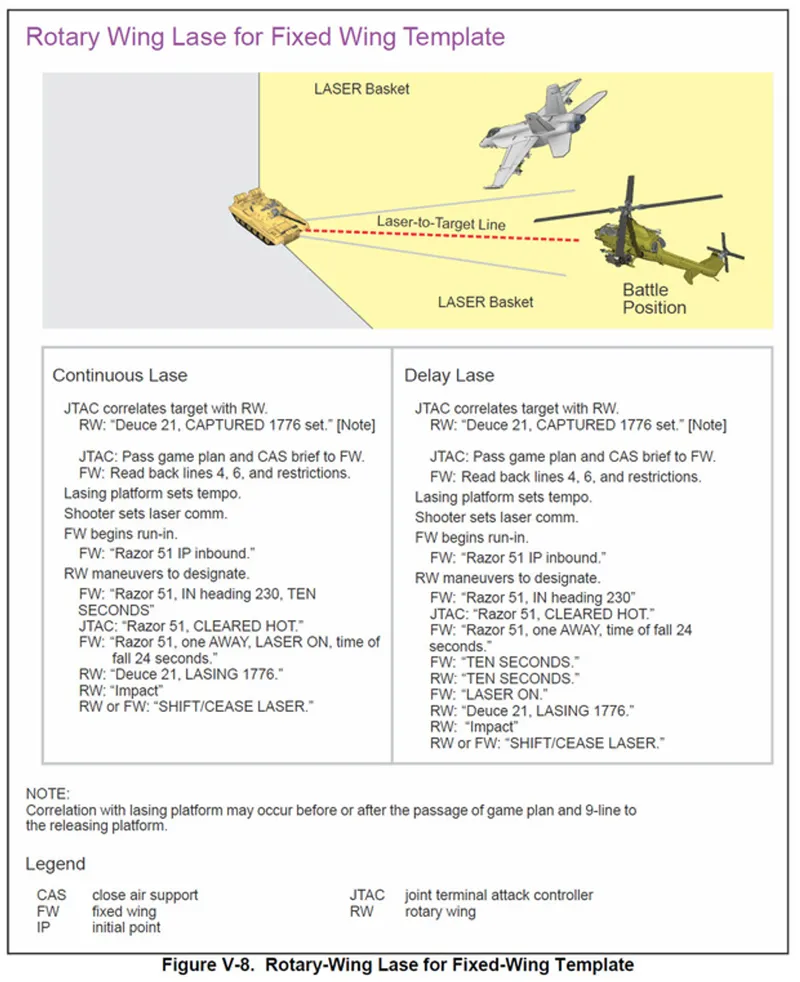
Continuous lasing is the most straightforward and recommended method of buddy lasing. In this situation, the designator begins lasing before or at weapon release and maintains a steady track on the target through the weapon's time of flight.
The following steps outline the typical radio communication exchange, using standard brevity terms.
Note that this is a supplement to all mandatory CAS calls (e.g. 9-line, “IN,” “Cleared Hot”, etc...) and assumes that tasking and coordination have already been completed.
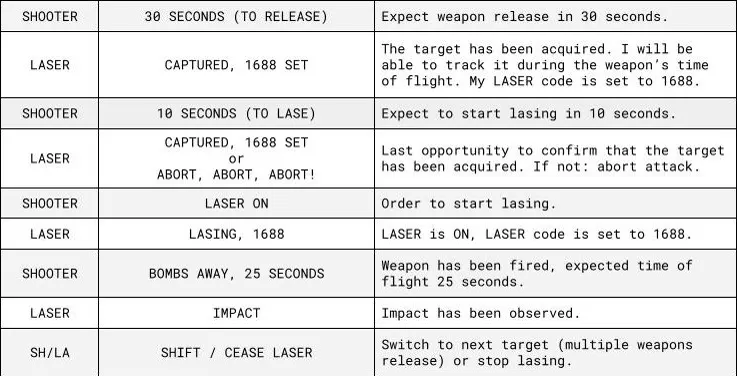
II.1 - Step-by-Step Sequence
The comms flow is usually initiated by the shooter, no later than 30 seconds before weapon release. In circumstances where time coordination is more complex, the initial call can happen even earlier, typically 4 to 5 minutes before weapon release.
The designator must then confirm that the correct target has been acquired and that the laser code is properly set. Once target capture is confirmed, the shooter provides a second time marker, 10 seconds before lasing should begin. This is the final opportunity for the designator to either confirm readiness or call for an abort if tracking cannot be maintained.
If everything is in place, the shooter gives the order to start lasing. The designator activates the laser and confirms that the system is firing with the correct code. As the weapon is released, the shooter announces time of flight to keep both parties synchronized. Throughout this period, the designator must maintain steady track on the target.
Once the weapon impacts, the designator announces the hit, and lasing is either ceased or redirected to a new target depending on mission requirements.
Communications flow for continuous lasing.
III. Communication Sequence: Delayed Lasing
Delayed lasing is a variation of buddy lasing in which the designator does not begin lasing until after the weapon has been released and has entered the terminal phase of flight.
Delayed lasing requires more precise timing and closer coordination between the shooter and the designator. There is less margin for error compared to continuous lasing, and the seeker has a shorter window in which to detect and guide to the laser energy. For this reason, delayed lasing is only used when necessary, either due to weapon-specific guidance behavior or tactical constraints such as the need to reduce laser signature.
III.1 - Step-by-Step Sequence
The sequence begins similarly to continuous lasing: the shooter announces that weapon release is imminent, allowing the designator to confirm target acquisition and laser code. After weapon release, the shooter announces time of flight.
10 seconds before the desired start of lasing, the shooter gives a head's up call, followed by the actual order to start lasing. That's only then that the designator activates the LASER.
Communications flow for delayed lasing.
III.2 - Examples of Operational Use of the Delayed Lasing
Delayed lasing is not the default method, since it introduces greater timing demands and offers less margin for error. However, in specific tactical situations, it is not only useful but necessary. Two common examples include the use of the Hellfire in LOAL mode, and operations in a counter-laser environment where limiting LASER exposure time is essential for survivability.
Hellfire in LOAL Mode
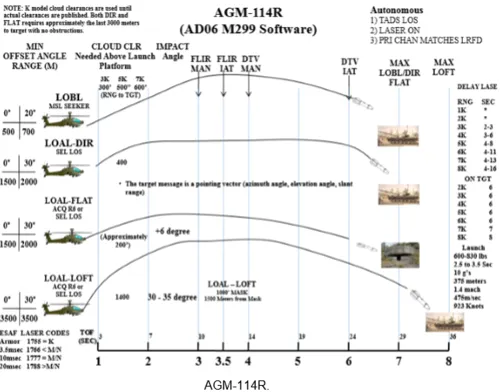
The AGM-114 Hellfire missile can be launched in several modes depending on terrain, weather, and survivability considerations. Among these, Lock-On After Launch (LOAL) modes are frequently used in buddy lasing scenarios, especially when the designator is not co-located with the firing platform.
In a LOAL engagement, the missile is fired without a seeker lock. Its laser seeker is caged during the initial phase of flight and begins searching for the coded laser spot only during the terminal phase, typically around 8 to 12 seconds before impact. This gives the shooter flexibility to launch without having a direct line of sight to the target at the moment of firing, which is especially valuable in masked or high-threat environments.
There are several LOAL variants:
LOAL-DIR (Direct): Lowest flight profile; minimizes altitude to avoid overflying terrain or entering cloud cover. Best for short-range engagements where exposure must be limited.
LOAL-LO (Low): Medium-low arc, allowing some terrain masking with a moderate climb.
LOAL-HI (High): Used to clear significant terrain features (up to ~1,000 ft), but with the trade-off of a higher trajectory and increased risk of seeker issues in poor visibility.
Comparison of Hellfire launch profiles.
In OEF and OIR, LOAL modes were widely used by Apaches and UAVs, especially when engaging targets from standoff ranges in mountainous terrain or urban environments. Ground teams often acted as remote designators, using systems like the G/VLLD or SOFLAM, while aircrews remained hidden behind ridgelines or operated under cloud cover.
Counter-LASER Environment
In high-threat environments where enemy forces possess laser warning receivers, laser jamming systems, or even lethal counter-LASER capabilities (e.g., artillery cued by laser detection), minimizing the time a LASER is active is a key survivability measure. In such situations, delayed lasing reduces the window during which friendly forces can be detected, tracked, or targeted based on their laser signature.
This is especially relevant in areas where adversaries had access to modern optical or infrared detection systems. To avoid triggering countermeasures, crews would delay lasing until the last possible moment. This tactic adds complexity but significantly reduces exposure to electronic countermeasures (ECM) and laser-guided retaliation.
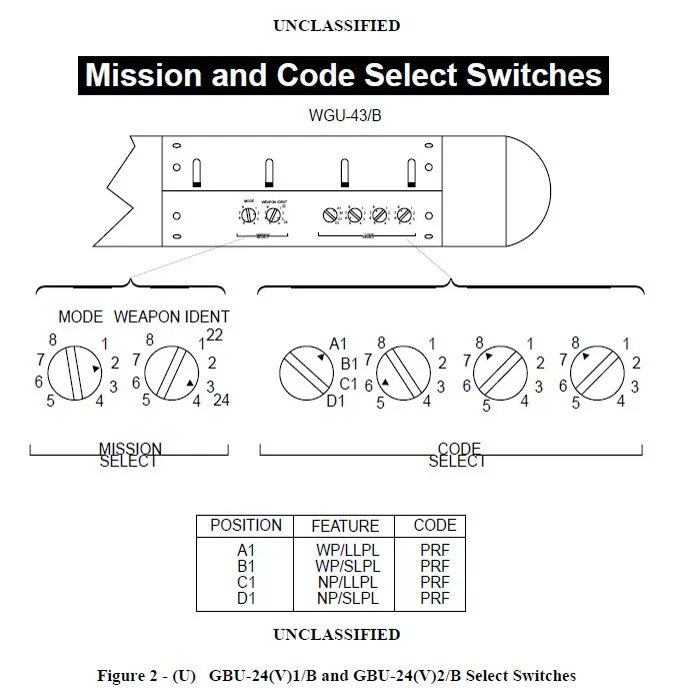
Some of the Paveway III settings (WP/NP) are used in LASER jamming environment. Delayed lasing reduces the opportunity to intercept signal, and can therefore be considered as a procedural electronic counter-counter-measure.
III.3 - Continuous Lasing vs Delayed Lasing
While delayed lasing has specific tactical applications, continuous lasing is generally preferred. It’s more reliable, more forgiving, and easier to coordinate, especially in operational conditions where small errors in timing can lead to complete misses.
The main advantage of continuous lasing lies in its communication simplicity. When the LASER is already active before weapon release, the shooter is sure that the weapon's guidance is active and the bomb won't be lost. It makes the process more robust in environments with latency or indirect control, such as when a JTAC must relay a “Laser On” order to a remotely piloted UAV or Fire Observer.
UAV are commonly controlled from the other side of the world thanks to their OTH (Over The Horizon) capabilities. It implies delays in communications, that can lead to failure whenever coordination is crucial.
Even for systems like the Paveway II, which technically only need laser energy in the final 8–10 seconds of flight, continuous lasing is still often the safer option. The marginal decrease in terminal accuracy is usually acceptable — a 10-meter error is operationally tolerable. On the other hand, a delayed lasing attempt that fails due to mistiming or masking can result in a complete miss, possibly hundreds of meters off target. In that context, continuous lasing provides a better balance between precision and reliability.
Conclusion
As you've seen it, buddy lasing relies on timing, clarity, and disciplined communication. While delayed lasing has its place, I highly suggest you to stick to continuous lasing, since it is generally more reliable and easier to coordinate, especially in multiplayer or remote-designation scenarios.
In the next post, as usual now, I’ll share a kneeboard-format summary of all key brevity terms and communications for use in your DCS missions.