





Fatigue does NOT stimulate hypertrophy
It is very well-established that muscle fibers grow in response to experiencing mechanical loading. However, the fitness industry persists in trying to persuade us that fatigue mechanisms also cause muscle growth to happen, when this is simply not the case.
.
#1. Muscle damage does NOT stimulate hypertrophy
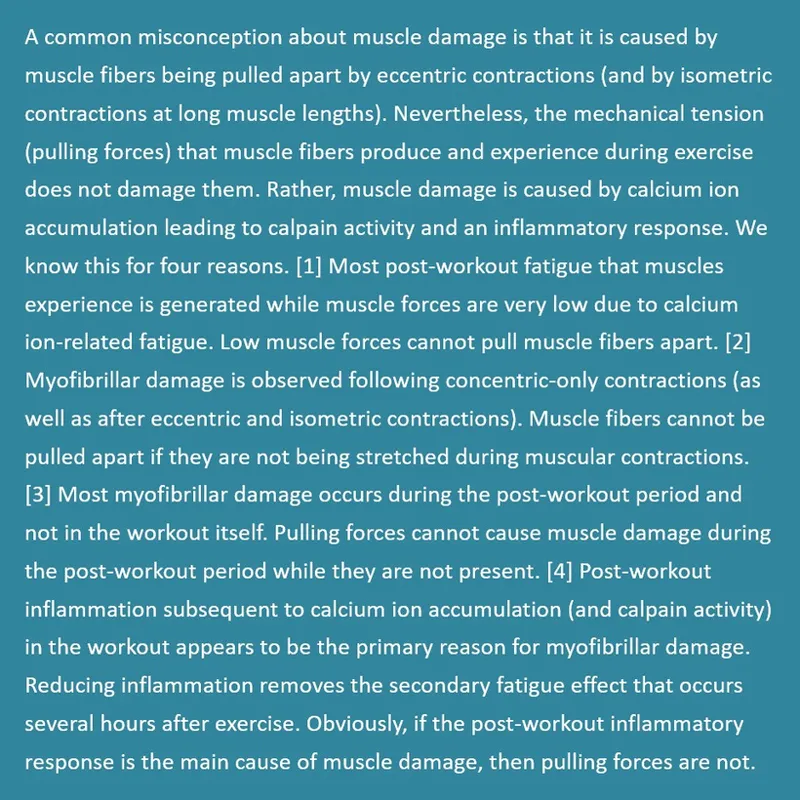
Muscle damage is a post-workout fatigue mechanism. It involves structural damage to the myofibrils that produce force and other elements inside the muscle fibers that transmit force and therefore it reduces the level of mechanical tension that a muscle fiber can generate. In contrast, to popular belief, it is caused not by the pulling forces that a muscle fiber experiences during exercise but instead is produced by the accumulation of calcium ions due to muscle fiber activation (read more).
.
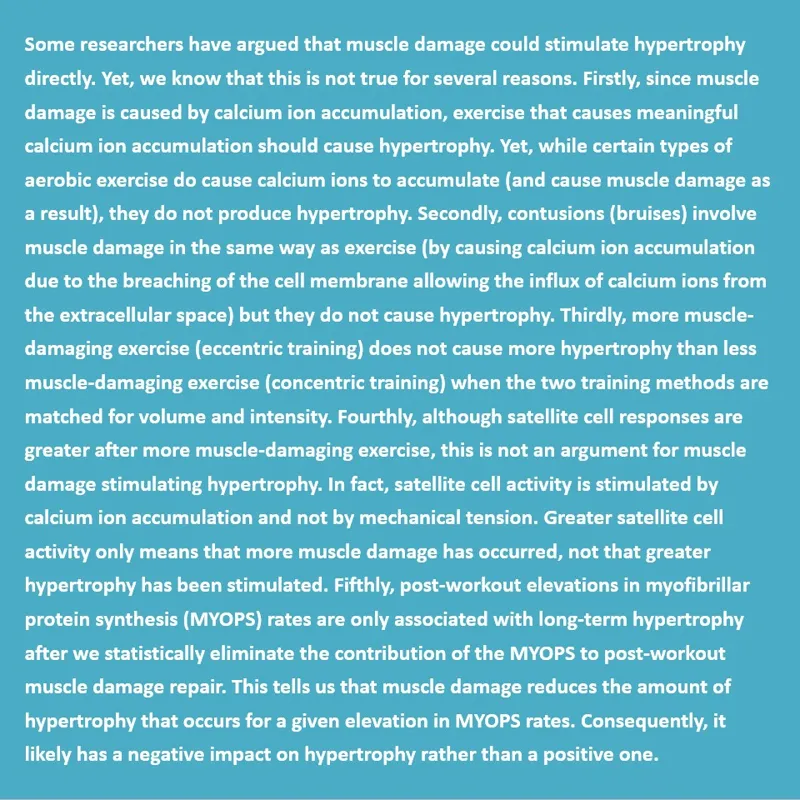
For many years, researchers who had been heavily-influenced by modern bodybuilding culture kept trying to show that muscle damage could cause hypertrophy. Recently, it has become clear that this idea can no longer be sustained and consequently has largely been abandoned (read more).
.
#2. Metabolite accumulation does NOT stimulate hypertrophy
Metabolite accumulation is a peri-workout fatigue mechanism. While the term "metabolic stress" is still very popular, it is really a marketing term instead of a scientific term. It is designed to make you assume that there is a stimulus for hypertrophy where none exists (read more).
.
#3. Peri-workout fatigue mechanisms
Peri-workout fatigue mechanisms can be summarised under seven different headings, with the first three being central nervous system (CNS) fatigue mechanisms and the remaining four being local muscular fatigue mechanisms. Fatigue mechanisms all reduce exercise performance (by definition) and they do this by either [1] reducing motor unit recruitment and therefore the number of activated muscle fibers (which reduces the hypertrophy stimulus), or [2] reducing muscle fiber mechanical tension (which reduces the hypertrophy stimulus), or [3] reducing muscle fiber shortening velocity (which has no effect on the hypertrophy stimulus).
.
#4. Central nervous system (CNS) fatigue has a negative effect on hypertrophy
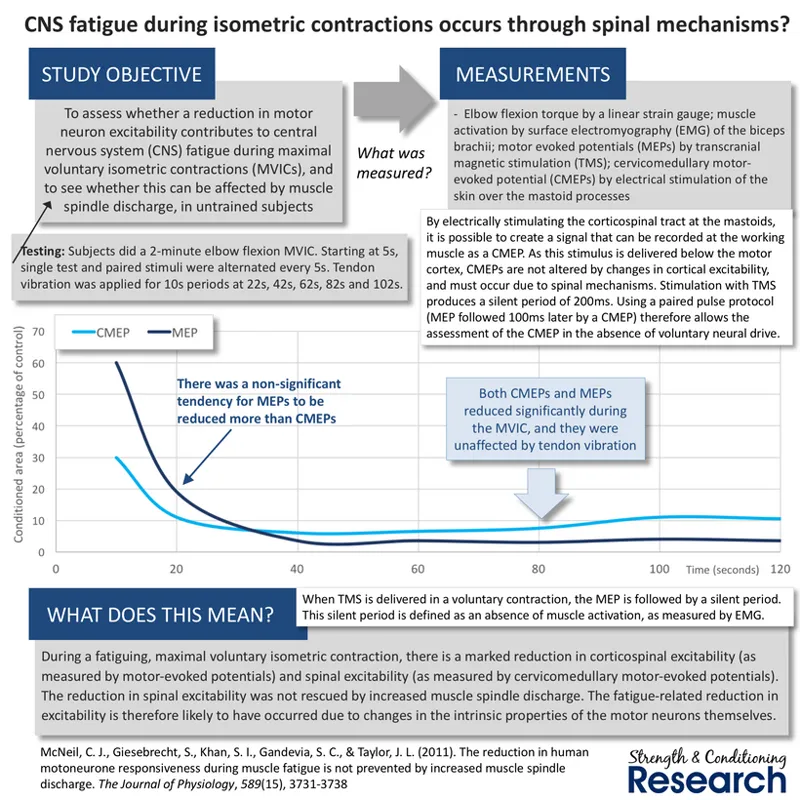
CNS fatigue mechanisms can be either supraspinal or spinal in nature. Supraspinal CNS fatigue has been recorded in muscular contractions analogous to strength training. It reduces the level of motor unit recruitment and therefore reduces the hypertrophy stimulus (read more).
.
Spinal CNS fatigue has also been recorded in muscular contractions analogous to strength training. It similarly reduces the level of motor unit recruitment and therefore reduces the hypertrophy stimulus.
.
#5. Calcium ion-related fatigue has a negative effect on hypertrophy
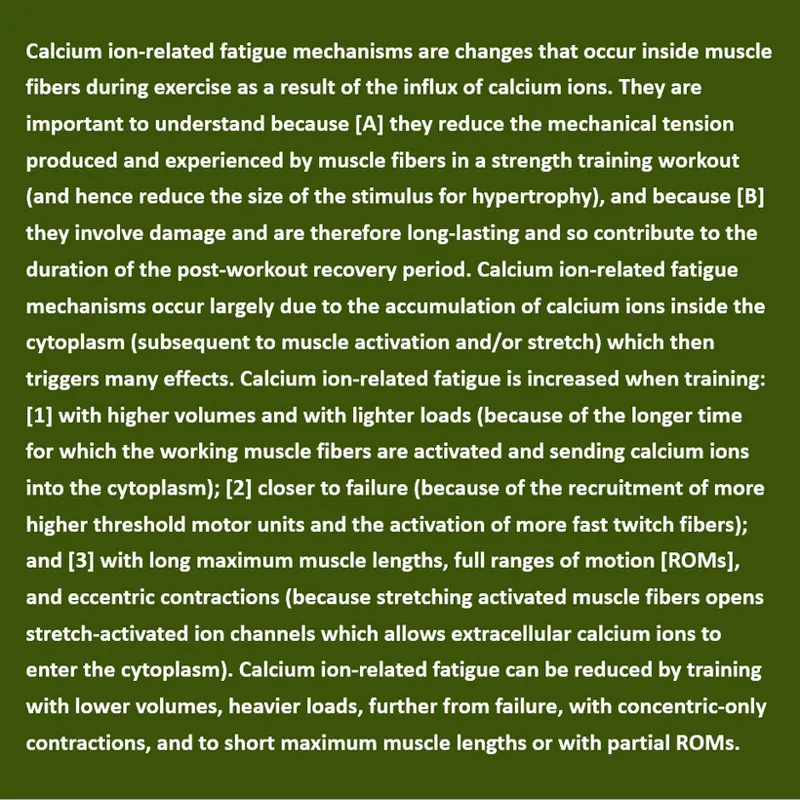
Calcium ion-related fatigue mechanisms can occur to the muscle cell membrane, at the triadic junction, or even in the cytoplasm of the muscle fiber. They have been recorded during muscular contractions analogous to strength training. They reduce the level of single muscle fiber mechanical tension and therefore reduce the hypertrophy stimulus (read more).
.
While some researchers have tried to argue that maybe hypertrophy is stimulated by muscle fiber activation and not by mechanical tension, this tentative hypothesis has quickly been forestalled by research showing that hypertrophy does not happen when muscle activation is high but single muscle fiber mechanical tension is low (as is the case during fast movement training).
.
#6. What are the practical implications?
We can conclude that fatigue mechanisms are NOT a stimulus for hypertrophy and in fact reduce the hypertrophy stimulus by reducing either motor unit recruitment or single muscle fiber mechanical tension. Thus, training methods that enhance fatigue (as is the case for advanced training methods), can be rejected in favour of conventional heavy strength training that minimises fatigue while still producing a robust hypertrophy stimulus (read more).
.
Conclusions
It is well-established that muscle fibers grow in response to experiencing mechanical loading. Yet, the fitness industry persists in trying to persuade us that fatigue mechanisms also cause muscle growth to happen, when this is simply not the case. The two main hypotheses that have been put forward that argue for a role of fatigue mechanisms in stimulating hypertrophy (being muscle damage and metabolic stress) have now been thoroughly debunked and rejected. Moreover, a review of fatigue mechanisms makes it clear that many of them reduce either of the two key features that are necessary for robust muscle growth to take place, being: [1] motor unit recruitment levels, and [2] single muscle fiber mechanical tension. We should make it clear that strength training programs intended to produce muscle growth should not seek to create fatigue but instead should aim to produce a hypertrophy stimulus by means of a simultaneously high level of motor unit recruitment (which requires a high level of effort) and a high level of single muscle fiber mechanical tension (which requires a slow concentric movement speed) while minimizing the fatigue mechanisms that reduce these two features. In practical terms, this means performing conventional strength training with heavy loads and long rest periods and avoiding so-called advanced training techniques that simply increase the amount of fatigue that is experienced without having any beneficial effect on the hypertrophy stimulus.




Comments (9)
Chris, what's the best strategy to leverage this info? Better to stay 2-3 reps from failure and do even more sets (8-10 sets at 2-3 RIR = 20-25 stimulating reps) or fewer sets at 1RIR (say 6 sets to get 24 stimulating reps)?
Hello Chris - thanks - does this mean that effort is not a stimulus for muscular development? I see the word effort or "hard sets" being referred to as a stimulus. What do you think? It seems like your saying the goal is to produce high mechanical tension on the muscle fibers with the trick being to make the workout easy. True?
If the effort is performed against a light resistance, such as during repeated throwing practice, and movement velocity does not slow down, then no hypertrophy will occur.
Takeaway/conclusion: 1. 6-8RM loads which makes all reps stimulating 2. 15-25 total reps 3. Less focus on fatigue/failure - i.e. manage vs. chase fatigue, as it will limit overall volume and increase recovery needs I recall you saying that a method you would use was e.g. 4 sets of 5 reps where the final rep was to failure, then slowly build up reps until you reach 4 sets of 7 reps, then increase load. The benefit of this is that it allows you to precisely judge whether you are getting stronger and thus recovering from the previous bout. According to this, if I understand you correctly, is that a perfectly viable alternative could be just to do sets of 3 reps, with sufficient rest periods to manage/minimize fatigue, until you hit 15-25 total reps? The downside being that if you don’t approach failure, you can’t be sure if you have recovered and gained since the last workout.
Yes, I agree with all of that. Also, it is possible to make progress doing 10 sets of 2-3 reps if we use the Hepburn protocol, which involves starting with sets of 2 reps and then adding a rep each workout. Very good for long-term progress, but a bit slow for beginners/intermediates.
I can feel the cluster set love in the air! ^^
Yes, there is definitely an argument for clusters, so long as the rests within sets are carefully timed
"Indeed, the optimal strength training program likely involves the largest possible dosage of mechanical tension for the smallest dosage of muscle activation and calcium ion-related fatigue." By "strength training program", do you mean or infer hypertrophy? This article essentially seems to add more evidence to support your earlier recommendations of submaximal (>1RIR) 5-8 reps, and 15-25 total stimulating reps - correct?
Yes, the context of this article is strength training for hypertrophy, and yes it agrees with what I have argued before about optimal bodybuilding training.