





Block periodization and fatigue
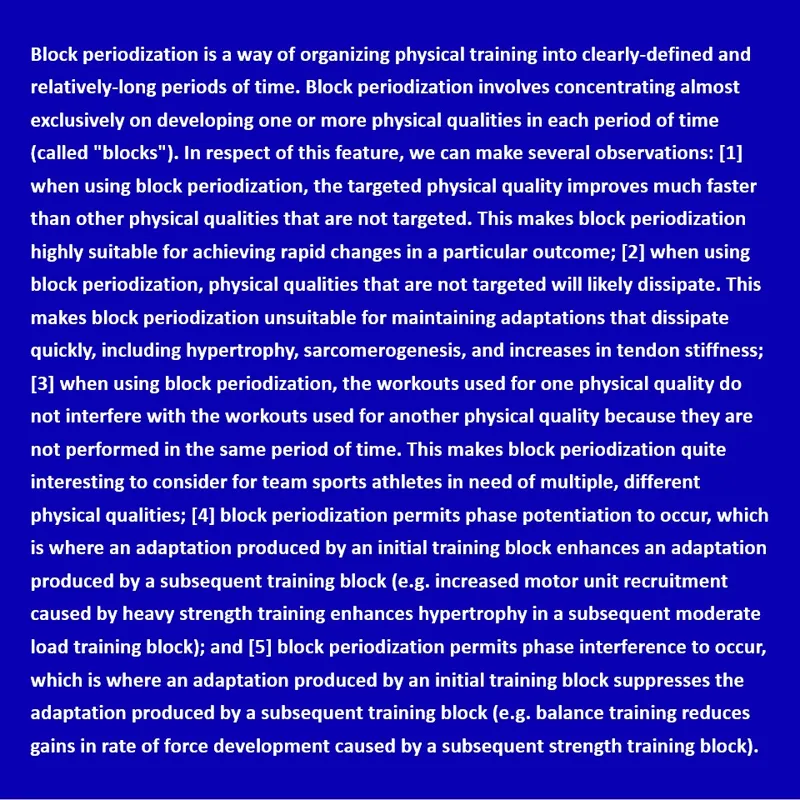
Block periodization is a method of organizing physical training that involves two main features, being [1] concentrating on developing one or more physical quality in each training block (e.g. strength, speed, power, muscular endurance, maximal anaerobic capacity, or maximal aerobic capacity), and [2] implementing training blocks with different levels of fatigue, so as to allow recovery to occur during low-volume, low-fatigue training blocks following high-volume, high-fatigue training blocks. In this article, I am going to examine the physiological basis for the second feature of block periodization. In my previous article, you can read about the rationale for the first feature (read more).
.
#1. What is fatigue?
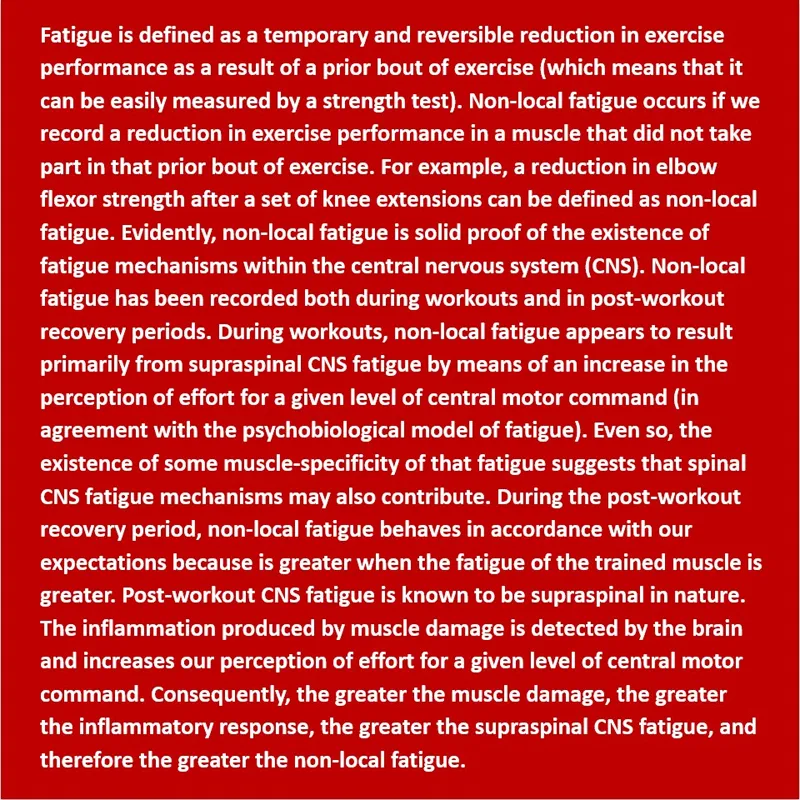
Fatigue is a temporary, reversible reduction in exercise performance caused by a previous bout of exercise. Such reductions in exercise performance can be produced by a variety of mechanisms.
.
#2. Do fatigue mechanisms differ depending on the type of exercise?
The relative amounts of each fatigue mechanism vary widely according to the type of exercise that is performed. For example, concentric-only strength training produces a lot of metabolite-related fatigue but little calcium ion-related fatigue, while eccentric-only training does the opposite.
.
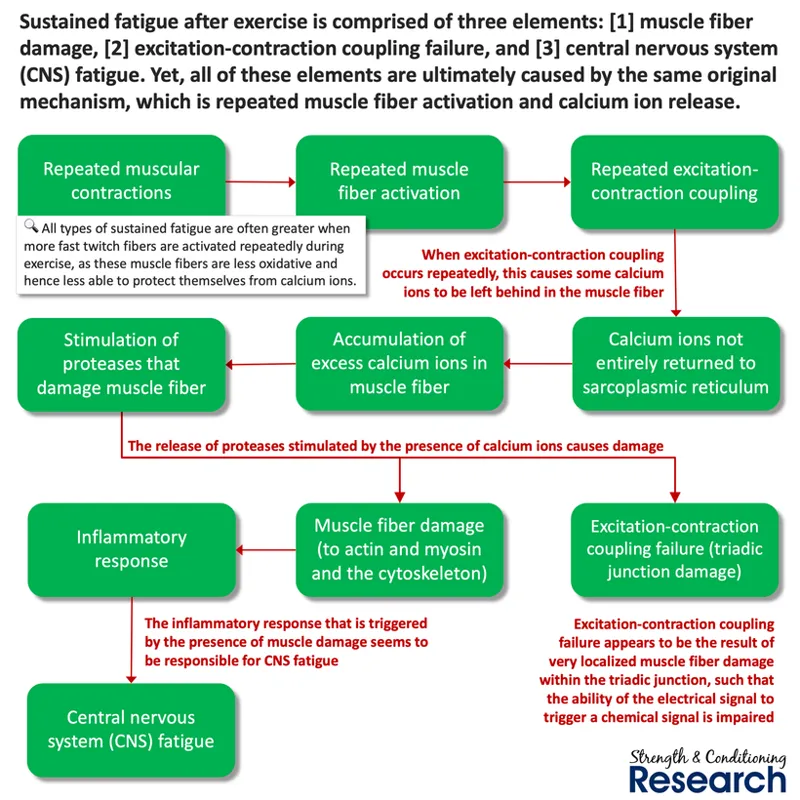
Even so, after a workout, the type of fatigue mechanisms probably do not differ according to the type of exercise that was performed. All types of exercise produce exactly the same post-workout fatigue mechanisms. The only thing that varies is the magnitude of the total fatigue experienced. This occurs because there is only one ultimate cause of post-workout fatigue, which is calcium ion accumulation.
.
#3. Does the location of the fatigue differ depending on the exercise performed?
Research has shown that the exercise selection affects the regional location within the muscle of any muscle damage. This suggests that alternating blocks of different exercises may be a way of using block periodization to manage fatigue (read more).
.
Even so, the central nervous system (CNS) fatigue produced by the inflammatory response to muscle damage has a fatiguing effect on other muscles. This is also called non-local fatigue (read more).
.
#4. Can fatigue "accumulate" during a training block?
Fatigue can absolutely accumulate during a training block. For example, consider this recent study in which daily workouts of four sets of knee extensions were completed. Typically, a workout comprising four sets of strength training exercise takes approximately 72 hours to recover from. Nevertheless, in this study, it took nearly two weeks to recover after the final workout when a full week of daily workouts was performed.
.
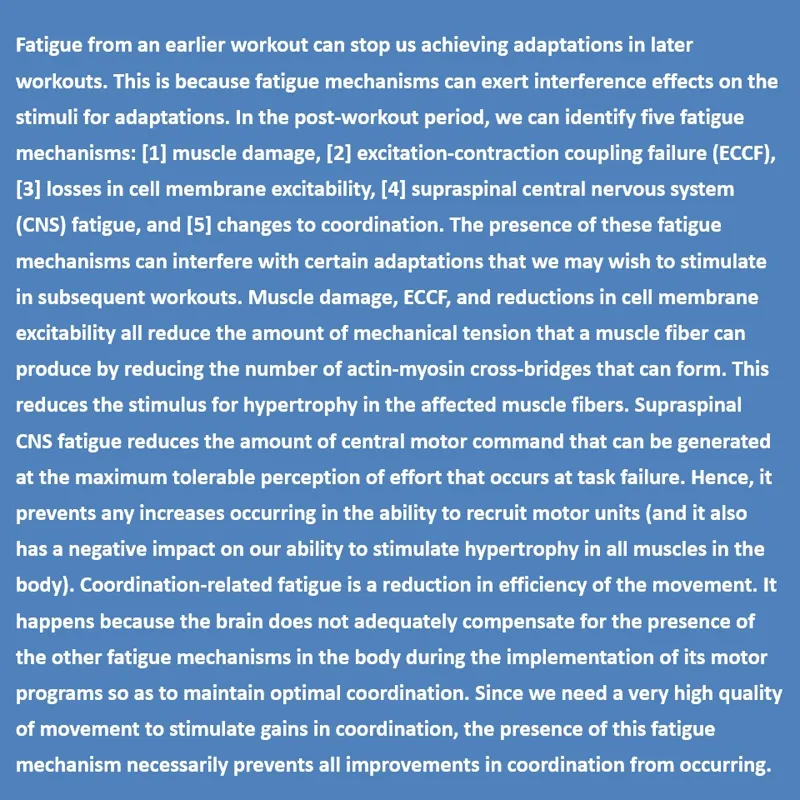
Moreover, research has shown that when very fatiguing workouts are performed sequentially and without adequate recovery between them, many adaptations (including hypertrophy) stop after a couple of workouts, and no further gains occur. It therefore seems likely that post-workout fatigue heavily interferes with our ability to stimulate adaptations that require high levels of motor unit recruitment and/or mechanical tension.
.
Indeed, the interference effects caused by post-workout fatigue mechanisms have been extremely well-documented (read more).
.
Conclusions
Block periodization is a way of organizing physical training into clearly-defined and relatively-long periods of time (called "blocks"). Since the types of exercise in each block are usually quite different, commentators have often made claims about the differences in post-workout fatigue. Firstly, they have suggested that the type of post-workout fatigue mechanisms can differ between blocks. This is not true. All types of exercise produce the same five fatigue mechanisms in the post-workout recovery period, being excitation-contraction coupling failure, losses of sarcolemmal excitability, muscle damage, supraspinal central nervous system fatigue, and disruptions to coordination. Secondly, they have observed that the regional location of post-workout fatigue mechanisms can differ between blocks. This is true so long as biomechanically-different exercises are performed in each block because neuromechanical matching determines where muscle activation is experienced. This presents an interesting approach to fatigue management that could be particularly relevant for bodybuilders. Thirdly, they have observed that the total quantity of post-workout fatigue can vary between training blocks, which is of course true. Even so, this has been used to justify alternating more-fatiguing and less-fatiguing blocks of training in order to permit recovery to occur from the post-workout fatigue that was accumulated in the more-fatiguing blocks during the less-fatiguing blocks. The problem with this strategy is that post-workout fatigue has an interference effect on our ability to stimulate both neural and peripheral adaptations. Therefore, any fatigue accumulation that occurs in a more-fatiguing block will prevent adaptations from being stimulated in the subsequent less-fatiguing block.

Comments (7)
Hi chris, Hope you are doing Great. I have a question regarding the typical concept of "inverse relationship between intensity and volume". The explanation behind that, was, IMO, that we thought higher load/intensity was more fatiguing than light loads. With that in mind, in order to maintain the level of fatigue constant or lower, we would decrease the total volume and increase the intensity (and vice-versa). Since we now know that light loads is creating way more CNS fatigue than high loads, what is the relevance of reducing the volume/intensity when we are increasing the other variable? Is it more related with managing the risk of injury that is more prevalent with higher loads and reduce the psychological demand associated with that kind of workout ? Thanks in advance.
Additionally: it is a common practice to use 3+1 (3 weeks of loading followed by 1 week of unloading) for intermediate athletes. Advanced athletes may follow something more like 2+1 (or even 1+1, 1+2... supposedly, though I believe I would be unable to refer to training logs of advanced athletes with such a scheme, Bompa makes this claim in Periodization). I've seen something more akin to an abrupt alternation/step model in practice for an advanced weightlifter. If you could challenge/address this practice of fatigue management, it would be interesting... In bodybuilding, it's usually not planned, or you might see something like 5+1 or 6+1. I believe you already did so with this article. That is, essentially prove that sustained fatigue is actually the sum of all the fatiguing mechanisms leading to strength loss and is best managed by not allowing it to accrue in the first place. I suppose I would posit that alternation of heavy-light-medium days would be one means to accomplish that (given the task of increased training frequency at reduced workloads, using variation to accomplish coordination training/accentuation). A staunch periodization guy might respond that there is evidence of delayed transformation (i.e., the LLTE).
I would be interested in seeing evidence of delayed adaptation, insofar as the adaptation/transformation is genuinely delayed and not simply hidden by the presence of fatigue.
Just to add, I looked into whether training status attenuates myofibrillar damage and it seems to be true, based on: Phillips, et al. Resistance training reduces the acute exercise-induced increase in muscle protein turnover. 1999. doi: 10.1152/ajpendo.1999.276.1.E118 and Damas, et al. Resistance training-induced changes in integrated myofibrillar protein synthesis are related to hypertrophy only after attenuation of muscle damage. 2016. doi: 10.1113/JP272472 So, does this alter our understanding of why periodization on the micro-cyclic scale (e.g., heavy-light-medium days) seems to work for the management of fatigue (primarily by reducing CNS fatigue; permitting higher frequency than the models predict) in any meaningful way? P.S. I apologize if you are wondering what I mean by micro-cyclic scale/differences in block definitions, to be honest, I have never heard your definition of "block periodization" before- my understanding of "block periodization" (also, coupled successive system, conjugate sequence system) is that of Siff/Verkh, management of training around the LLTE (long-lagging training effect), and is highly inapposite of what is done in practice outside of planned functional overreaching ('shock' microcycles) and loosely termed "block periodization" (informal). EDIT: It seems really hard to believe that considering all the experience you have with this data, especially on CNS fatigue beginning and increasing from the very first exercise in a session, that your model would be meaningfully altered by training status. I don't know how to square what I believe (that periodization makes training with high frequency (i.e., 10 session weekly) possible) with this model/analysis.
Unless I am working with physiological concepts (which can be defined very accurately), I tend to reduce definitions to the simplest possible form so that they are applicable to the models of as many other authors as possible, without adopting the specifics of any of those other models. So my model of block periodization is any training program that is divided into blocks.
Thank you VERY much for this, Chris. I've been looking forward to your discussions and analyses on periodization! First, it is noteworthy that your model of fatigue differs substantially from Yakovlev's "supercompensation" model often used as the very basis for periodization. Yakovlev's work was on the sympathoadrenergic system and the depletion-restitution of creatine phosphate and glycogen in muscle roughly 50 years ago, and seems highly inapposite the management of training intensity. I greatly appreciate your accurate model of fatigue phenomena! On the second matter of alternating heavy, light, medium "blocks" and the notion of "sustained fatigue," I don't think you are presenting a case against microcyclic (weekly) variation of workload (tonnage), but rather mesocyclic variation (i.e alternations on an every 2-6 weekly basis)? Is it true that training status meaningfully attenuates myofibrillar damage? That is, beyond the research showing this important mechanism in novices, does development towards advanced status not actually reduce myofibrillar damage? If true that myofibrillar damage is attenuated by training status, does this thereby attenuate CNS fatigue (i.e., can an advanced athlete train with greater frequency, within reason, due to this mechanism/interplay?) I'm envisioning a shifting of the curves where ECCF predominates as a concern, but with CNS fatigue recovering a bit more quickly than 48 hr (especially when there is a greater plyometric component to the bulk of training). The research demonstrating that lower intensities (i.e., weight on the bar) cause greater fatigue is all volume-equated, correct? Practically, the use of periodization and the SRB method will manipulate intensity, volume, workload -- and the heavy, light, medium or some permutation thereof is a common theme. If you are not familiar with Stone & O'Bryant's Set-Repetition Best method for managing intensity (SRB), it is described succinctly in Suchomel's "Training for Muscular Strength: Methods for Monitoring and Adjusting Training Intensity" (2021). I want to properly square this research with the common practice of reducing not only intensity (weight), but at the same moment workload as well. The heavy-light-medium alternation is not the be-all-end-all of periodization, but it is certainly a defensible model, at least on the microcyclic scale. My interpretation of the evidence here is that it is a strong case FOR such an alternation as well as alternating muscles trained on an inter-session basis. Your work is the best there is on this subject! Thank you.
(1) yes, my model of fatigue follows the physiological definition of fatigue and then looks at its individual components. It is different from the way that fatigue is generally in much of the coaching literature.