










Stretching sarcomeres
How does static stretching produce muscle growth? Until recently, researchers were very sceptical about whether static stretching could produce an increase in muscle size in humans and this question was therefore largely ignored by them. However, now that we know that muscle growth can occur after static stretching in humans, it has become a hot topic.
.
#1. Static stretching causes muscle growth in animals
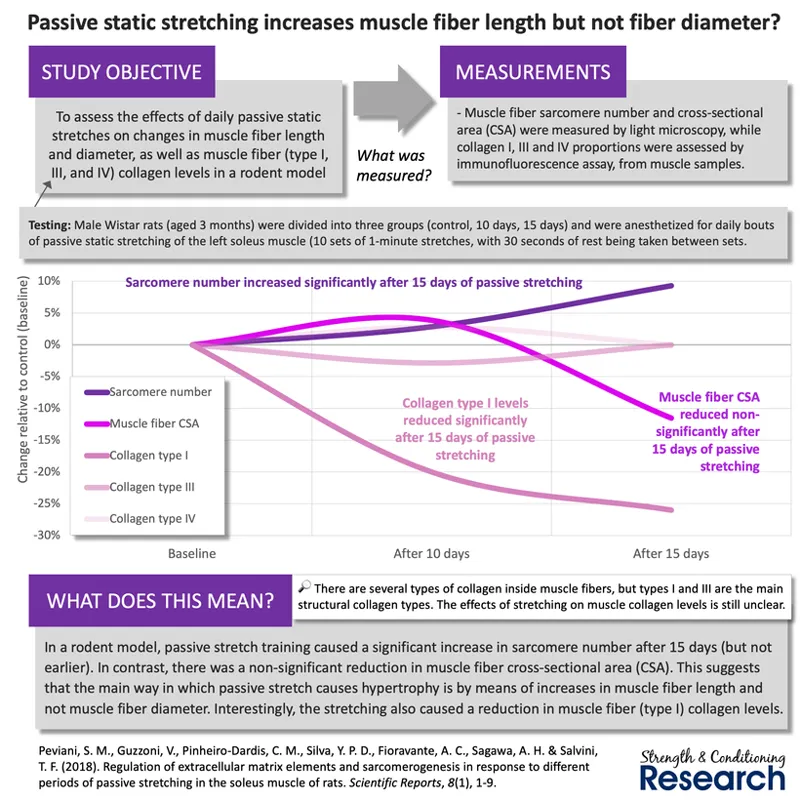
Many animal model studies have demonstrated that passive, static stretching can stimulate muscle growth, even when muscle fibers have been denervated, thereby removing any potential for the central nervous system to accidentally activate the stretched muscle fibers. This proves the point that passive, static stretching has the potential to cause muscle growth in animals (as we might expect, given that passive mechanical tension is still mechanical tension).
.
Importantly, static stretching studies in animal models have shown that the muscle growth that is stimulated comprises sarcomeres being added in series and not myofibrils being added in parallel to cause an increase in muscle fiber cross-sectional area.
.
This is by no means an isolated result and many similar studies have made the same observation.
.
#2. Static stretching causes muscle growth in humans
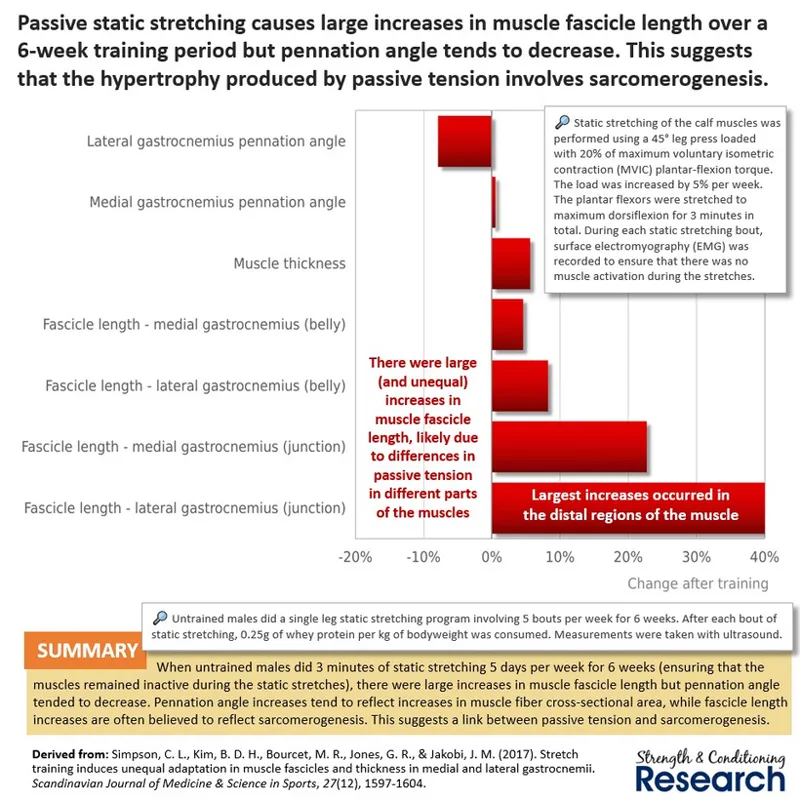
Today, more and more studies are reporting that passive, static stretching can cause muscle growth in humans, matching the results of the older, animal studies that have shown exactly the same result.
.
Some of these studies have even shown that the muscle growth produced by static stretching can match the amount of hypertrophy achieved by strength training programs.
.
#3. Static stretching increases fascicle lengths
Importantly, many of the studies that have reported increases in muscle size after passive, static stretching in humans have typically reported increases in fascicle length, which is often taken as an indicator of sarcomerogenesis (the addition of sarcomeres in series).
.
Indeed, it seems like the vast majority (if not the totality) of the increases in muscle mass produced by static stretching in humans are the result of increases in muscle fascicle length.
.
This is a very repeatable finding with any study measuring changes in muscle fascicle length in humans after static stretching reporting exactly the same finding.
.
#4. Static stretching causes greater increases in strength at long muscle lengths
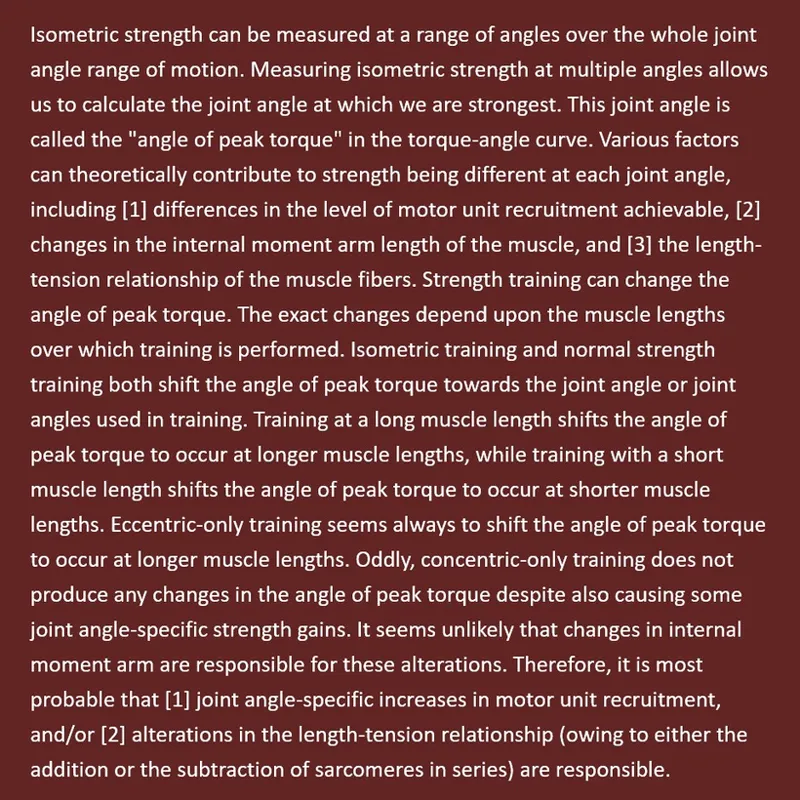
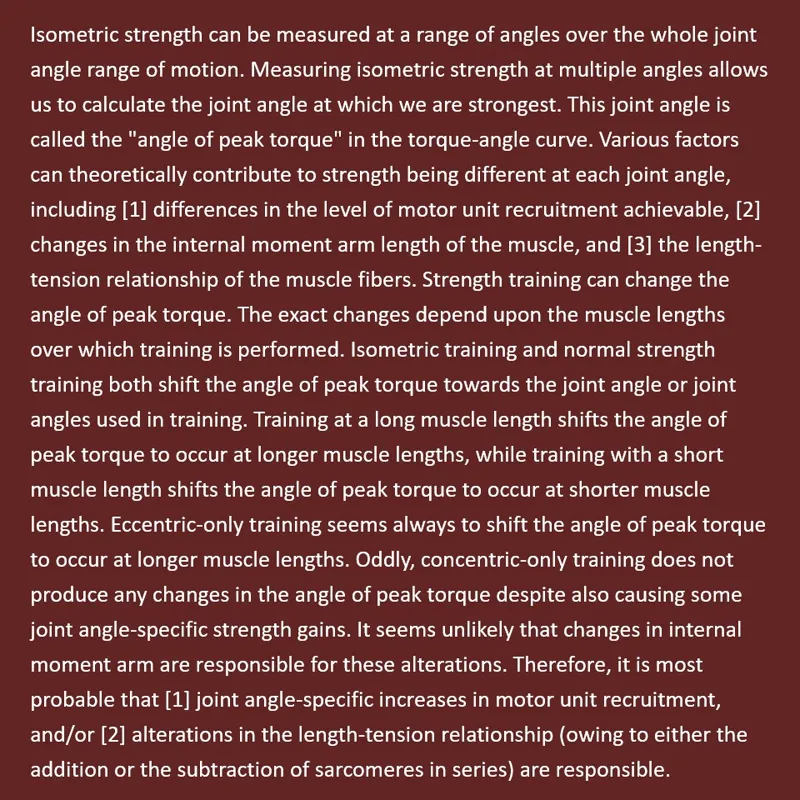
Since it increases muscle size, static stretching causes an increase in maximum strength. Yet, it causes this increase in maximum strength to occur preferentially at long muscle lengths. This tells us that the angle of peak torque has altered towards longer muscle lengths, which is yet another indicator of an addition of sarcomeres in series.
.
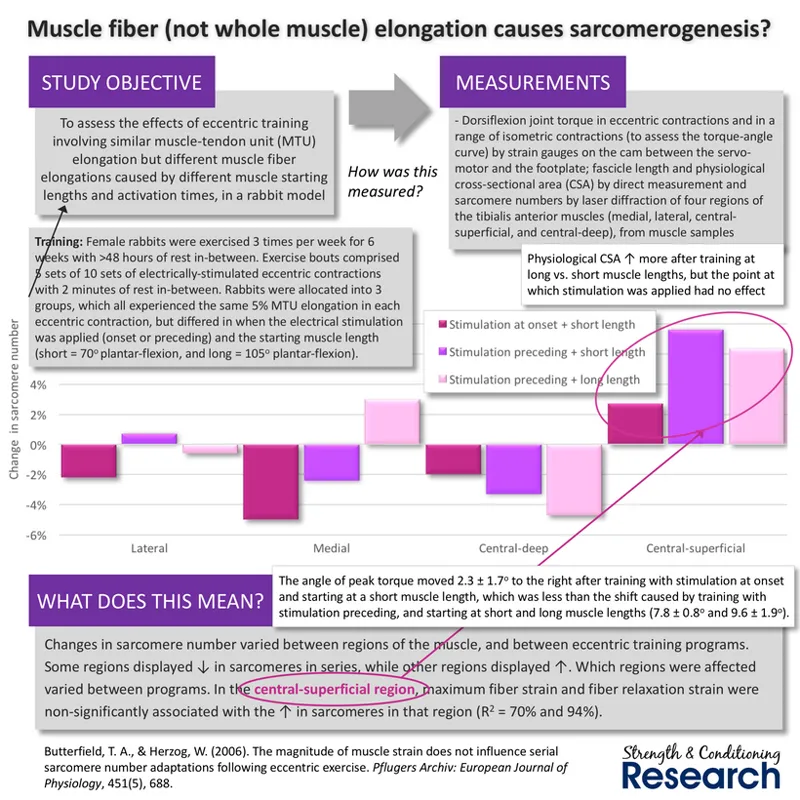
Changes in the angle of peak torque after different types of strength training have been extremely well-described and are believed to be closely related to the addition or subtraction of sarcomeres (read more).
.
#5. Some types of strength training also increase muscle fascicle lengths
Eccentric contractions produce passive mechanical tension and also increase muscle fascicle length and shift the angle of peak torque towards longer muscle lengths. In contrast, concentric contractions do not produce passive mechanical tension and therefore do not increase muscle fascicle length or shift the angle of peak torque.
.
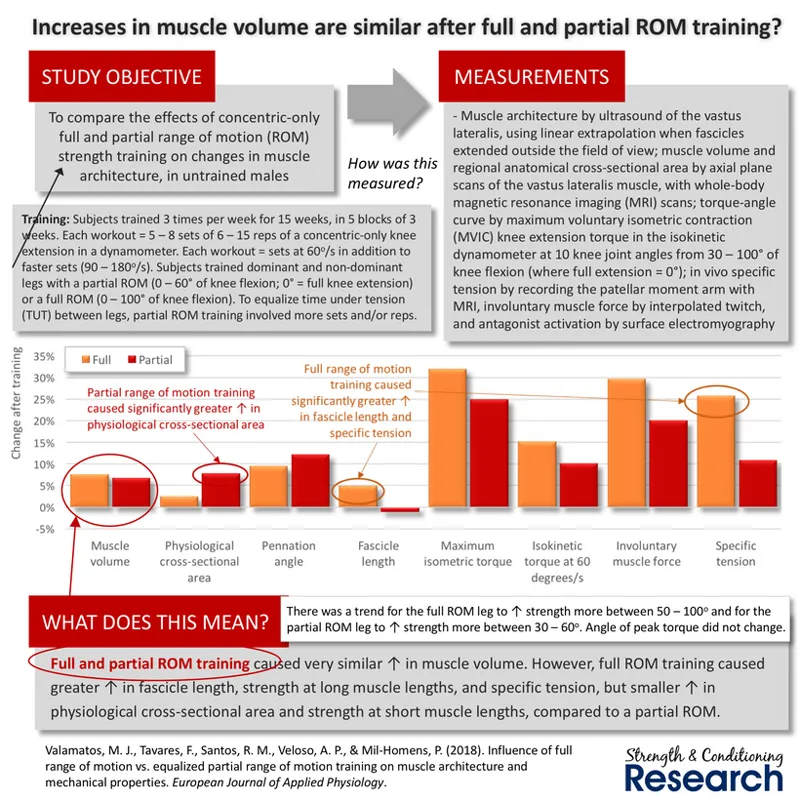
Full range of motion strength training involves producing passive mechanical tension and also increases muscle fascicle length and shifts the angle of peak torque towards longer muscle lengths. In contrast, partial range of motion strength training does not involve the production of passive mechanical tension and does not increase muscle fascicle length or shift the angle of peak torque.
.
#6. When titin produces passive tension, this signals increases in muscle fiber length
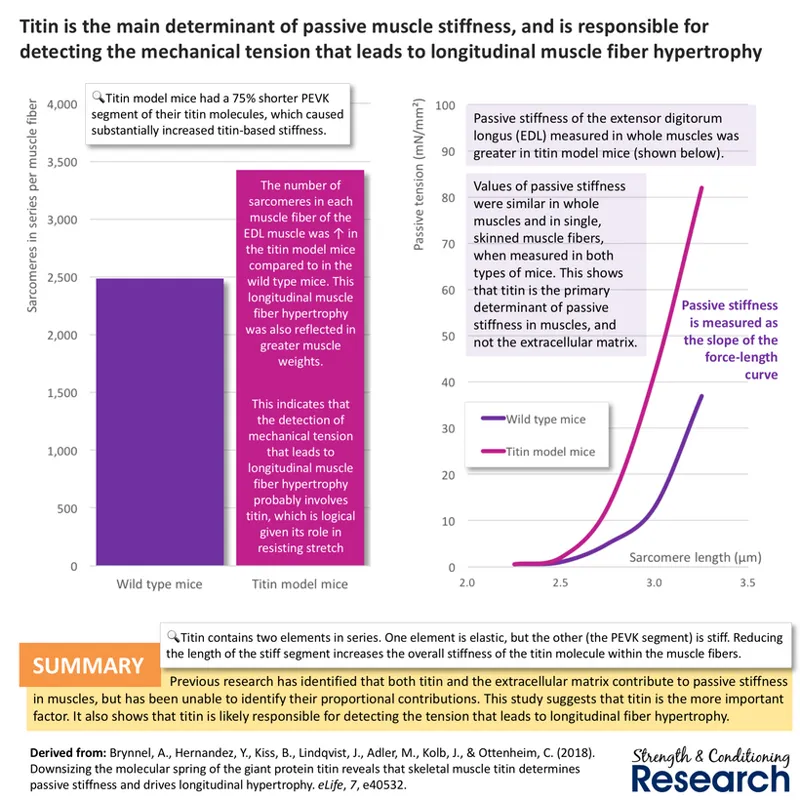
Rodent studies have shown that sarcomerogenesis can be stimulated by reducing the length of titin molecules inside muscle fibers, thereby increasing the amount of passive stiffness that titin displays during muscular contractions. This suggests that titin is the molecule that is responsible for causing the passive mechanical tension that stimulates sarcomerogenesis.
.
#7. The passive mechanical tension produced by titin is determined by sarcomere length
The fact that titin is responsible for stimulating increases in muscle fiber length after muscle fiber stretch is very important, because titin is segmented into three sections, whose lengths are governed by the lengths of the sarcomeres in which the titin molecule is found. For this reason, sarcomere lengths are the key to the amount of mechanical tension that titin produces inside muscle fibers. When sarcomere lengths are short, little mechanical tension is produced by titin. When sarcomere lengths are long, a lot of mechanical tension is generated by titin (although this differs when muscle fibers are activated, as during eccentric contractions). Importantly, the increase in mechanical tension with increasing sarcomere length is not linear, and there is a sharp increase in mechanical tension once sarcomere length exceeds a certain length. This is due to the segmented nature of titin.
.
#8. Sarcomere length determines passive tension (not muscle length)
Since it is the sarcomere length during stretch that determines the passive mechanical tension (and therefore the hypertrophy of the muscle fiber) and since sarcomere lengths can vary between regions of a muscle, we might predict that the amount of regional muscle growth that occurs after passive, static stretching or eccentric training might vary between regions of a muscle. Indeed, this is exactly what happens.
.
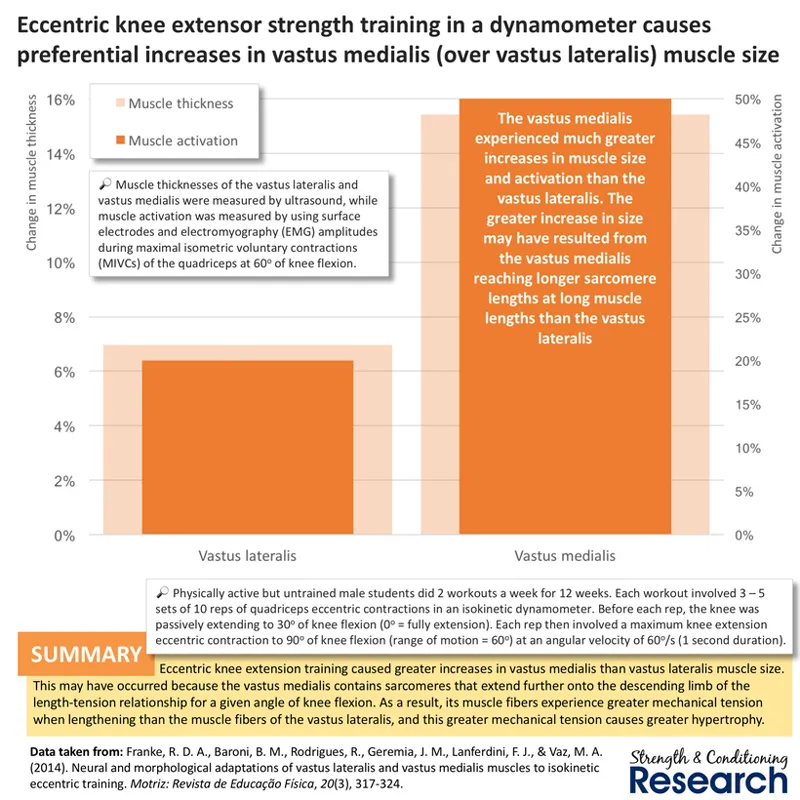
Sarcomere lengths of the individual quadriceps muscle differ from one another. Some recent research has reported that the vastus lateralis displays shorter sarcomere lengths than the vastus intermedius, at the same knee joint angle, while other research has shown that the vastus lateralis displays shorter sarcomere lengths than the vastus medialis. In general, the vastus lateralis seems to have the shortest sarcomere lengths out of the four quadriceps muscles, suggesting that it will grow the least when exposed to quadriceps muscle stretch or eccentric training.
.
Indeed, the vastus lateralis does display less hypertrophy than either the vastus medialis after knee extension eccentric training.
.
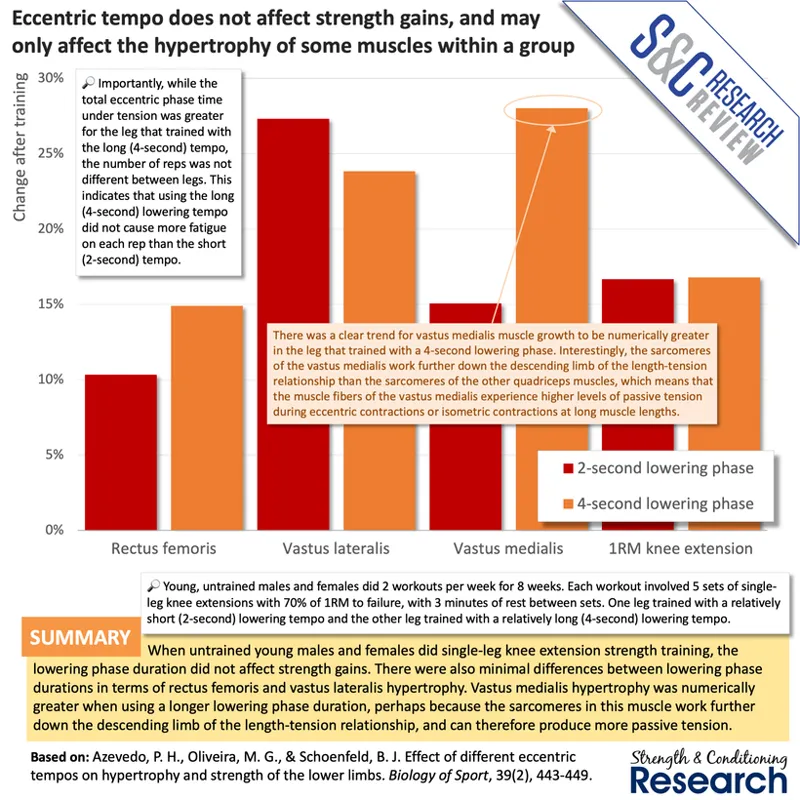
Similarly, vastus medialis (but not vastus lateralis) hypertrophy is enhanced when slow eccentric tempos are used during conventional strength training.
.
#9. Static stretching only causes hypertrophy when sarcomere lengths are long
Sarcomere lengths can also explain why all studies generally report hypertrophy after passive, static stretching programs in animals, and why only some studies have reported hypertrophy after passive, static stretching programs in humans. In animals, the static stretches are typically applied for arbitrary distances of stretch that are applied while the animals are under anesthetic. Thus, there is no protective, neural mechanism that stops the stretch from being applied to long sarcomere lengths. In contrast, humans typically voluntary stop static stretches once they reach their maximum stretch tolerance. Stretch tolerance is unrelated to maximum muscle fiber length or to sarcomere lengths. Since flexibility differs greatly between individuals, stretch tolerance likely also differs greatly between individuals, making static stretching variable in its effects depending on the person.
.
Conclusions
For many years (if not decades), it has been clear that passive, static stretching causes an increase in muscle size in animals. Moreover, the increases in muscle size can be largely (if not entirely) attributed to an increase in the number of sarcomeres in series. Recently, passive, static stretching studies in humans have reported increases in muscle size that can be largely (if not entirely) attributed to an increase in muscle fascicle length, which is often taken as a proxy for sarcomerogenesis. Aligned with this, passive, static stretching in humans also causes a shift in the angle of peak torque towards longer muscle lengths, which indicates the addition of sarcomeres in series. Mechanistic studies have shown that manipulating the amount of passive mechanical tension that is generated by titin molecules inside muscle fibers causes an increase in muscle mass by means of sarcomerogenesis. The extent to which titin is elongated depends on the behavior of the individual sarcomeres of the muscle fiber, since titin is located within individual sarcomeres. Yet, sarcomere number (and therefore sarcomere lengthening for a given amount of muscle fiber lengthening) varies between muscles and muscle regions. This predicts that we should see variations in sarcomerogenesis between muscles and between muscle regions when performing a passive, static stretch or eccentric contraction. This is exactly what we see. Additionally, since flexibility varies between individuals because of differences in stretch tolerance, we might expect some people to be capable of producing much more sarcomerogenesis than others.
Comments (4)
Great! So, given that inter-set stretching would lead to a reduction in the effectiveness of the following sets—given that some studies do not observe differences—is it reasonable to suggest that stretching can confer some benefit that counteracts the negatives effects it causes? 😅
Absolutely.
Hi Chris, thanks for the comprehensive article. I have two questions: 1) From a practical standpoint, is there a benefit to improving stretch tolerance for certain muscles in order to maximize hypertrophy? 2) How do you fit/see studies that apply inter-set stretching in this puzzle?
(1) Sure, it makes sense that individuals who have developed better stretch tolerance will be able to generate stretch-mediated hypertrophy to a greater extent than individuals who have not. (2) Inter-set stretching is really difficult to study, because the act of stretching is itself fatiguing, so there is a negative fatigue impact on subsequent strength training sets as well as a positive stimulating effect. Therefore, I don't think that research will be able to resolve whether there is a net benefit of inter-set stretching anytime soon. IMO, it is probably better to perform post-workout stretching for hypertrophy, rather than inter-set stretching, but that is solely based on practicalities rather than specific net effects.