



Block periodization
Block periodization is a method of organizing physical training that involves two main features, being [1] concentrating on developing one or more physical quality in each training cycle (e.g. maximum strength, speed, power, muscular endurance, maximal anaerobic capacity, or maximal aerobic capacity), and [2] implementing training cycles with different levels of fatigue, so as to allow recovery to occur during low volume, low fatigue training cycles following high volume, high fatigue training cycles. In this article, I set out the physiological rationale for the first feature of block periodization. In a subsequent article, I will look at the basis for the second feature (read more).
.
#1. Block periodization does cause specific adaptations in each block
At the outset, it is important to note that specific adaptations are produced by different types of training and therefore different training blocks. For example, here we can see differing adaptations being produced by strength, power, and speed training, causing different changes in the force-velocity profile of the athletes.
.
#2. Block periodization probably suffers from detraining effects in untrained adaptations
While rarely studied in the context of block periodization, we do know that every individual adaptation has its own unique stimulus. Removing this stimulus leads to the dissipation of the adaptation. Hence, detraining of adaptations can occur even while exercise is being performed (read more).
.
#3. Block periodization reduces the interference effect during concurrent training
One very interesting benefit of block periodization is that it may allow coaches and athletes to circumvent the negative interference effects that commonly reduce gains in maximum strength, speed, and muscle size during concurrent strength training and endurance exercise.
.
#4. Block periodization may create a phase potentiation effect
Block periodization can also cause a phase potentiation effect. Phase potentiation means that an initial block of training enhances the gains achieved in a subsequent block of training. Phase potentiation does not refer to the additive effects of sequential blocks of training (which might occur regardless of the order in which blocks of training are performed). Rather, it refers to the potentiating effects of one block of training on the adaptations that occur from the second block.
.
Phase potentiation has only rarely been observed in the literature. The best example is when a block of heavy strength training potentiates gains in muscle size during subsequent light or moderate load strength training blocks by increasing the ability to recruit high-threshold motor units (which increases the number of muscle fibers that can be trained).
.
#5. Block periodization may create a phase interference effect
While it rarely discussed, block periodization also has the potential to cause a phase interference effect. Phase interference occurs when an initial block of one type training reduces the adaptations that occur from a subsequent block.
.
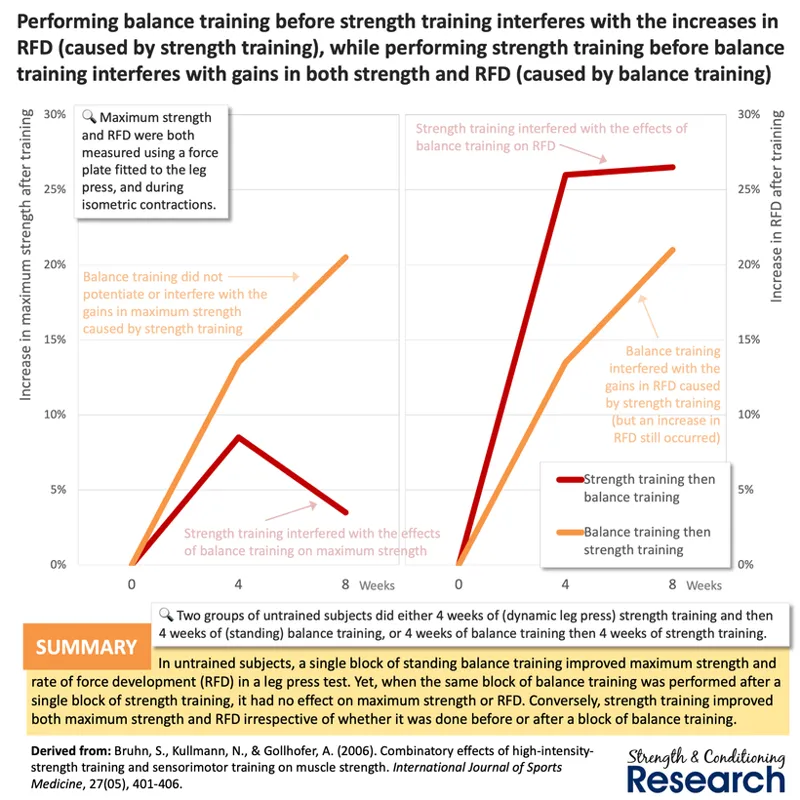
Indeed, research has shown that a period of balance training interferes with the ability of future blocks of strength training to produce improvements in rate of force development. This is currently the best (and possibly the only) example of phase interference in the literature.
.
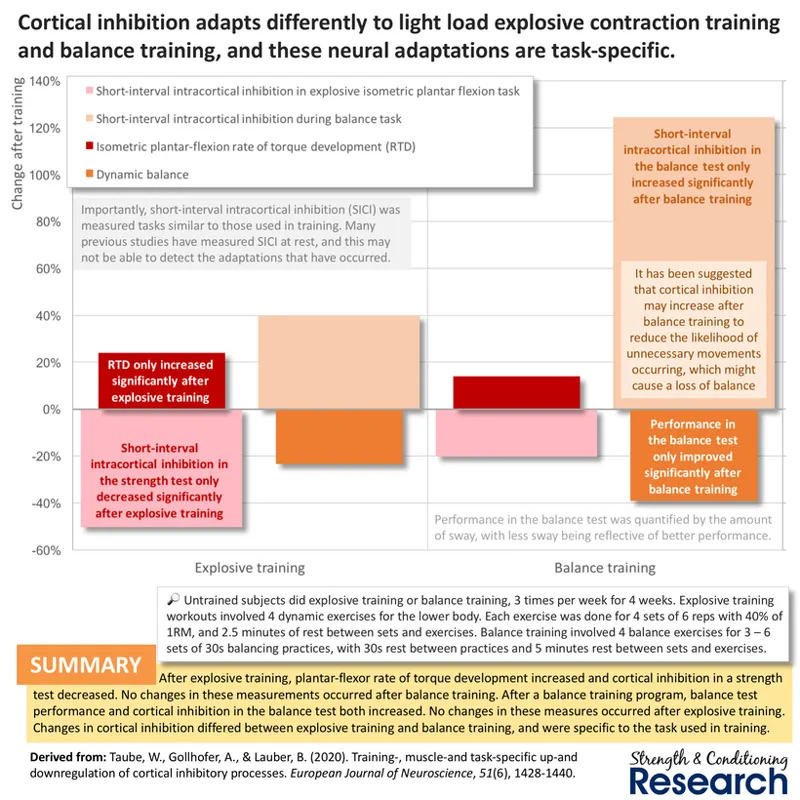
Balance training increases cortical inhibition, which facilitates balancing and improves performance in unstable tasks. In contrast, rapid movement training decreases cortical inhibition in order to facilitate an increase in the speed of movement. These adaptations seem to be directly opposite to one another.
.
Conclusions
Block periodization is a way of organizing physical training into clearly-defined and relatively-long periods of time. Block periodization involves concentrating almost exclusively on developing one or more physical qualities in each period of time (called "blocks"). In respect of this feature, we can make several observations: [1] when using block periodization, the targeted physical quality improves much faster than other physical qualities that are not targeted. This makes block periodization highly suitable for achieving rapid changes in a particular outcome; [2] when using block periodization, physical qualities that are not targeted will likely dissipate. This makes block periodization unsuitable for maintaining adaptations that dissipate quickly, including hypertrophy, sarcomerogenesis, and increases in tendon stiffness; [3] when using block periodization, the workouts used for one physical quality do not interfere with the workouts used for another physical quality because they are not performed in the same period of time. This makes block periodization quite interesting to consider for team sports athletes in need of multiple, different physical qualities; [4] block periodization permits phase potentiation to occur, which is where an adaptation produced by an initial training block enhances an adaptation produced by a subsequent training block (e.g. increased motor unit recruitment caused by heavy strength training enhances hypertrophy in a subsequent moderate load training block); and [5] block periodization permits phase interference to occur, which is where an adaptation produced by an initial training block suppresses the adaptation produced by a subsequent training block (e.g. balance training reduces gains in rate of force development caused by a subsequent strength training block).


Comments (2)
I was very surprised that in study 2 block periodisation was more effective than concurrent training at increasing endurance. I was expecting concurrent training to actually favour endurance whilst reducing strength/power adaptions.
Yes, and it's more evidence for why the traditional molecular signaling explanation of the concurrent training interference effect isn't that great. On the other hand, a model based on CNS fatigue works in both directions...