








Calves
Calf muscle training is a contentious topic among bodybuilders, since many lifters find them among the most challenging muscle groups to train. New research provides some insights into the best ways of training the calves.
.
#1. Plantar-flexion internal moment arm lengths - the effect of knee angle
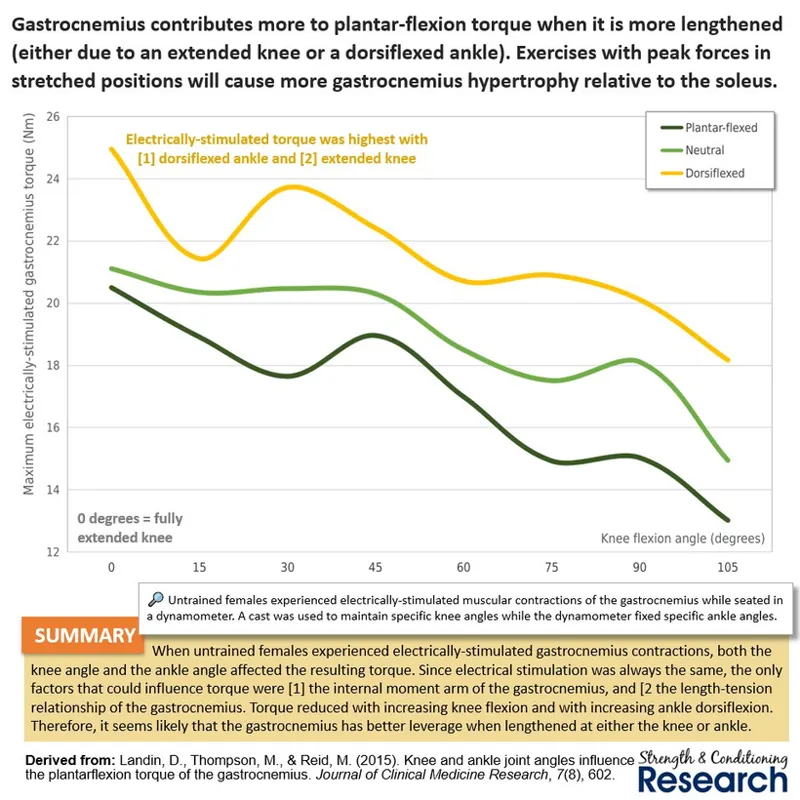
The calves comprise two separate two-joint gastrocnemius muscles (lateral and medial) and the single-joint soleus muscle. All three of these muscles can perform ankle plantar-flexion. The knee angle affects the ability of the gastrocnemius to perform ankle plantar-flexion. When the knee is extended (which stretches the gastrocnemius because it is a knee flexor), this increases gastrocnemius leverage for ankle plantar-flexion. Therefore, a standing calf raise will automatically involve more gastrocnemius simply because of its better leverage.
.
This difference in leverages with muscle length is partly reflected in the muscle activation data. The gastrocnemius lateralis is more strongly activated when peak force is produced at a long muscle length, while the gastrocnemius medialis is more strongly activated when peak force is produced at a short muscle length.
.
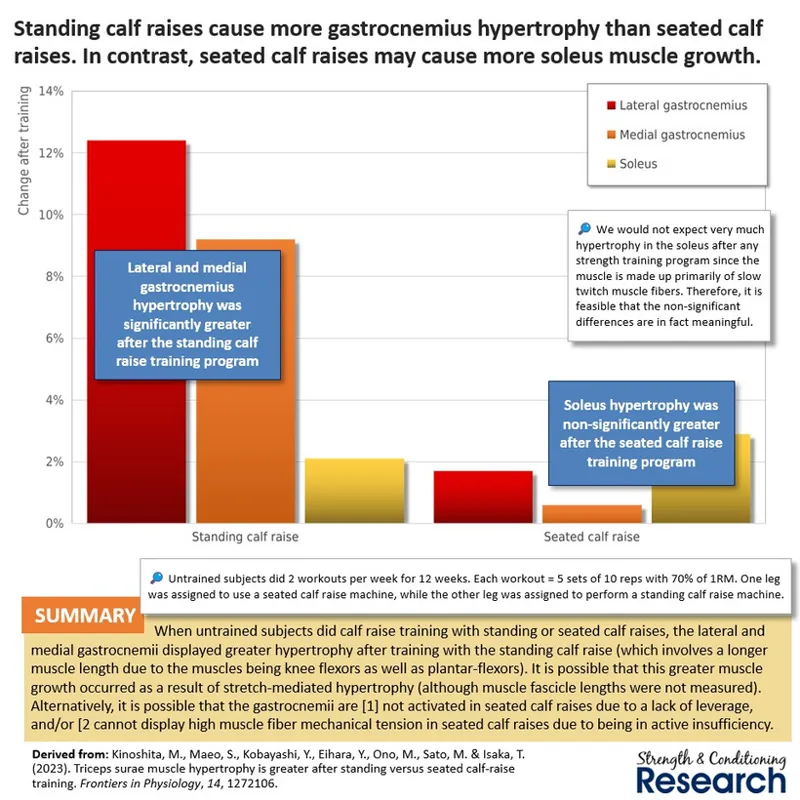
The difference in leverages with muscle length is much more accurately reflected in the muscle swelling data. Both the medial and lateral gastrocnemius lateralis swell more when they are tested immediately after being trained by ankle plantar-flexion with an extended knee compared to when they are trained by ankle plantar-flexion with a flexed knee.
.
Nevertheless, despite the somewhat odd muscle activation data, long-term training data gives the result we might expect from the internal moment arm lengths. Both the medial and lateral gastrocnemius grow better when trained by ankle plantar-flexion exercise while the knee is extended. In contrast, the soleus grows more when the knee is flexed.
.
#2. Plantar-flexion internal moment arm lengths - the effect of ankle angle
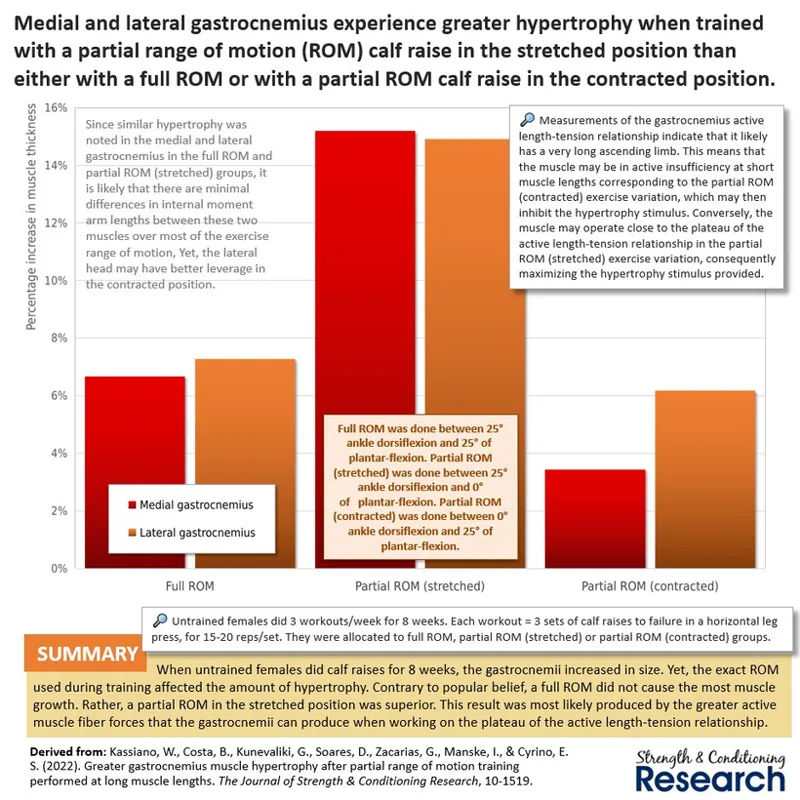
When the ankle is dorsiflexed (which stretches all three ankle plantar-flexors), this increases gastrocnemius leverage for ankle plantar-flexion but decreases soleus leverage. Therefore, a partial range of motion calf raise involves a greater contribution from the gastrocnemius and a smaller contribution from the soleus. This is reflected in the long-term training studies.
.
#3. Hip rotation angle affects the relative activation and growth of the gastrocnemius medialis and lateralis
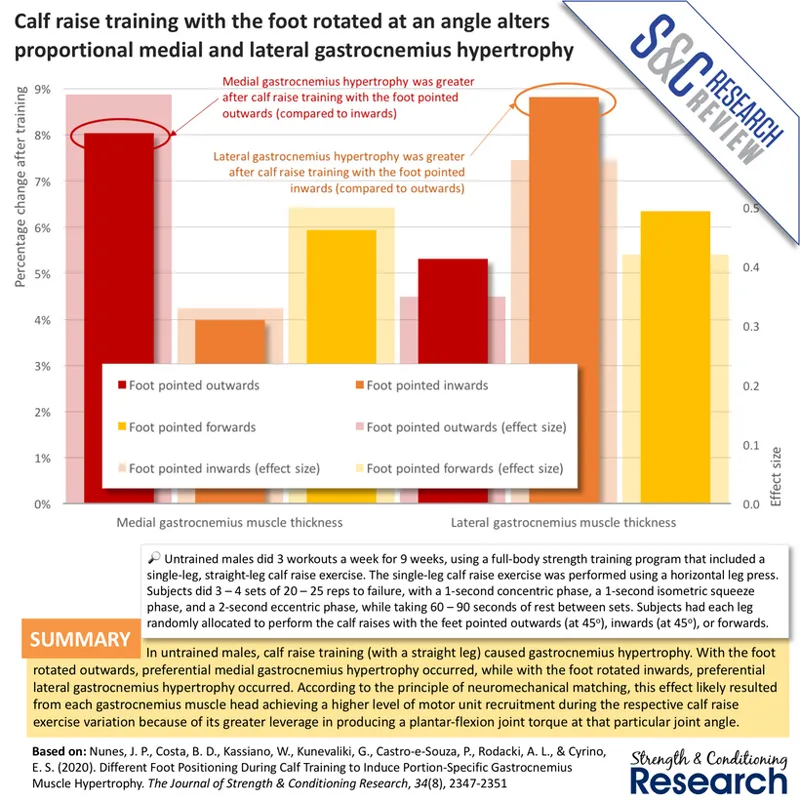
Hip rotation angle does directly affect proportional gastrocnemius lateralis and medialis hypertrophy. Training with the hip externally rotated (such that the foot is also pointing outwards), causes preferentially more gastrocnemius medialis hypertrophy, while training with the hip internally rotated (such that the foot is also pointing inwards), causes preferentially more gastrocnemius lateralis hypertrophy.
.
#4. The gastrocnemius muscles are two-joint muscles and display typical two-joint muscle behavior
As two-joint muscles that perform both ankle plantar-flexion and knee flexion, the activation of the gastrocnemius muscles is greatly suppressed during any combined knee extension and ankle plantar-flexion movement (like squats and leg presses).
.
In addition, the medial gastrocnemius tend to display more distal region activation during any plantar-flexion task, which is a common behavior of two-joint muscles like the rectus femoris.
.
#5. The gastrocnemius muscles do not work on the descending limb so we should not expect stretch-mediated hypertrophy
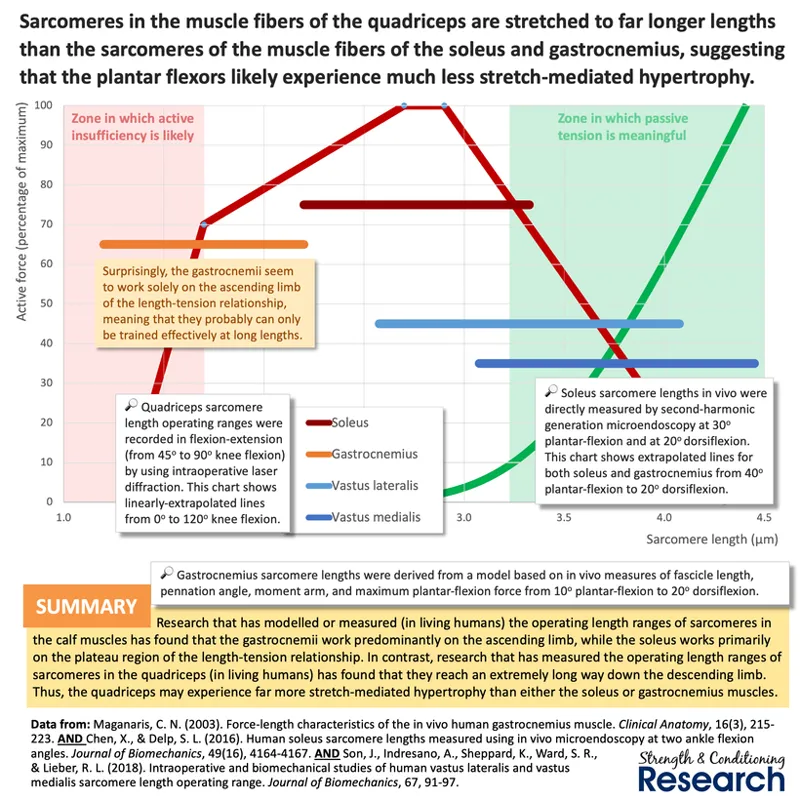
The gastrocnemius muscles appear to work mainly on the ascending limb and plateau of the length-tension relationship and probably do not therefore experience stretch-mediated hypertrophy after strength training.
.
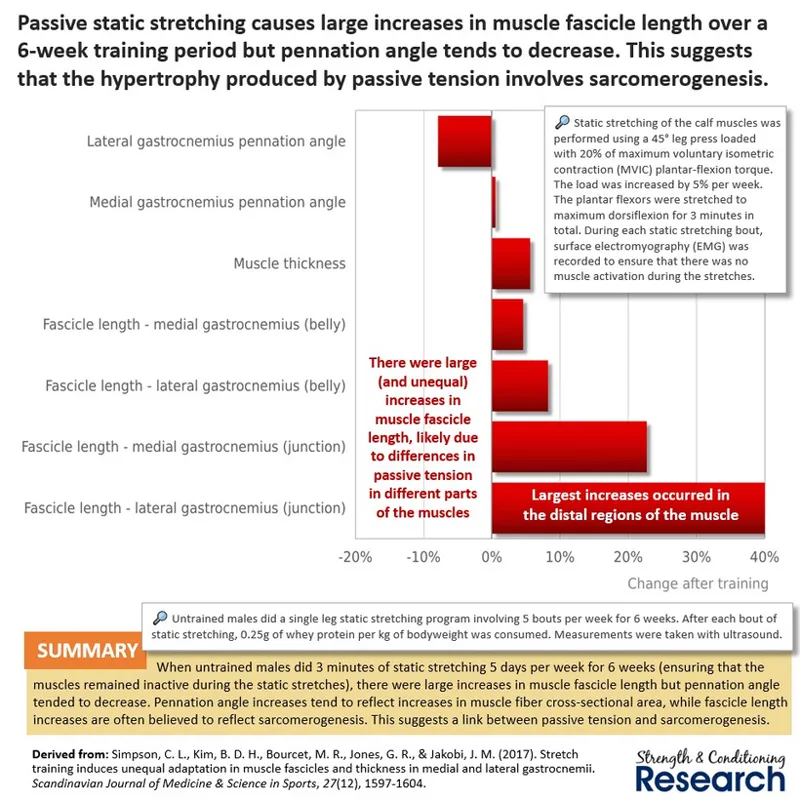
Nevertheless, static stretching appears to produce increases in muscle fascicle length, which is somewhat unexpected (this is what I mean when I say that the calves break the model).
.
Similarly, they display increases in muscle fascicle length after maximal effort eccentric training programs. Even so, the soleus displays greater increases in muscle fascicle length, which is exactly what we would expect based on its operating sarcomere lengths that reach much further onto the descending limb.
.
#6. Training with light loads does not cause greater calf muscle growth
It has been suggested that muscles with mainly slow twitch muscle fibers might respond better to being trained with lighter loads, while muscles that contain more fast twitch muscle fibers might respond better to being trained with heavier loads. Yet, research has shown that the predominantly slow twitch soleus muscle does not respond better to being trained with light loads than with moderate loads, and that the balanced gastrocnemius muscle similarly does not respond differently from being trained with either light or moderate loads.
.
#7. The calf muscles recover quickly after exercise
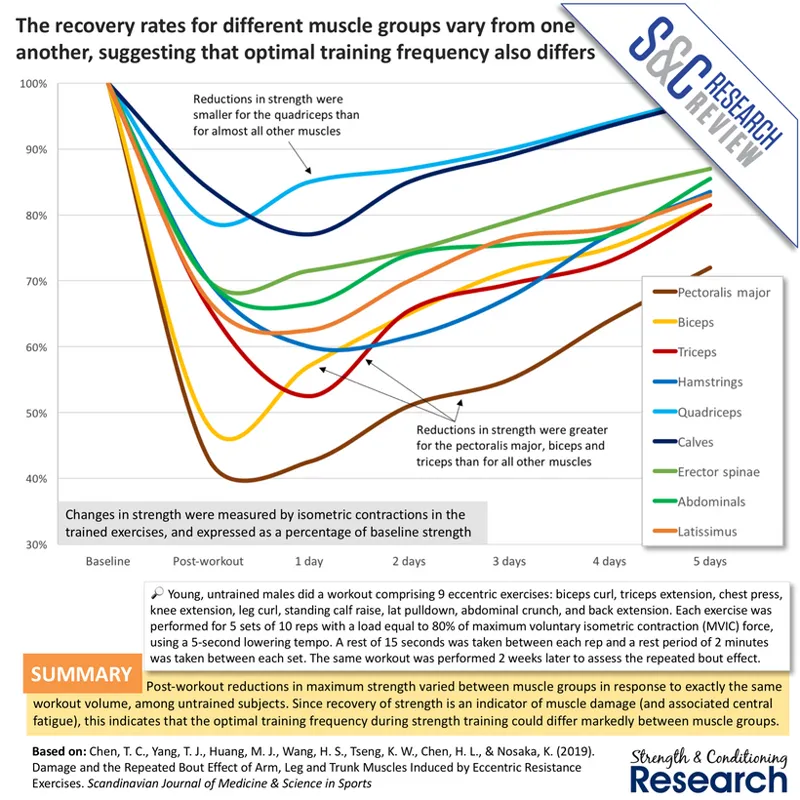
Although the quadriceps are the muscle group that is least susceptible to damage after exercise (contrary to popular belief), the calves are not far behind.
.
The calf muscles are a moderately-large muscle group, and are therefore relatively difficult to activate fully. This likely contributes to their tendency to recover quickly post-workout since it means that fewer of their easily-damaged fast twitch muscle fibers are activated during exercise.
.
Indeed, while the soleus is an extremely slow twitch muscle group, the gastrocnemius is much more balanced between slow and fast twitch proportions. Thus, it is more likely the low voluntary activation that contributes to its tendency to recover quickly post-workout.
.
Conclusions
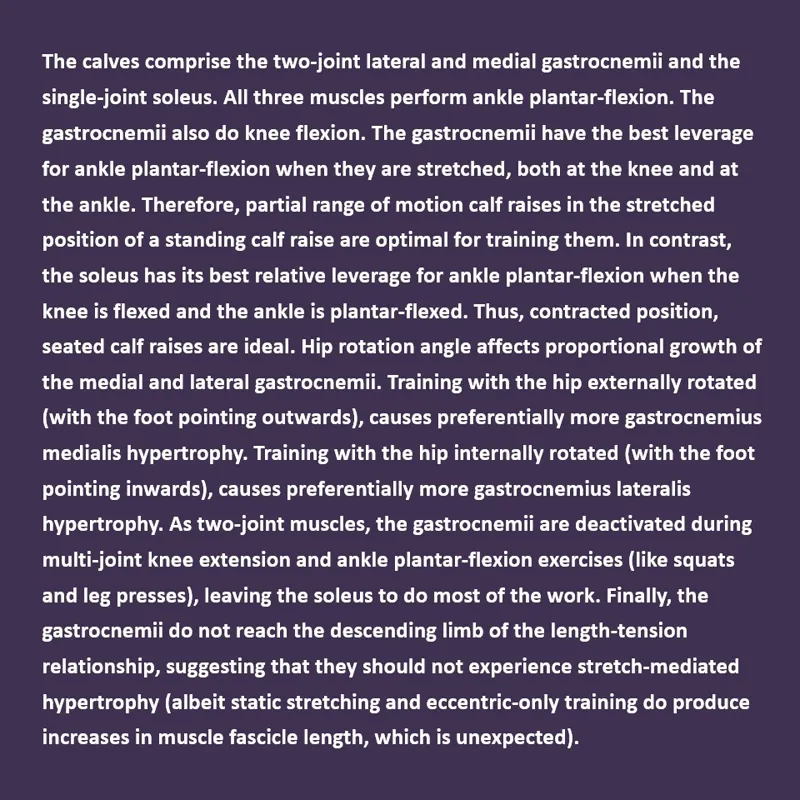
The calves comprise the two-joint lateral and medial gastrocnemii and the single-joint soleus. All three muscles perform ankle plantar-flexion. The gastrocnemii also do knee flexion. The gastrocnemii have the best leverage for ankle plantar-flexion when they are stretched, both at the knee and at the ankle. Therefore, partial range of motion calf raises in the stretched position of a standing calf raise are optimal for training them. In contrast, the soleus has its best relative leverage for ankle plantar-flexion when the knee is flexed and the ankle is plantar-flexed. Thus, contracted position, seated calf raises are ideal. Hip rotation angle affects proportional growth of the medial and lateral gastrocnemii. Training with the hip externally rotated (with the foot pointing outwards), causes preferentially more gastrocnemius medialis hypertrophy. Training with the hip internally rotated (with the foot pointing inwards), causes preferentially more gastrocnemius lateralis hypertrophy. As two-joint muscles, the gastrocnemii are deactivated during multi-joint knee extension and ankle plantar-flexion exercises (like squats and leg presses), leaving the soleus to do most of the work. Finally, the gastrocnemii do not reach the descending limb of the length-tension relationship, suggesting that they should not experience stretch-mediated hypertrophy (albeit static stretching and eccentric-only training do produce increases in muscle fascicle length, which is unexpected).
Comments (4)
so the medial gastroc has better leverage in a shorter position? i thought its best to focus the stretch?
I find that both quads and calves seem easier to cluster set, even at higher reps. I can do 10 reps of calf raises (unilateral, leg press machine) and then after switching side immediately get another 7-8 reps out of it before near-failure. Is this due to their faster recovery rate vs other muscles? Calves being better activated when extending the knee - could this be applied to keeping the knee slightly flexed as well, due to the quads being more active to prevent further passive knee flexion? Some kind of radiation phenomenon? Are the calves stronger in that position as well? Personally I find the contact somewhat better there, compared to extended knees. Great article as always!
Great article. When you say the calves are a moderately large muscle does that refer to both the gastrocnemius medialis and gastrocnemius lateralis? From my vantage point I’m used to hearing people group them together as one “gastroc” or gastrocnemius. I’m very interested in this research suggesting that larger muscles are harder to activate fully. What do you think is a reasonable before and after change in terms calf muscle voluntary activation level. Is 84% to 99% possible?
The soleus makes up about 50–60% of the calf muscle group, and the medial gastrocnemius is most of the remainder, but yes I was referring to the plantar flexor muscle group in its entirety. TBH, we don't really have good data on how much each muscle can change in terms of voluntary activation over a long period of time. Most studies have just looked at 2-3 months of training, and usually only in the quadriceps.