








Quadriceps
Which exercises are best for training the quadriceps muscles?
.
#1. Internal moment arm lengths
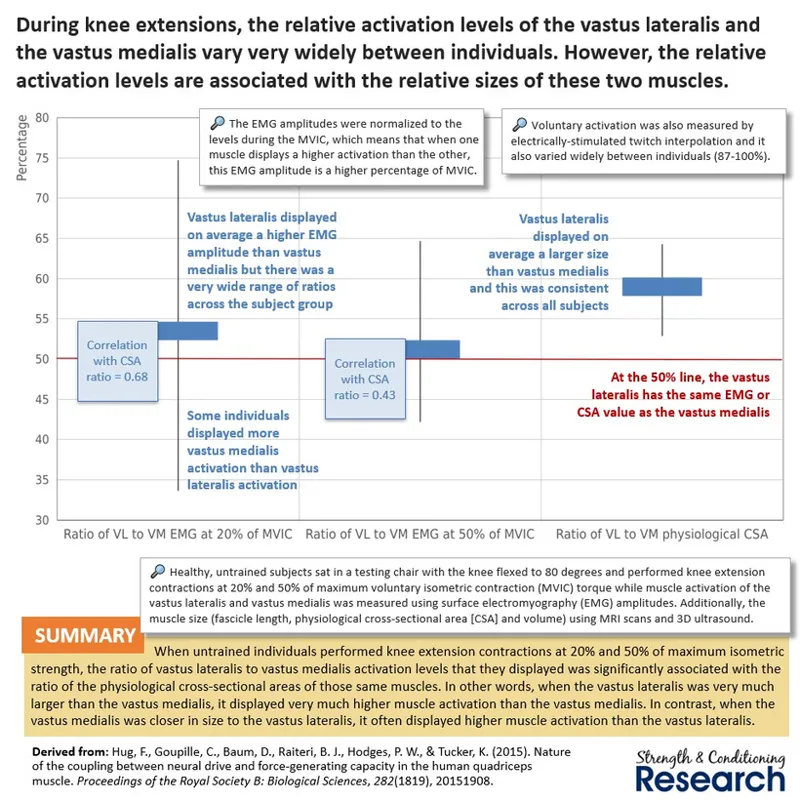
The quadriceps muscles have similar leverages for knee extension. Therefore, their size tends to determine which of them receive the most central motor command during an exercise.
.
#2. Squats, lunges, and leg presses
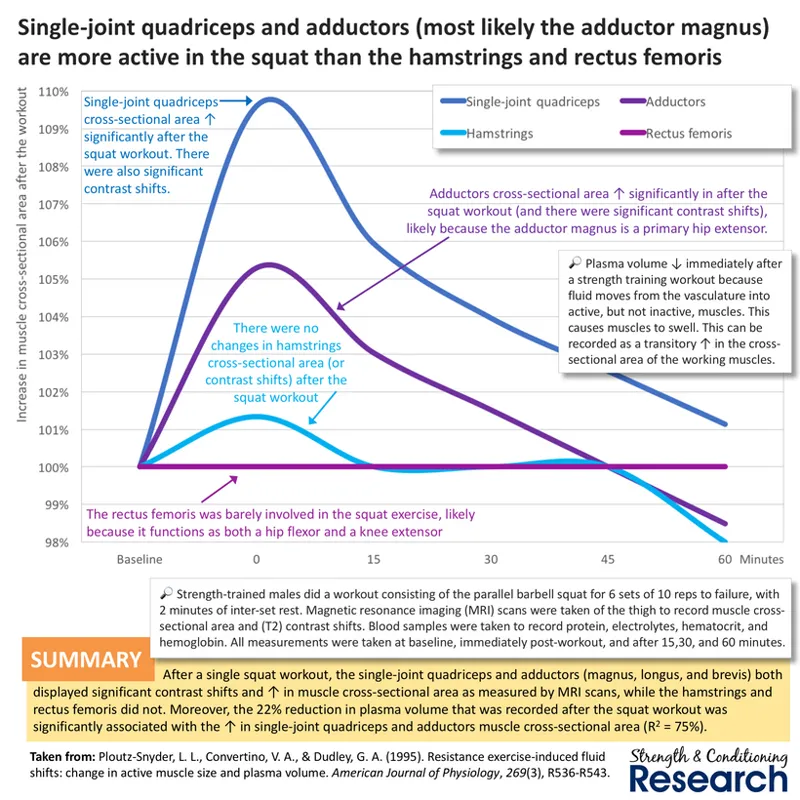
The single-joint quadriceps muscles are all highly active during the back squat exercise, whereas the two-joint rectus femoris is not. This is difficult to assess with electromyography because of cross-talk between the muscles (which are very close together). However, it can be detected by temporary changes in muscle cross-sectional area using magnetic resonance imaging (MRI) scans.
.
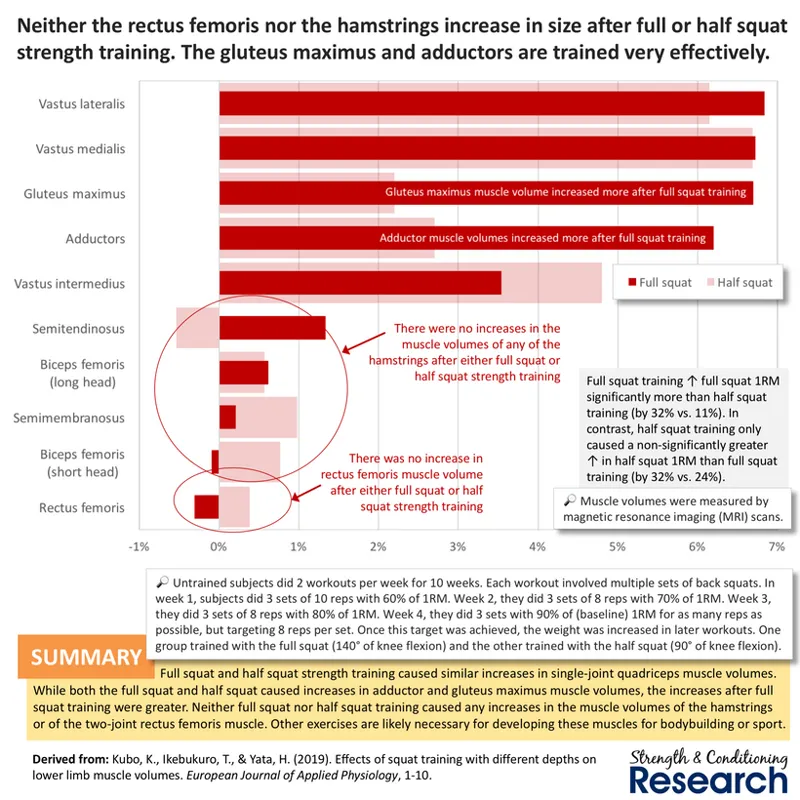
Consequently, while the single-joint quadriceps muscles grow after strength training with the back squat exercise, the rectus femoris does not grow at all.
.
The same phenomenon can be observed with training programs also including the leg press, deadlift, and lunge. The rectus femoris simply does not grow.
.
This happens because of antagonist inhibition of the rectus femoris in accordance with the two-joint muscle problem or two-joint muscle principle (read more).
.
#3. Knee extensions
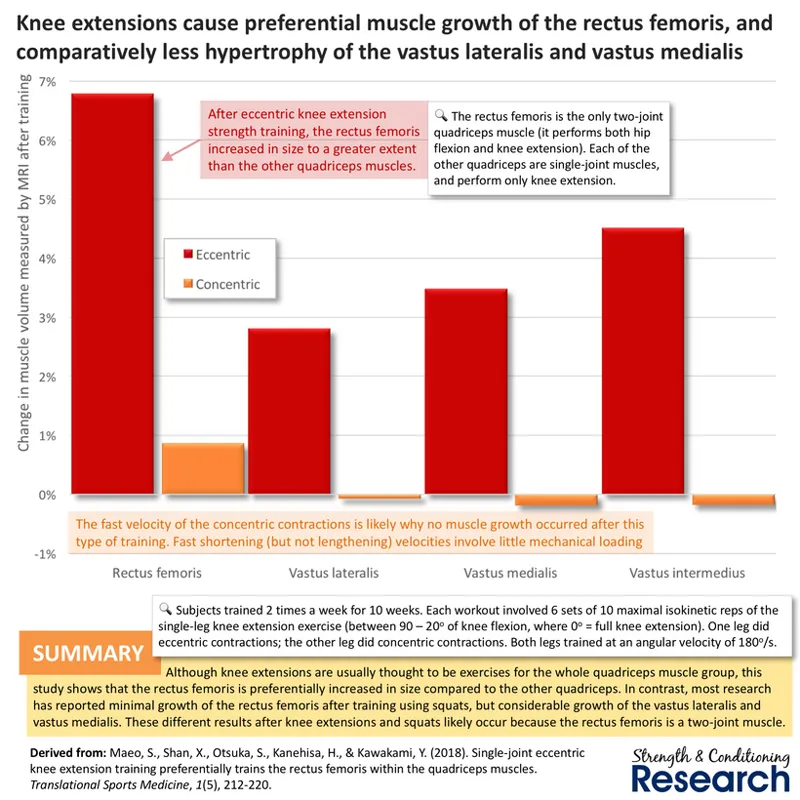
The single-joint quadriceps muscles are less active during the knee extension exercise in comparison with the two-joint rectus femoris. Consequently, the rectus femoris experiences much greater hypertrophy after knee extension strength training than the single-joint quadriceps.
.
#4. Hip flexion
The rectus femoris is a two-joint hip flexor and knee extensor. It has the best leverage out of all of the hip flexor muscles for the first 65 degrees of hip flexion. Therefore, we can train the muscle with contracted position or partial range of motion hip flexion exercises.
.
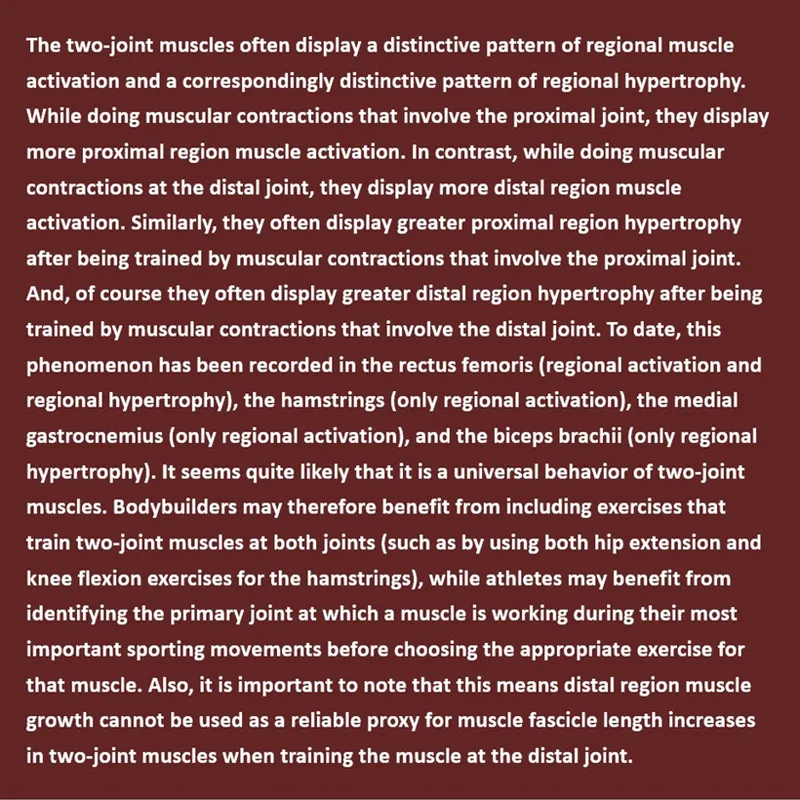
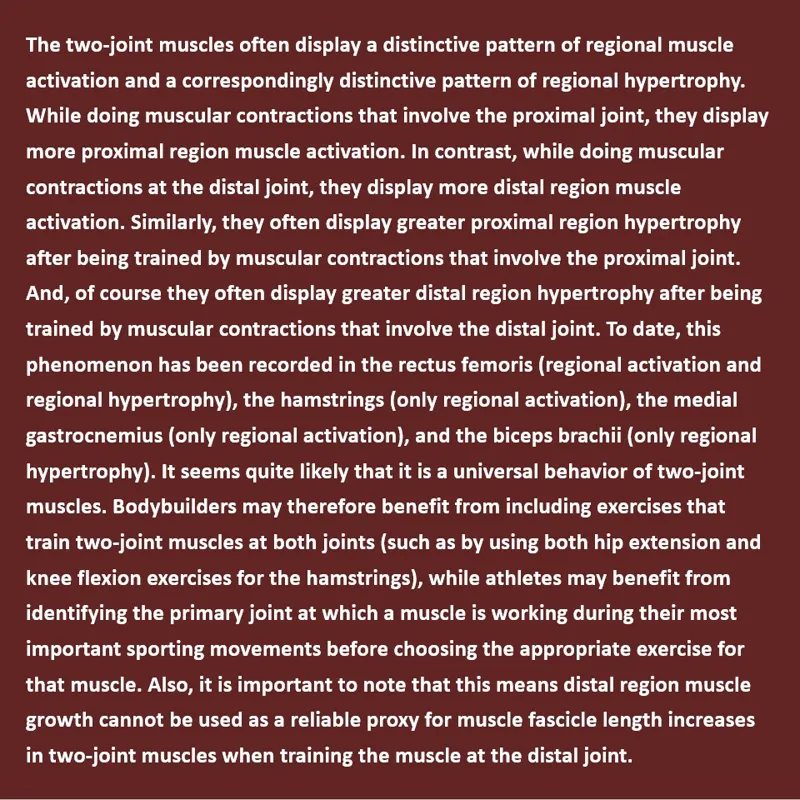
The proximal part of the rectus femoris is primarily active during hip flexion, while the distal part is primarily active during knee extension. Therefore, both hip flexion and knee extension exercises are likely necessary for maximal rectus femoris development.
.
This phenomenon is common to most if not all two-joint muscles, which tend to display greater activation in the regions of the muscle closest to the joint that is doing the movement (read more).
.
#5. The rectus femoris as a hip flexor in sporting movements
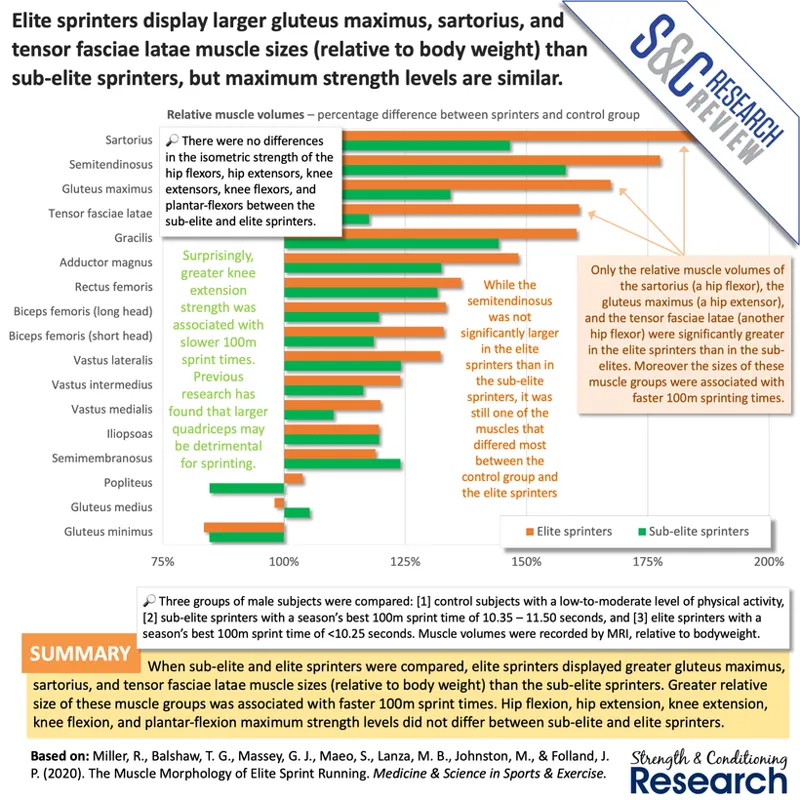
Importantly, the sprinting movement is primarily dependent upon the work done by the hip extensors and hip flexors. The hip extensors do positive work in terminal swing (and the amount of this work done increases dramatically with increasing running speed), while the hip flexors do positive work in initial swing (and the amount of this work done similarly increases dramatically with increasing running speed). Thus, to achieve very high sprinting speeds requires the hip flexors to be able to produce very high power outputs.
.
In line with this, recent research has shown that the most important muscles for sprint running are hip extensors (including the gluteus maximus and hamstrings) and hip flexors (including the sartorius and tensor fasciae latae). Developing these muscles is therefore very important for athletes who sprint.
.
Although research has only linked the size of certain hip flexors with higher levels of performance, it is likely that most if not all of the hip flexors (including the rectus femoris) contribute to faster sprinting speeds. Indeed, previous biomechanical research has shown that the rectus femoris does increase its involvement as running speed increases.
.
#6. Stretch-mediated hypertrophy
Several studies have recorded the operating sarcomere lengths of the various quadriceps muscles. The methods used greatly influence the results. The most recent studies using the most advanced methods have revealed very long descending limbs, which suggest that this muscle group is likely to experience stretch-mediated hypertrophy during strength training.
.
Indeed, many studies have reported that the quadriceps display increases in muscle fascicle length after beginners take part in strength training programs.
.
The effect can be enhanced in the rectus femoris by using a reclined seat position to move the hip into an extended position, thereby lengthening the two-joint muscle.
.
Conclusions
The quadriceps comprise one two-joint muscle (the rectus femoris) and three single-joint muscles (the vastus lateralis, vastus medialis, and vastus intermedius). During multi-joint hip and knee extension exercises (like squats, lunges and leg presses), the rectus femoris is switched off due to antagonist inhibition but the three single-joint muscles are trained very effectively. Since they have similar leverages to one another over the joint range of motion, their relative sizes tend to determine which of them is most activated. During single-joint hip flexion, the rectus femoris has best leverage in the contracted position and its proximal part is more strongly activated than its distal part. During single-joint knee extension, the rectus femoris is more activated than the single-joint quadriceps and its distal part is more strongly activated than its proximal part. For maximal rectus femoris growth, both hip flexion and knee extension exercises may be necessary. All of the quadriceps have operating sarcomere lengths that reach the descending limb and therefore display stretch-mediated hypertrophy when trained at longer muscle lengths. This effect can be increased in the two-joint rectus femoris by performing knee extensions with the hip extended rather than flexed (by leaning backwards).

Comments (7)
I don’t understand the rationale of higher activity In a leg extension. Because it’s just achieving one function knee extension which is a function of all the quad muscles muscles. If it was like only hip flexion movement that would make more sense. What would make sense is that if the group that trained the leg extension didn’t train much of their rec fem which made them grow more or that the rec fem is the greatest knee extensor in shortened positions while the other at mid maybe?
Where do the single joint quads have their best leverage? Thank you.
In terms of frequency, would it be better to alternate between squat and knee extension sessions, once per week each, or should they both be in the same session? I'm guessing the exercises are different enough in terms of muscle and regions that by alternating, the time lapse between sessions may be unnecessarily long?
There is an interesting physiological phenomenon that informs exercise order that is relevant to squats/knee extensions. Exercises that involve more muscle mass involve more CNS fatigue during exercise (not after exercise, where CNS fatigue is caused by a different mechanism). So our ability to achieve high levels of motor unit recruitment is reduced in squats compared to in knee extensions. Since CNS fatigue also builds up during exercise, this means that if we start a workout with squats (at a certain level of motor unit recruitment) and then proceed to knee extensions (normally at a higher level of motor unit recruitment, but reduced due to being performed after squats), then the stimulus produced by each exercise is likely to be quite similar (albeit directed towards different muscles). So the two exercises actually work quite well together in a single workout.
I see, makes sense.
I heard someone with a sport science background the other day say that exercises which involve a larger displacement aka range of motion such as in thigh parallel squats versus quarter squats, the force velocity curve is shifted more towards a velocity oriented profile. Is that a concept you are familiar with? I’ve not seen many people talk about it. With that in mind, to train velocity friendly characteristics in the rectus femoris, bands could be used to train the leg through hip flexion all the way to knee extension. If the idea of bar displacement or band displacement has merit?
The reason that larger ROMs involve a more velocity-oriented profile is that the maximum velocity achievable at the end of the rep is faster, due to the longer period of time available for acceleration. The same concept applies when comparing back squats with maximal effort and a light load with jump squats. IMO, this works because achieving a faster velocity is what causes peripheral adaptations inside the muscle fiber that benefit muscle shortening velocity (and not because of changes in rate coding).