



Two-joint muscle regional hypertrophy
Two-joint muscles (like the hamstrings, rectus femoris, biceps brachii, triceps brachii long head, and gastrocnemius) display a very distinctive pattern of regional muscle activation and therefore also a corresponding pattern of regional hypertrophy. When performing muscular contractions with the proximal joint, they display proximal region muscle activation (and subsequently they display proximal region hypertrophy). And when performing muscular contractions with the distal joint, they display distal region muscle activation (and distal region hypertrophy).
.
#1. Rectus femoris
When doing knee extension contractions, the activation of the rectus femoris is biased towards the distal region. In contrast, when doing hip flexion contractions, the activation of the rectus femoris is biased towards the proximal region.
.
Correspondingly, when strength training the rectus femoris with knee extension exercises, we see distal region hypertrophy predominating (since this study was performed in strength-trained lifters, it is unlikely that the distal region hypertrophy could be attributed to sarcomerogenesis)
.
#2. Hamstrings
When doing hip extension contractions, the activation of the hamstrings is biased towards the proximal region. In contrast, when doing knee flexion contractions, the activation of the muscles is biased towards the distal region.
.
#3. Medial gastrocnemius
When the gastrocnemius is used to carry out plantar-flexion activity, it has been observed to display greater distal region muscle activation than proximal region activation.
.
#4. Biceps brachii
When the biceps brachii are exposed to a variety of pressing exercises (flat bench press, incline bench press, decline bench press), they display proximal region hypertrophy. The biceps brachii are actually quite good shoulder flexors but only within a very limited range of motion, so using a wide variety of pressing exercises raises the chances that they will contribute during a training program.
.
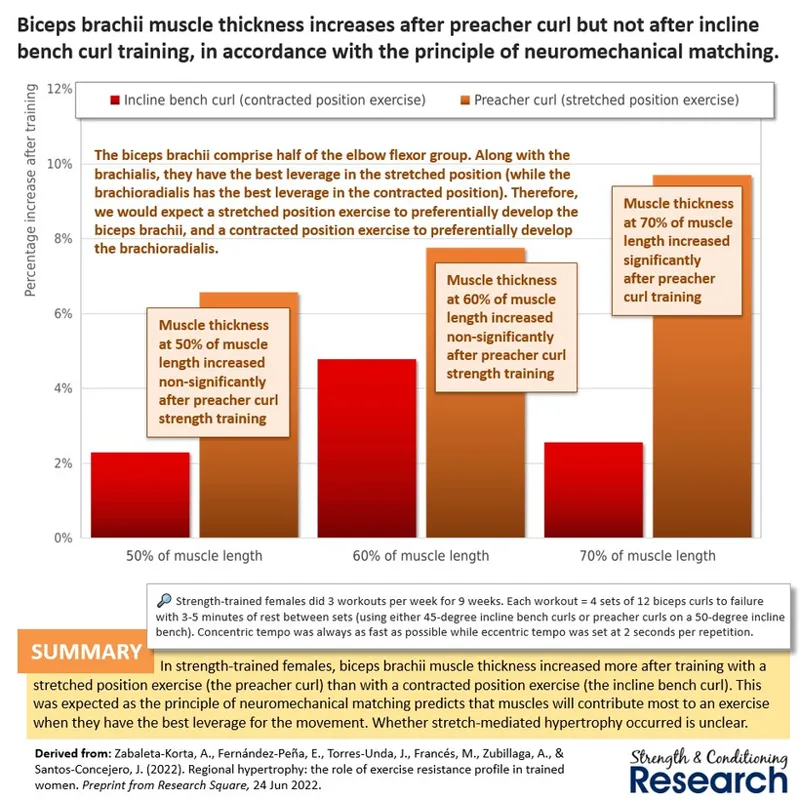
Interestingly, the incline bench curl seems to target the proximal region of the biceps brachii, which indicates that it mainly works as a shoulder flexor in this exercise instead of as an elbow flexor. This has important implications for programming.
.
In contrast, the biceps brachii very reliably displays greater distal region muscle growth after being trained primarily as an elbow flexor during curl variations.
.
Indeed, this has been observed in a number of studies and is therefore a repeatable finding.
.
Conclusions
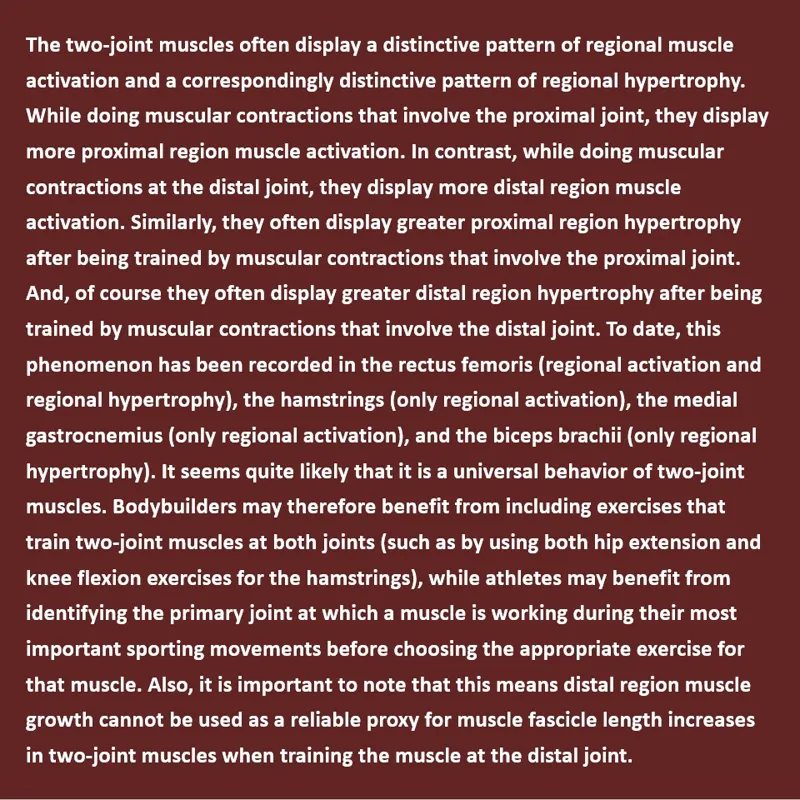
The two-joint muscles often display a distinctive pattern of regional muscle activation and a correspondingly distinctive pattern of regional hypertrophy. While doing muscular contractions that involve the proximal joint, they display more proximal region muscle activation. In contrast, while doing muscular contractions at the distal joint, they display more distal region muscle activation. Similarly, they often display greater proximal region hypertrophy after being trained by muscular contractions that involve the proximal joint. And, of course they often display greater distal region hypertrophy after being trained by muscular contractions that involve the distal joint. To date, this phenomenon has been recorded in the rectus femoris (regional activation and regional hypertrophy), the hamstrings (only regional activation), the medial gastrocnemius (only regional activation), and the biceps brachii (only regional hypertrophy). It seems quite likely that it is a universal behavior of two-joint muscles. Bodybuilders may therefore benefit from including exercises that train two-joint muscles at both joints (such as by using both hip extension and knee flexion exercises for the hamstrings), while athletes may benefit from identifying the primary joint at which a muscle is working during their most important sporting movements before choosing the appropriate exercise for that muscle. Also, it is important to note that this means distal region muscle growth cannot be used as a reliable proxy for muscle fascicle length increases in two-joint muscles when training the muscle at the distal joint.