

Post-workout fatigue factors
There are five main training variables that affect the magnitude of post-workout fatigue during strength training workouts. They all affect post-workout fatigue by altering the amount of calcium ion accumulation, either from the sarcoplasmic reticulum or through the stretch-activated ion channels.
.
#1. Training volume
Higher volumes of training cause more post-workout fatigue than lower volumes because they involve muscle fibers being activated for a longer duration of time and therefore exposed to more calcium ion accumulation.
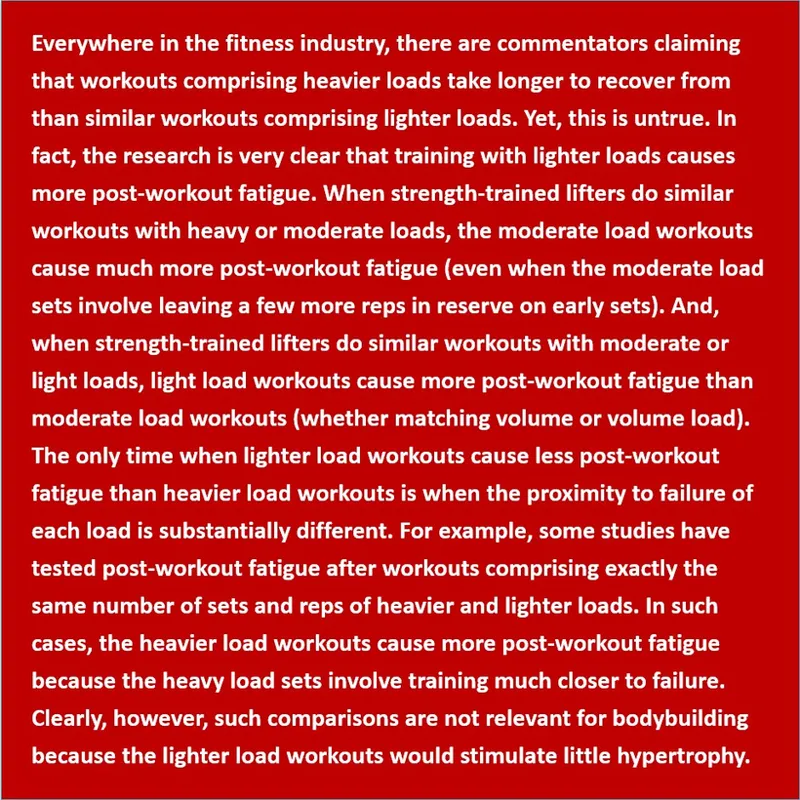
#2. Repetition range
Lighter loads cause more post-workout fatigue than heavier loads because they involve muscle fibers being activated for a longer duration of time and therefore exposed to more calcium ion accumulation (read more).
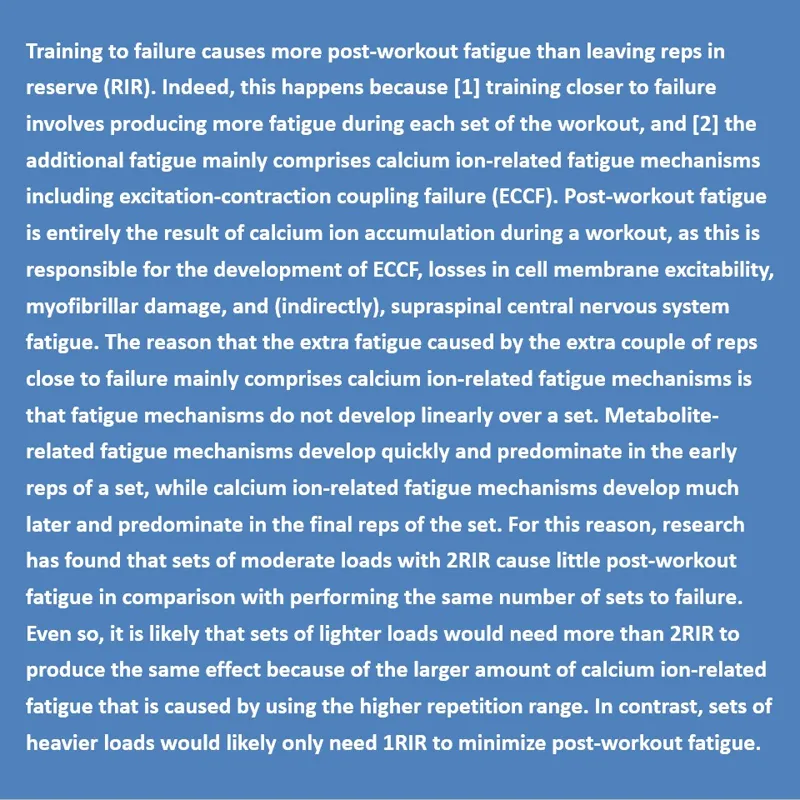
#3. Proximity to failure
Training closer to failure causes more post-workout fatigue than leaving one or two reps in reserve because it involves more (specifically fast twitch muscle fibers) being activated for a longer duration of time and therefore exposed to more calcium ion accumulation (read more).
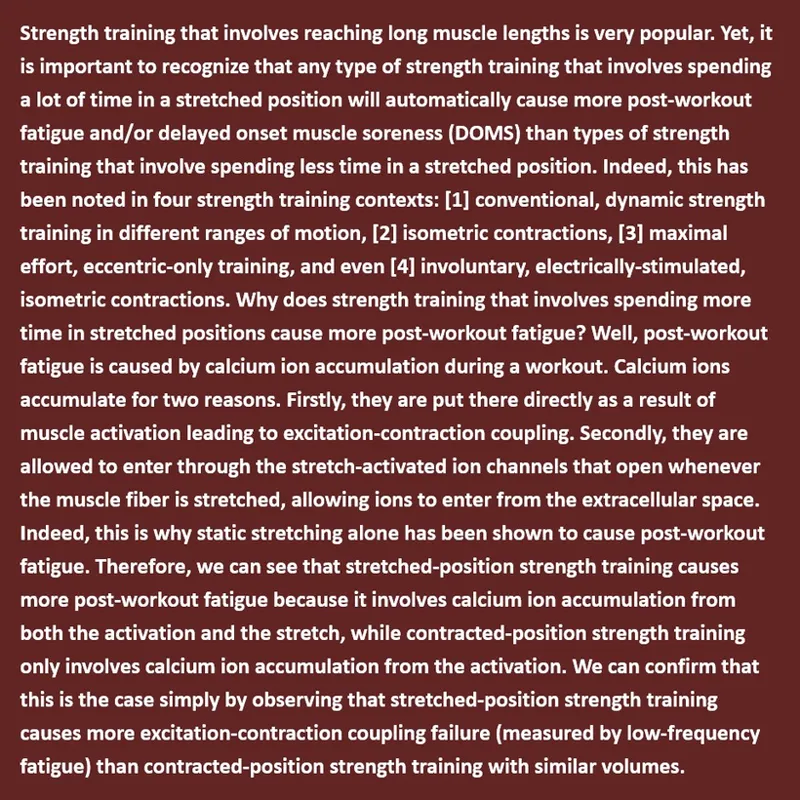
#4. Resistance profile
Training with stretched-position exercises causes more post-workout fatigue than training with contracted-position exercises because stretched-position exercises involve additional calcium ion accumulation occurring due to the opening of stretch-activated ion channels (read more).
#5. Duration (and intensity) of the eccentric phase
Training with longer-duration or higher-intensity lowering phases causes more post-workout fatigue than training with shorter-duration or lower-intensity lowering phases because longer-duration and higher-intensity lowering phases involve additional calcium ion accumulation occurring due to the greater opening of stretch-activated ion channels (read more). .
Conclusions
Five training variables alone determine the magnitude of post-workout fatigue: [1] workout training volume, [2] rep range, [3] proximity to failure, [4] resistance profile, and [5] the nature of the eccentric phase. They all affect post-workout fatigue by altering the amount of calcium ion accumulation, either from the sarcoplasmic reticulum or through the stretch-activated ion channels. Indeed, greater training volumes, higher repetition ranges (involving lighter loads), and training closer to failure all involve exposing muscle fibers (especially the fast twitch muscle fibers that are most susceptible to calcium ion-related fatigue) to more calcium ions from the sarcoplasmic reticulum because the muscle is activated for a longer duration of time. Similarly, training with a more stretched-position exercise (or using a lengthened partial) and training with either a slower lowering (eccentric) phase or a higher-intensity lowering (eccentric) phase by using weight-releasers also involve exposing muscle fibers (especially the fast twitch muscle fibers that are most susceptible to calcium ion-related fatigue) to larger amounts of calcium ions. In contrast, the source of the calcium ions in these cases is the extracellular space. While the muscle fibers are stretched, the stretch-activated ion channels open and allow the surrounding calcium ions to enter the muscle fiber cytoplasm, where they cause exactly the same problems as calcium ions that enter from the sarcoplasmic reticulum. Reducing post-workout fatigue necessarily involves minimizing each of these individual training variables while maintaining a high hypertrophy stimulus at the same time.