







Stretched position exercises and fatigue
For most of the last year or so, the fitness industry hive mind have been totally obsessed with doing lengthened partial exercise variations, believing them to be superior for hypertrophy (when in reality, they just cause a little bit more muscle growth in beginners due to sarcomerogenesis). However, there is a large downside associated with doing lengthened partial exercise variations, which is the greater fatigue that they cause. Now, I am quite sure that after reading this, many of them will shriek that there is no evidence that this statement is true, but if you look at the data that do exist, you will find that the extrapolation is inevitable.
.
#1. Lengthened partials cause more muscle soreness than full ROM training
In the context of traditional, dynamic strength training, lengthened partials have been shown to cause significantly more delayed onset muscle soreness (DOMS) and non-significantly more post-workout fatigue than conventional full range of motion (ROM) strength training exercise variations that involve reaching a shorter muscle length.
.
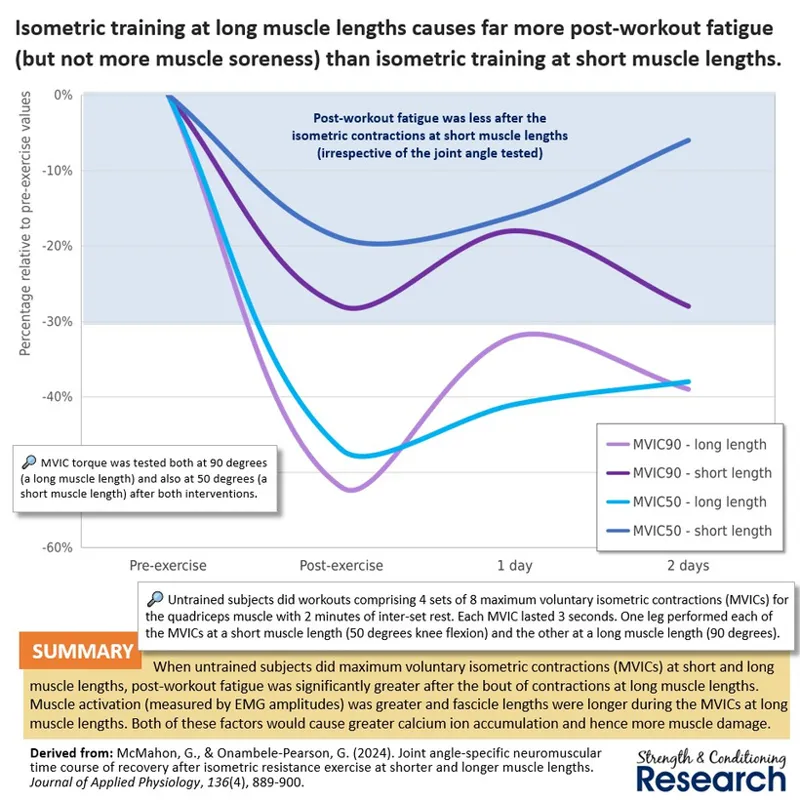
#2. Isometric contractions at long muscle lengths cause more post-workout fatigue
In the context of training with isometric contractions (which are really not any different from conventional, dynamic strength training as far as hypertrophy is concerned), isometric contractions at long muscle lengths have been shown to cause significantly more post-workout fatigue than similar isometric contractions performed at a shorter muscle length.
.
#3. Eccentric contractions to long muscle lengths cause more post-workout fatigue, soreness, and swelling
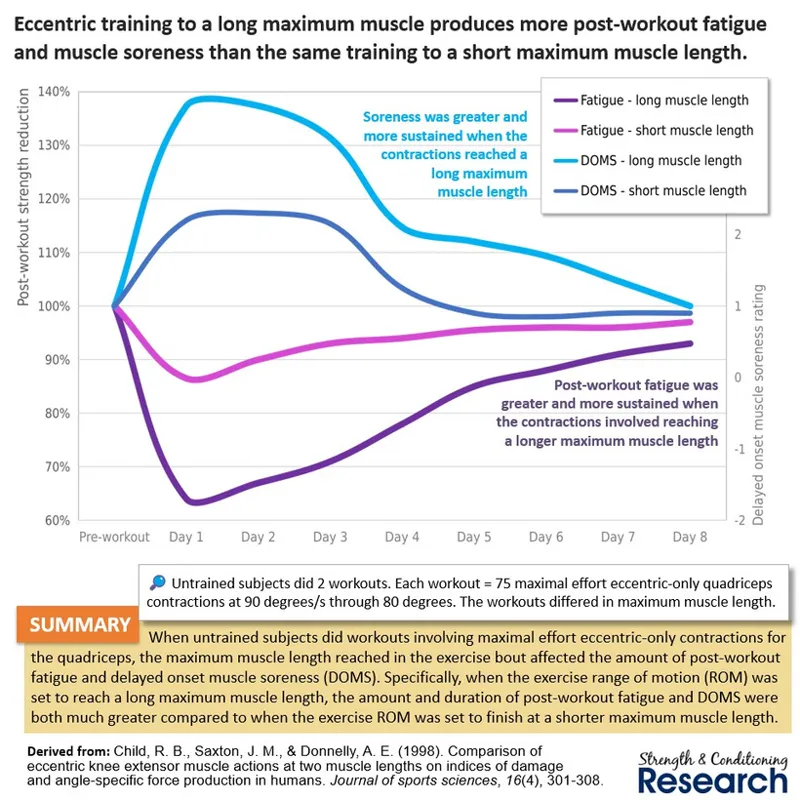
Many studies have found that maximal effort eccentric contractions that reach long muscle lengths at the end of each repetition cause much more post-workout fatigue than maximal effort eccentric contractions that reach a shorter muscle length. Since the eccentric phase of conventional strength training is a major contributor to the post-workout fatigue that we experience, performing supramaximal eccentrics greatly increases the magnitude of fatigue by damaging a greater number of muscle fibers. Yet, it is otherwise similar in effects to conventional, dynamic strength training.
.
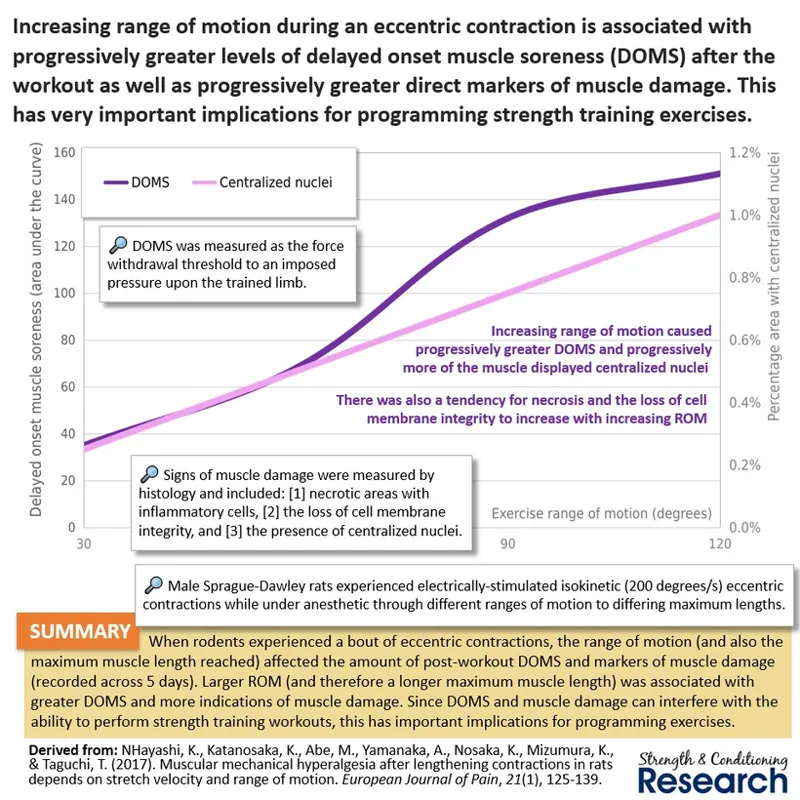
Importantly, the literature regarding eccentric training has shown that exercises involving a longer maximum muscle length cause more delayed onset muscle soreness (DOMS) as well as more post-workout fatigue.
.
It has also shown that eccentric exercises involving a longer maximum muscle length cause more muscle swelling (although this difference might only be apparent after a couple of days of post-workout recovery).
.
Although many fitness influencers dislike animal studies (for unknown reasons), the animal data show exactly the same thing.
.
#4. Electrically-stimulated, involuntary isometric contractions at long muscle lengths cause more post-workout fatigue
In the context of training with electrically-stimulated, involuntary isometric contractions, studies have shown that training at a longer muscle length causes more post-workout fatigue than the same volume of exercise performed at a shorter muscle length. Researchers use a training model of electrically-stimulated, involuntary isometric contractions so that they can equate the level of muscle activation between the conditions more easily.
.
#5. Static stretching causes post-workout fatigue
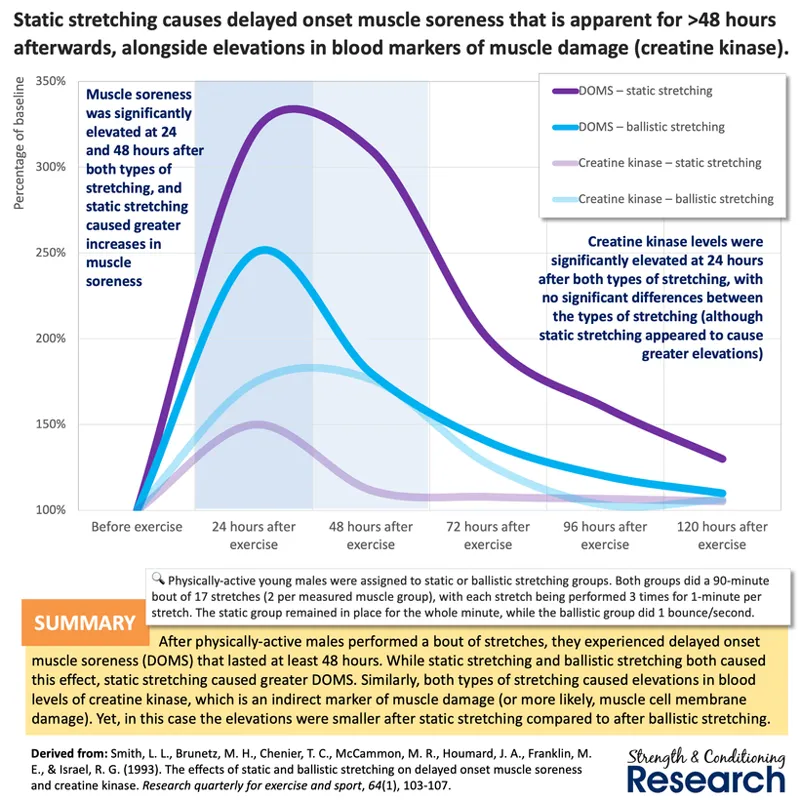
Leaving strength training aside for one moment, it is important to note that simply stretching a muscle (without activating it) also causes post-workout fatigue, delayed onset muscle soreness, and markers of muscle damage. This can help us understand why stretched-position strength training exercises involve more post-workout fatigue than contracted-position exercises. In the stretched-position strength training exercises, post-workout fatigue is caused by both stretch and contraction, while in the contracted-position exercises, post-workout fatigue is only caused by contractions.
.
#6. Why do stretched positions cause more post-workout fatigue?
The primary cause of all post-workout fatigue mechanisms is calcium ion accumulation during a workout. The main way in which calcium ions enter a muscle fiber and accumulate is by means of muscle activation. When a muscle fiber is activated, the sarcoplasmic reticulum puts calcium ions into the cytoplasm in order to produce actin-myosin crossbridges.
.
Nevertheless, calcium ions do not only enter the muscle fiber cytoplasm due to being put there by the sarcoplasmic reticulum subsequent to muscle fiber activation. They are also put there by the opening of stretch-activated ion channels. These allow calcium ions surrounding the muscle fiber to enter the cytoplasm and cause the same post-workout fatigue mechanisms.
.
We can confirm that the greater post-workout fatigue that occurs after strength training at long muscle lengths is caused by more calcium ion accumulation because there is a larger amount of low frequency fatigue.
.
Conclusions
Strength training that involves reaching long muscle lengths is very popular. Yet, it is important to recognize that any type of strength training that involves spending a lot of time in a stretched position will automatically cause more post-workout fatigue and/or delayed onset muscle soreness (DOMS) than types of strength training that involve spending less time in a stretched position. Indeed, this has been noted in four strength training contexts: [1] conventional, dynamic strength training in different ranges of motion, [2] isometric contractions, [3] maximal effort, eccentric-only training, and even [4] involuntary, electrically-stimulated, isometric contractions. Why does strength training that involves spending more time in stretched positions cause more post-workout fatigue? Well, post-workout fatigue is caused by calcium ion accumulation during a workout. Calcium ions accumulate for two reasons. Firstly, they are put there directly as a result of muscle activation leading to excitation-contraction coupling. Secondly, they are allowed to enter through the stretch-activated ion channels that open whenever the muscle fiber is stretched, allowing ions to enter from the extracellular space. Indeed, this is why static stretching alone has been shown to cause post-workout fatigue. Therefore, we can see that stretched-position strength training causes more post-workout fatigue because it involves calcium ion accumulation from both the activation and the stretch, while contracted-position strength training only involves calcium ion accumulation from the activation. We can confirm that this is the case simply by observing that stretched-position strength training causes more excitation-contraction coupling failure (measured by low-frequency fatigue) than contracted-position strength training with similar volumes.
Comments (3)
tremendous information Chris - thanks - I would also like to add that the lengthened partials are dangerous for the articualtion
Can we quantify how much more recovery time is needed, say we can recover 3 sets of short position exercise (moderate loads to failure), how many of stretched position exercise sets can we recover?
This is a great question that I have as well. Considering the Weekly Net Stimulus model is fundamentally based on fatigue this would be extremely useful to know.