



Eccentric phases and fatigue
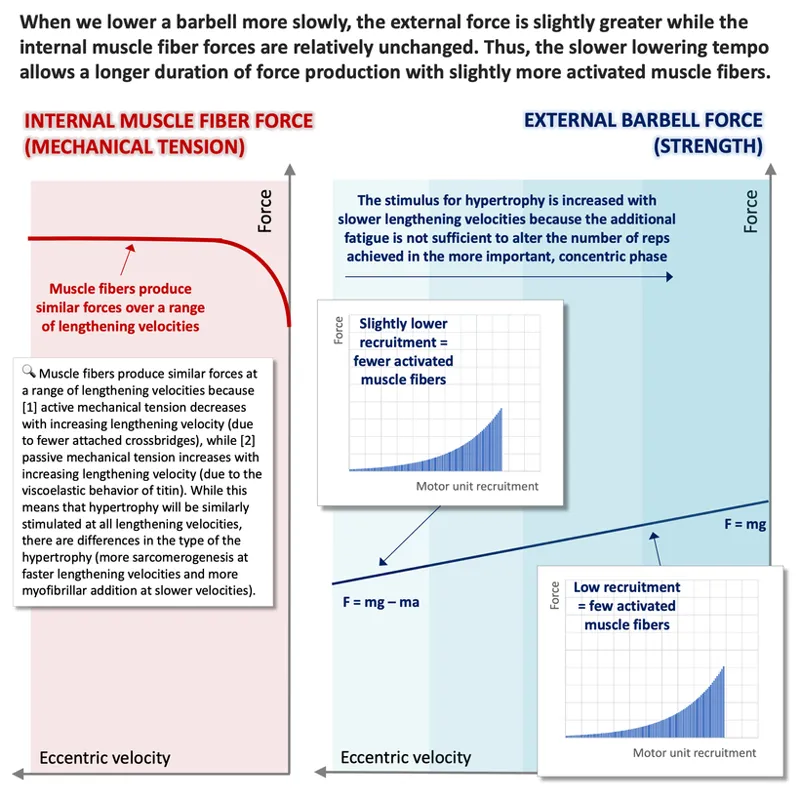
When strength training sets include slow lowering (eccentric) phases, they can cause more fatigue both during the workout and also after the workout. Additionally, when the eccentric phase involves a greater load such that motor unit recruitment is increased, this also causes more fatigue than conventional strength training.
.
#1. Slow lowering (eccentric) phases cause more fatigue during the workout
When slower lowering (eccentric) phases are used during conventional strength training, this causes additional fatigue to be experienced during the set itself that leads to fewer total reps being performed before we reach muscular failure.
.
Even so, the slower lowering (eccentric) phase does not cause more metabolite-related fatigue to be experienced, as indicated by the much lower levels of blood lactate that are recorded. For this reason, the additional fatigue experienced when using the slower lowering (eccentric) phase is necessarily the result of calcium ion-related fatigue mechanisms (which we would expect to then contribute to more post-workout fatigue).
.
#2. Slow lowering (eccentric) phases cause more fatigue after the workout
Indeed, in line with this analysis, research has show that the amount of post-workout fatigue is greater when we use slow lowering (eccentric) phases during conventional strength training.
.
Importantly, when we lower a weight more slowly in the context of conventional strength training, the external force is increased and the level of motor unit recruitment is increased. This higher level of motor unit recruitment means that more fast twitch muscle fibers are activated and this is what causes the greater post-workout fatigue. This is very different from when we compare fast and slow movement velocities during maximal effort, eccentric-only exercise, in which motor unit recruitment is very high in both conditions.
.
#3. Eccentric overload causes more fatigue after the workout
Indeed, when we compare the post-workout fatigue caused by conventional strength training with the post-workout fatigue caused by strength training with additional eccentric overload, we can see that the additional eccentric overload creates far more post-workout fatigue. This is due to the higher levels of motor unit recruitment achieved during the lowering (eccentric) phase and hence the greater number of fast twitch muscle fibers that are activated.
.
Conclusions
Although it is not very important for hypertrophy, the lowering (eccentric) phase of conventional strength training sets greatly influences the amount of post-workout fatigue. The two key characteristics of the lowering phase are: [1] the duration, and [2] the intensity. When the duration of the lowering phase is longer, fewer reps are achieved in a set to failure despite metabolite accumulation being lower. Consequently, the additional fatigue caused by the slow lowering phase tempo must be calcium ion-related, and therefore we would expect it to cause more post-workout fatigue. The obvious reason for this greater calcium ion-related fatigue is the higher level of motor unit recruitment in the lowering phase, which causes greater fast twitch fiber activation and the subsequent exposure of those activated fast twitch fibers to stretch and hence a large influx of calcium ions that are not then dealt with by mitochondria. Indeed, research has shown that delayed onset muscle soreness (DOMS) is greater when the lowering phase is done with a slower (3-second) tempo compared to a faster (1-second) tempo. Similarly, when the intensity of the lowering phase is higher (as when eccentric overload is implemented with weight-releasers or a flywheel), this also causes more post-workout fatigue in comparison with conventional strength training without eccentric overload. This greater post-workout fatigue is self-evidently caused by higher levels of motor unit recruitment in the lowering phase causing more fast twitch fiber activation and the subsequent exposure of those activated fast twitch fibers to stretch and hence a large influx of calcium ions.
Comments (1)
Hi, Chris, very interesting article about eccentrics! I have two questions: 1) Could you say that theoretically, one rep with high, controlled eccentric overload would equal two reps of conventional training? So that 2-3 rep sets would equal 5-6 normal reps? 2) Would using an apparatus able to significantly reduce, or even remove, the eccentric (like the Beyond Power Voltra) be ideal for hypertrophy for minimizing fatigue? Cheers, Audun