


Proximity to failure and fatigue
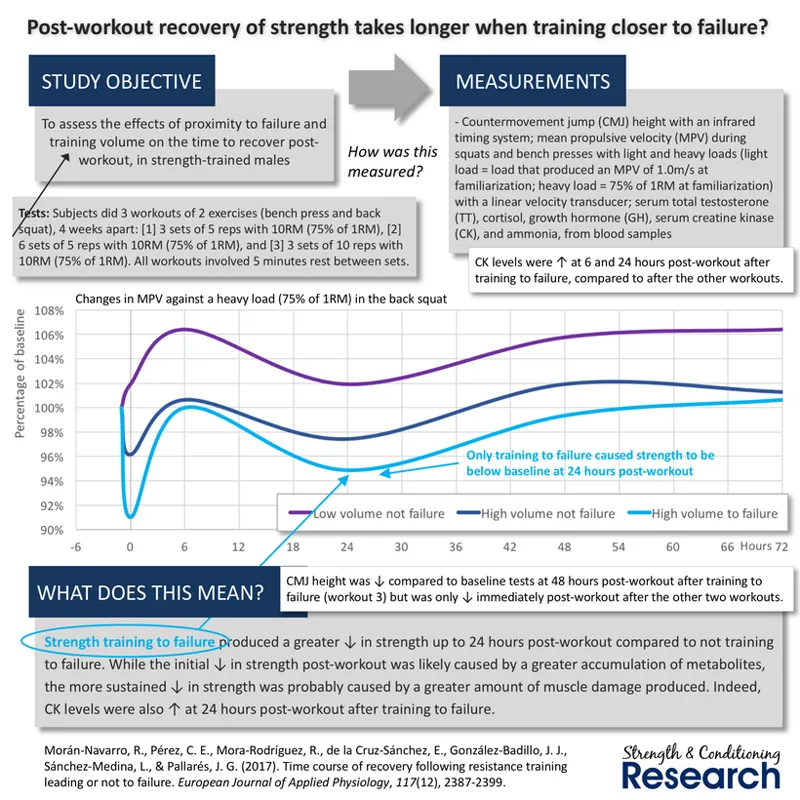
Lifters often report anecdotally that it takes them longer to recover between workouts when they train to failure compared to when they leave one or two reps in reserve. Unfamiliar with how the physiology actually works, they frequently give incorrect explanations for why this happens. But if we look at the fatigue research, we can see what is really happening.
.
#1. Training closer to failure causes more peri-workout fatigue
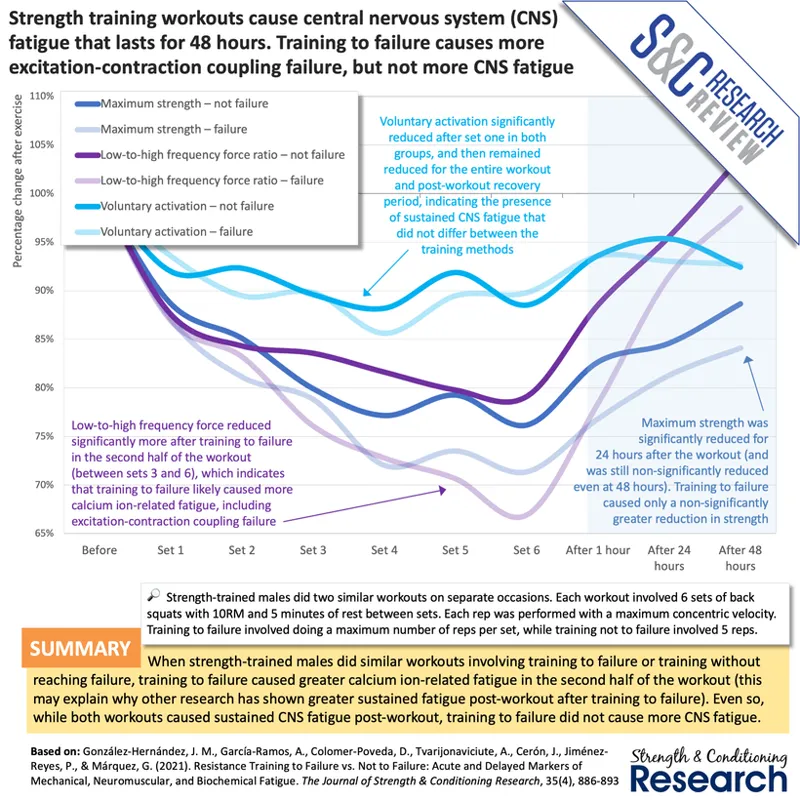
Various studies have shown that when strength training sets are taken closer to muscular failure, the amount of fatigue experienced during the workout (peri-workout fatigue) is greater. This can be observed by recording the velocity loss during maximal effort repetitions. Of course, the next important question we must ask is what type of fatigue mechanism is responsible for this effect?
.
#2. Training closer to failure causes more calcium ion-related fatigue
Various studies have shown that when strength training sets are taken closer to muscular failure, the amount of excitation-contraction coupling failure that is produced is greater. This can easily be observed by recording the ratio of low-to-high frequency force.
.
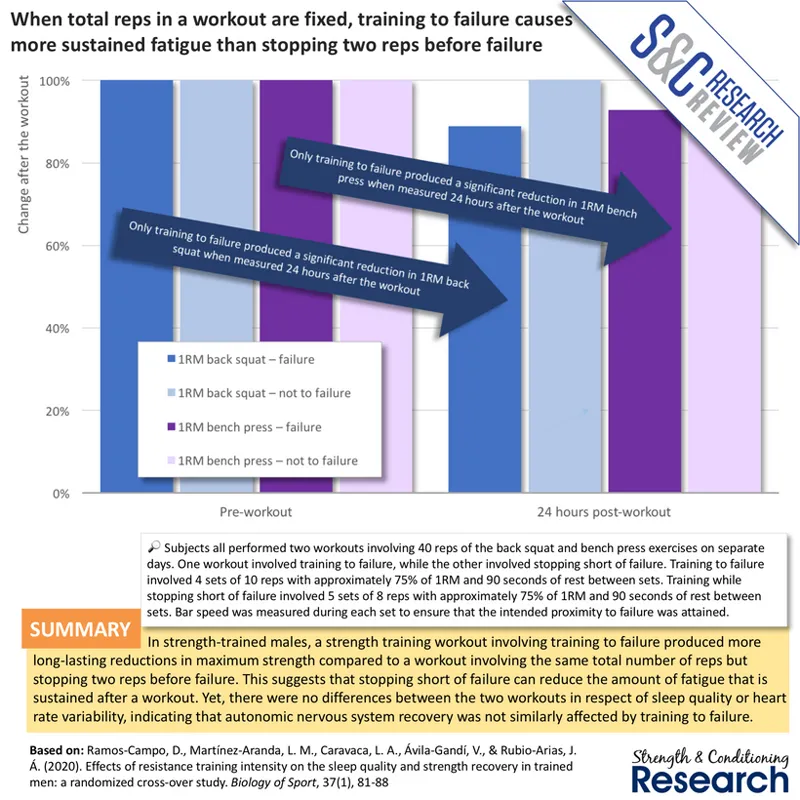
It is therefore unsurprising that training closer to failure causes more post-workout fatigue, since calcium ion-related fatigue mechanisms like excitation-contraction coupling failure are mainly responsible for the post-workout fatigue effect.
.
#3. Why does training closer to failure cause more calcium ion-related fatigue?
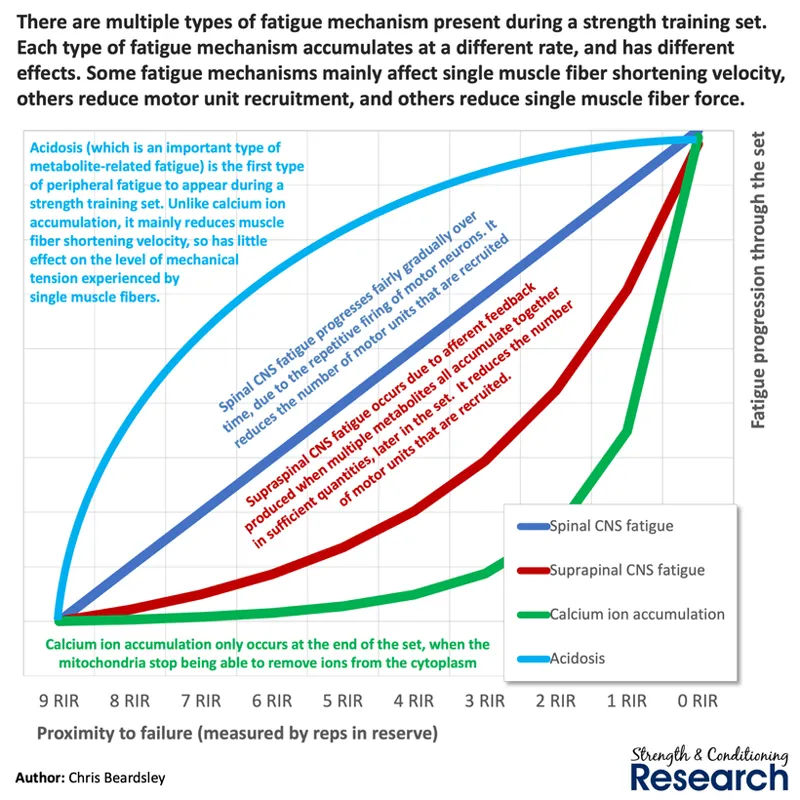
Importantly, the types of fatigue mechanism that develop over the course of a strength training set vary with the duration of the set. Acidosis is the most rapid and contributes to the early losses in bar speed during a set performed with maximal effort on every rep. In contrast, the calcium ion-related fatigue mechanisms only develop towards the end of the set. Consequently, the additional fatigue that is caused by training closer to failure involves a disproportionately greater amount of calcium ion-related fatigue mechanisms, which are those that cause post-workout fatigue.
.
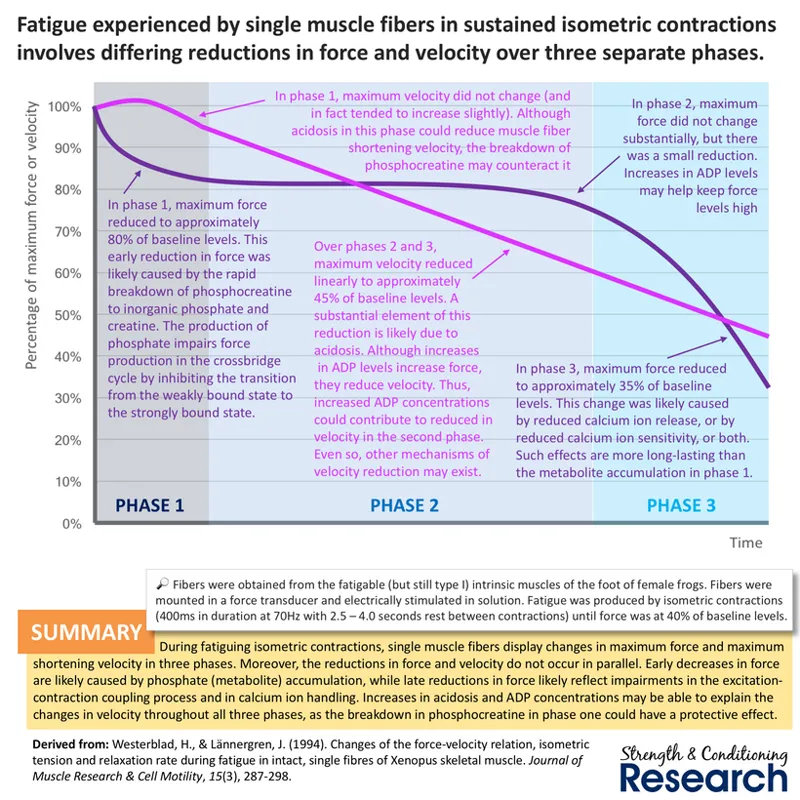
Indeed, careful research into the fatigue mechanisms experienced by single muscle fibers has shown that the early phases of a fatiguing contraction mainly affect muscle fiber shortening speed (and are therefore metabolite-related), while the final phase mainly affects muscle fiber force (and is therefore calcium ion-related).
.
#4. Leaving two reps in reserve greatly reduces post-workout fatigue
Importantly, research has shown that when we train with moderate loads, the last two reps of the set are responsible for the majority of the calcium ion-related fatigue. Stopping sets before those two reps are completed totally prevents the post-workout fatigue from happening. Nevertheless, this is likely to be a different number for every rep range, with greater numbers of reps in reserve being needed for higher repetition sets that cause more calcium ion-related fatigue effects.
.
Incidentally, the same effect can also be seen on fiber type shifts. Stopping a couple of reps in reserve fails to cause fiber type shifts between type IIA and type IIX because calcium ions are also responsible for the fiber type shifting process.
.
Conclusions
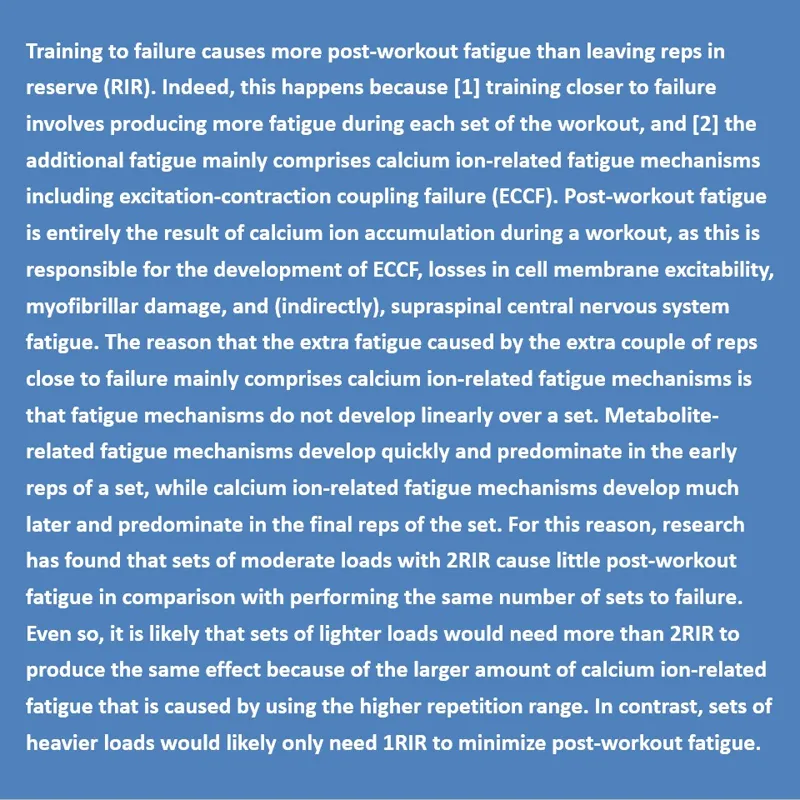
Training to failure causes more post-workout fatigue than leaving reps in reserve (RIR). Indeed, this happens because [1] training closer to failure involves producing more fatigue during each set of the workout, and [2] the additional fatigue mainly comprises calcium ion-related fatigue mechanisms including excitation-contraction coupling failure (ECCF). Post-workout fatigue is entirely the result of calcium ion accumulation during a workout, as this is responsible for the development of ECCF, losses in cell membrane excitability, myofibrillar damage, and (indirectly), supraspinal central nervous system fatigue. The reason that the extra fatigue caused by the extra couple of reps close to failure mainly comprises calcium ion-related fatigue mechanisms is that fatigue mechanisms do not develop linearly over a set. Metabolite-related fatigue mechanisms develop quickly and predominate in the early reps of a set, while calcium ion-related fatigue mechanisms develop much later and predominate in the final reps of the set. For this reason, research has found that sets of moderate loads with 2RIR cause little post-workout fatigue in comparison with performing the same number of sets to failure. Even so, it is likely that sets of lighter loads would need more than 2RIR to produce the same effect because of the larger amount of calcium ion-related fatigue that is caused by using the higher repetition range. In contrast, sets of heavier loads would likely only need 1RIR to minimize post-workout fatigue.
Comments (3)
Fantastic summary, thank you!
Tremendous information - if I start the set without a ballistic lift - so rather than a maximal effort but a 2 second cadence - the distinction being definitely not slow - just not a yank - in fact I believe there exists an electromechanical delay whereby full tension cannot be produced instantaneously - but maybe not - in any event a slightly slower start - is it still metabolite fatigue followed by calcium ion fatigue? or would it change?
Thank you Chris!