






Rapid muscle loss during detraining
Muscle mass is lost relatively quickly once the strength training stimulus has been removed. This simple observation has caused many fitness influencers to cry out in despair. But what more can we deduce from the current literature?
.
#1. Muscle cross-sectional area is lost within 7-10 days of stopping training
Recent studies have shown that muscle thickness reduces significantly after one week without strength training, following a 6-week strength training program that caused the increase to happen.
.
This is in line with other studies reporting extremely large numerical reductions in muscle fiber cross-sectional area after stopping strength training (half of the gains produced by the preceding 3 months of strength training).
.
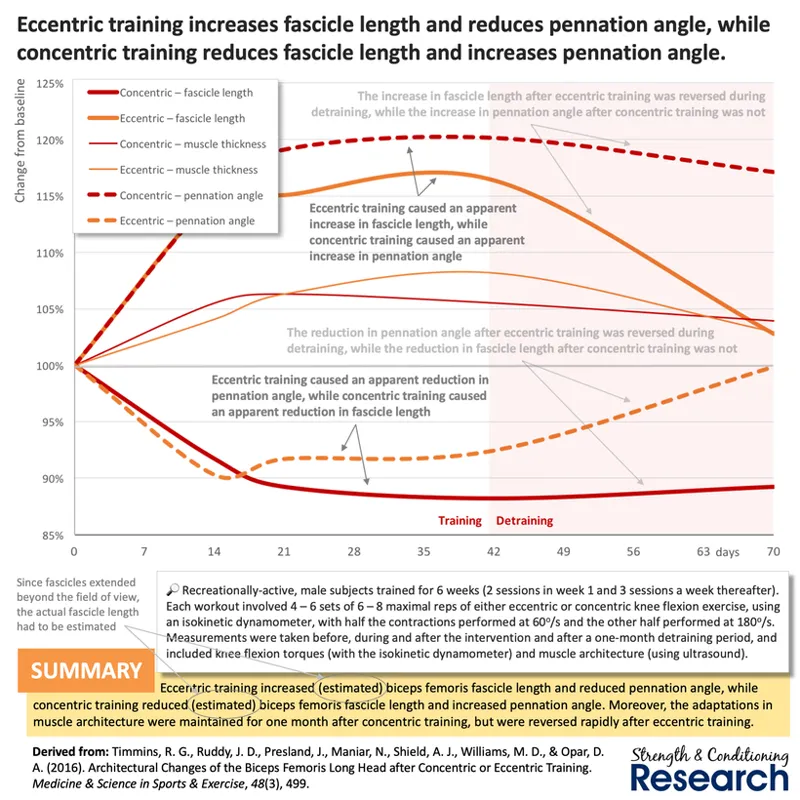
#2. Muscle fascicle length is lost within a single training week
Similarly, studies have shown that muscle fascicle length reduces significantly after a single week without eccentric-only training, following a 6-week eccentric-only training program that caused an increase to happen.
#3. Increases in muscle fascicle length (sarcomerogenesis) are lost more rapidly than increases in muscle cross-sectional area (myofibrillar addition)
The rate at which muscle fascicle length reverts to baseline (after cessation of eccentric training) seems to be faster than the rate at which pennation angle reverts to baseline (after cessation of concentric training). This implies that the rate at which sarcomeres are lost is faster than the rate at which myofibrils are lost.
In line with this observation, Nordic curl training studies frequently report extremely rapid losses in fascicle length in the detraining period afterwards. Many studies only take their first post-training measurements at 2 weeks, but the losses at that point are very substantial (to the point where the entirety of the fascicle length increase caused by training is lost).
.
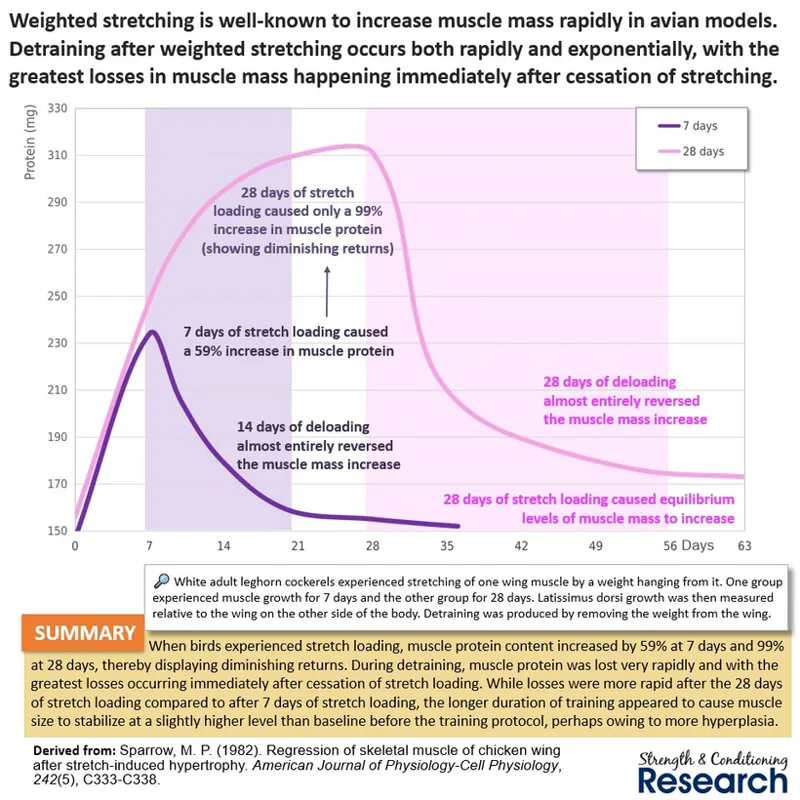
Indeed, when detraining after stretch loading is observed, the rate of loss of muscle mass can be twice as fast as the rate of gain of the same amount of muscle mass.
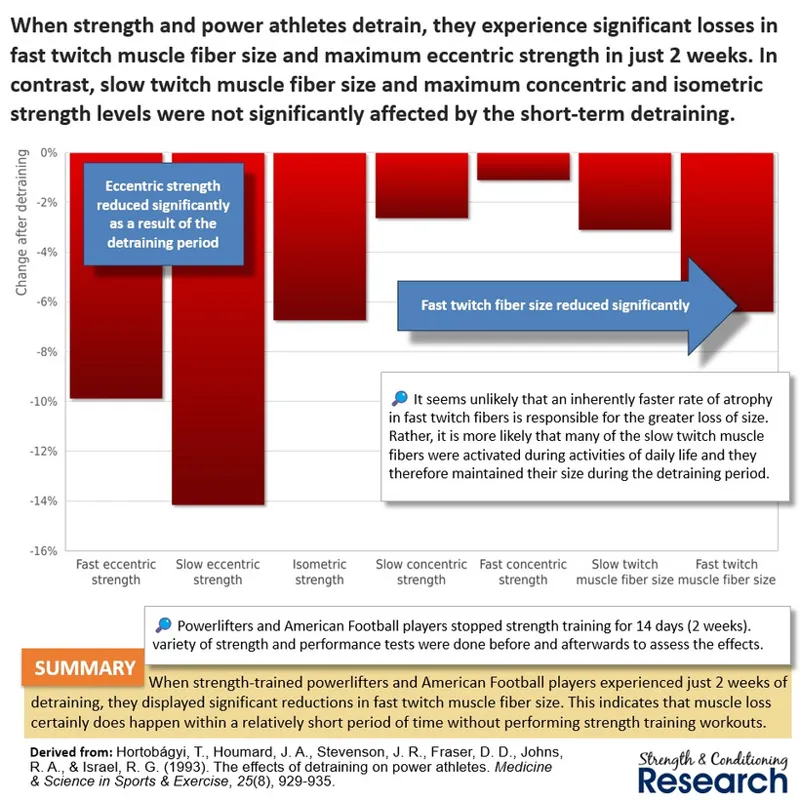
#4. Fast twitch muscle fiber size is lost more rapidly than slow twitch muscle fiber size
Furthermore, the rate at which fast twitch muscle fiber size dissipates during detraining seems to be faster than the rate at which slow twitch muscle fiber size reduces. This may be because many of the slow twitch muscle fibers are still used in the activities of daily life and are therefore still mechanically loaded during detraining.
Several other studies have reported this phenomenon, with extremely rapid atrophy being observed in fast twitch muscle fibers during detraining and the rate of atrophy of slow twitch muscle fibers being somewhat slower.
#5. Muscle mass is lost exponentially (with more gains lost sooner rather than later)
Fitness influencers often argue that the rate of loss is slow to begin with and occurs more rapidly after several weeks without training have passed. In fact, the opposite is the case. Clearly, we can see that the rate of loss of muscle mass is faster immediately after training cessation and slows as muscle is lost and muscle fibers reach their new equilibrium points. This is very obvious in the Nordic curl training and detraining studies.
.
It is also apparent in animal models of detraining following stretch-induced muscle growth.
Conclusions
Contrary to popular belief, muscle mass is lost within a single week following the cessation of strength training or other forms of mechanical loading. In humans, significant reductions in muscle thickness and muscle fascicle length have been noted within 1 week following cessation of training. Interestingly, increases in muscle fascicle length stimulated by passive mechanical loading methods (like stretch loading in animal models or eccentric training in humans) seem to dissipate more quickly than increases in muscle cross-sectional area. This suggests that muscle fibers lose sarcomeres in series more rapidly (after losing the passive mechanical tension stimulus) than they lose myofibrils in parallel (after losing the active mechanical tension stimulus). Additionally, fast twitch muscle fiber size seems to reduce more quickly than slow twitch muscle fiber size. This is most likely because many of the slow twitch muscles are part of motor units that are used in the activities of daily life and still experience some mechanical loading even during the detraining period. Finally, it is noteworthy that when the rate of loss of muscle mass is recorded in animal models, it displays an exponential profile, with the greatest losses actually taking place immediately after the cessation of mechanical loading. This makes sense because this is the point at which the most muscle fibers still have an elevated size. As atrophy occurs and the muscle fibers shrink, some of them reach an equilibrium point at a smaller size and stop shrinking. As muscle fibers stop shrinking, this reduces the rate at which overall muscle size decreases.