



Fascicle length and sarcomeres in series
Currently, it is popular to argue that there is no strong relationship between the number of sarcomeres inside a muscle fiber and the length of the muscle fascicle in which that muscle fiber is located. Yet, there is evidence that sarcomeres in series are indeed closely related to muscle fascicle lengths.
.
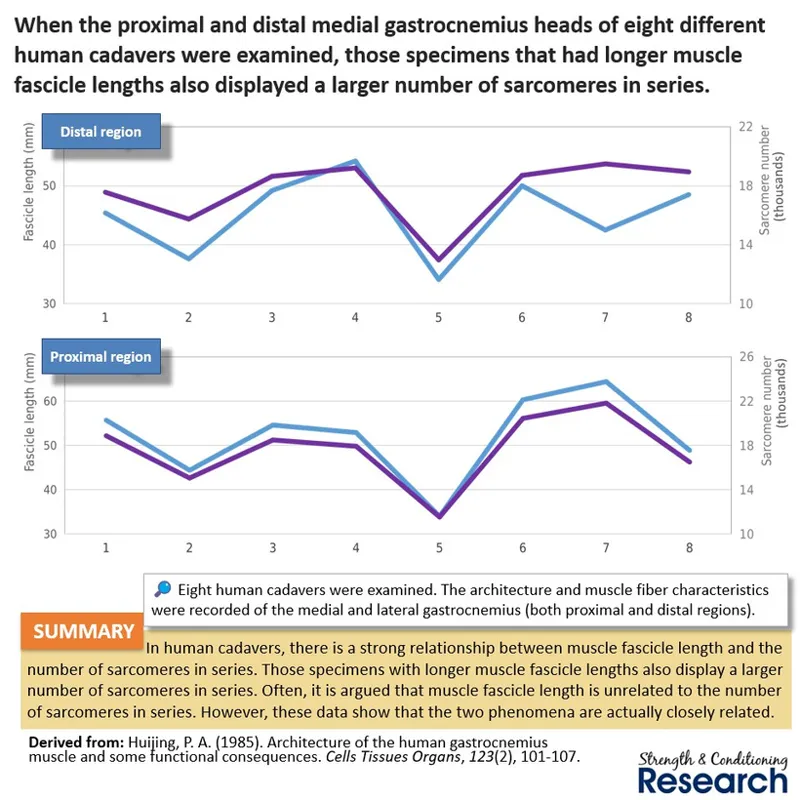
#1. Fascicle lengths and sarcomeres in series in humans
Across a group of people, those individuals who have longer muscle fascicles have more sarcomeres in series within their muscle fibers and vice versa. This shows that there is indeed a basic relationship between the number of sarcomeres in series and muscle fascicle lengths.
.
#2. Changes in muscle fascicle lengths and sarcomeres in series in humans
When humans perform eccentric training and experience increases in muscle fascicle lengths, they also experience increases in the number of sarcomeres in series. Moreover, the changes in muscle fascicle length correspond to the changes in sarcomeres in series. Here, the central region displayed small increases in muscle fascicle length and sarcomere number, while the distal region displayed large increases in muscle fascicle length and sarcomere number.
.
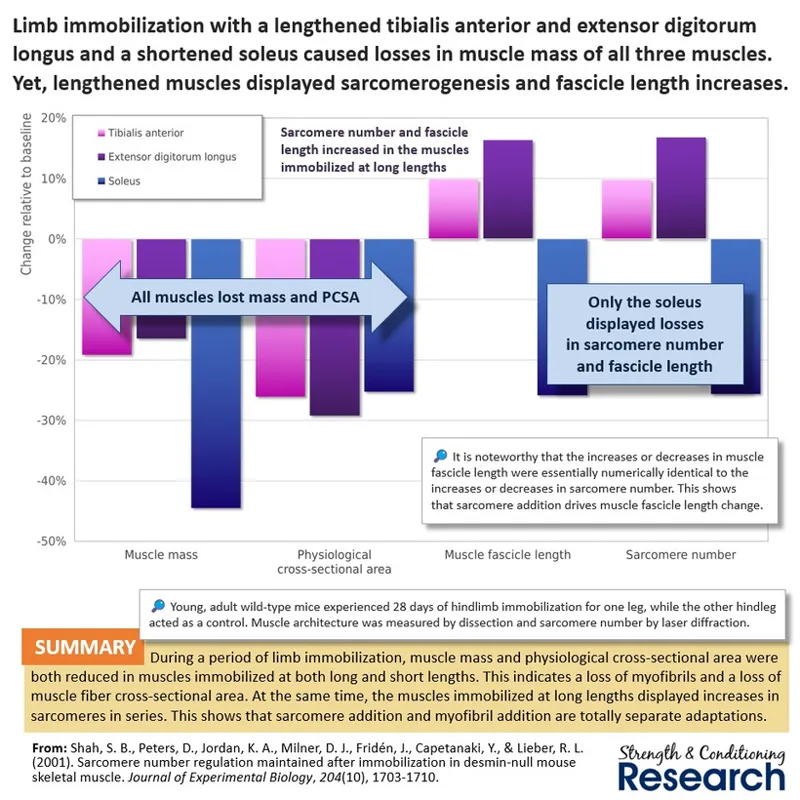
#3. Changes in muscle fascicle lengths and sarcomeres in series in animals
When animals experience limb immobilization in a stretched position and experience increases in muscle fascicle lengths, they also experience increases in the number of sarcomeres in series. Moreover, the changes in muscle fascicle length correspond to the changes in sarcomeres in series.
.
When animals experience tendon elongation and experience decreases in muscle fascicle lengths, they also experience decreases in the number of sarcomeres in series. Moreover, the changes in muscle fascicle length correspond to the changes in sarcomeres in series.
.
Conclusions
Currently, it is popular to argue that there is no strong relationship between the number of sarcomeres inside a muscle fiber and the length of the muscle fascicle in which that muscle fiber is located. Yet, there are three sources of evidence showing that sarcomeres in series are closely related to fascicle lengths. Firstly, human cadaver muscles with longer fascicles have muscle fibers containing more sarcomeres in series. Moreover, this relationship is actually relatively strong. Secondly, when human subjects do eccentric-only strength training, they display increases in both fascicle lengths and also the number of sarcomeres in series of those same muscles. Moreover, in those muscle regions where fascicle length increases by a large amount, there is a large increase in in sarcomere number. Conversely, in those muscle regions where fascicle length increases only by a small amount, there is a similarly a small increase in in sarcomere number. Thirdly, in animal models that increase sarcomere number (such as limb immobilization in a stretched position), fascicle length and sarcomere number increase in tandem with one another. And of course, in animal models that decrease sarcomere number (such as tendon elongation), fascicle length and sarcomere number correspondingly decrease in tandem with one another. These studies thereby show a close relationship between fascicle length and sarcomere number. We can therefore use changes in fascicle length to infer changes in sarcomere number where measuring the number of sarcomeres in series is difficult to carry out.