







Concurrent training
How does concurrent aerobic exercise interfere with muscle growth? Currently, the mainstream fitness industry will not really be able to give you a sensible answer. In reality, the physiology is very clear and we can understand the problem relatively easily.
.
#1. Historical concurrent molecular signaling interference hypothesis
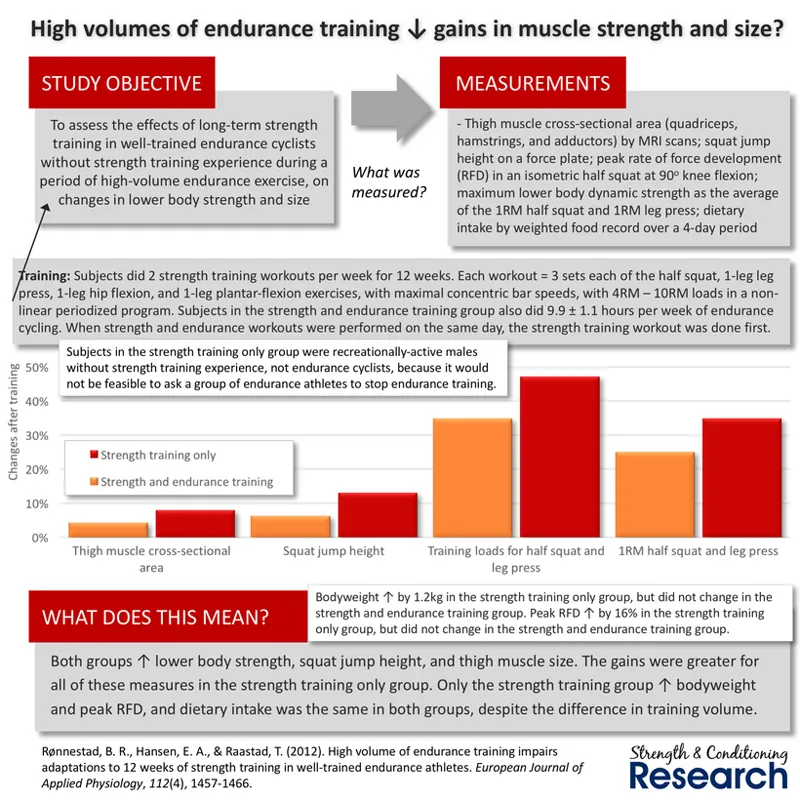
The concurrent molecular signaling interference hypothesis arose because initially researchers noticed that aerobic exercise performed in the same training week as strength training workouts caused reductions in strength gains. Even so, later research found that this effect was only really apparent in more well-trained individuals, which casts doubt upon the idea that there is a fundamental interference effect between aerobic exercise signaling and strength training signaling, since this would be expected to occur in people of every training status.
.
Similarly, while some early studies suggested that concurrent aerobic exercise might reduce gains in muscle size, later studies have only really found that extremely high volumes of aerobic exercise are able to reduce muscle growth.
.
#2. Fatigue interference hypothesis
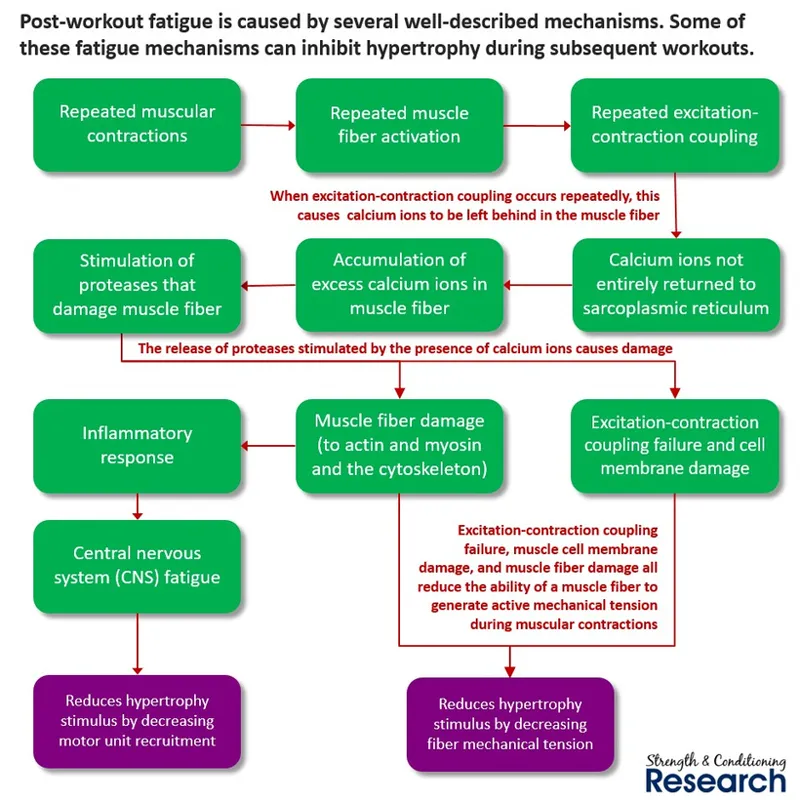
Instead of the concurrent molecular signaling interference hypothesis, we can simply propose that fatigue mechanisms reduce the hypertrophy stimulus. The stimulating reps model indicates that maximum muscle growth happens when [1] motor unit recruitment is high, and [2] single muscle fiber mechanical tension is sufficiently high (read more). Fatigue mechanisms can reduce both of these.
.
#3. Peri-workout fatigue
When aerobic exercise is performed just prior to a strength training workout, peri-workout fatigue mechanisms will be present when the strength training workout starts. We can see this by looking at data examining the fatiguing effects of cardiovascular exercise performed immediately before a strength training workout.
.
Low-intensity repetitive contractions cause reductions in single muscle fiber mechanical tension due to the development of excitation-contraction coupling failure (measured by low-frequency fatigue). This is apparent immediately after the bout of exercise has been completed.
.
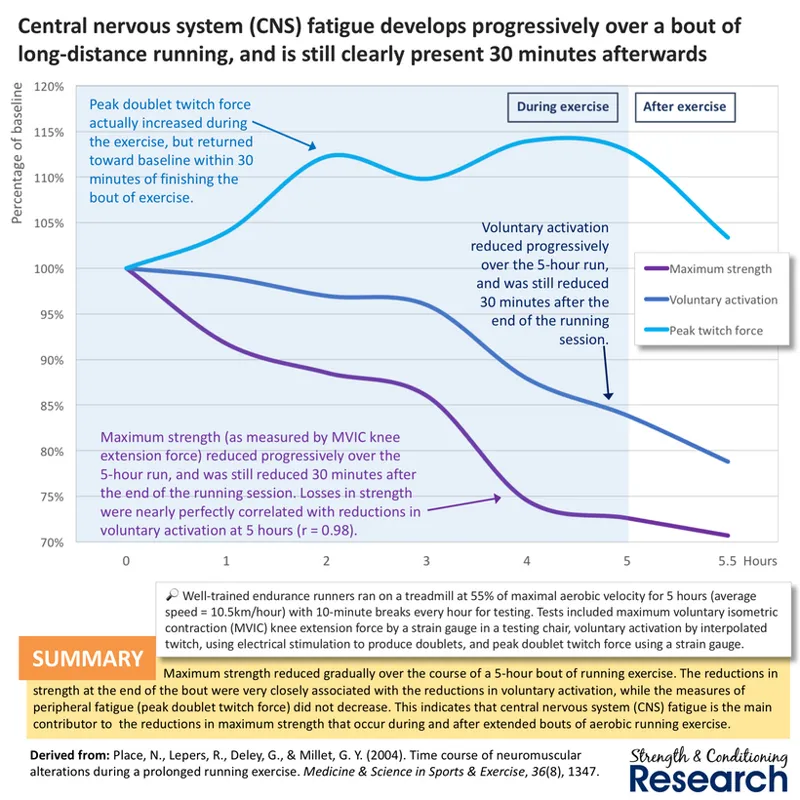
Aerobic exercise also causes reductions in motor unit recruitment due to the development of central nervous system fatigue. Voluntary activation reduces during a long bout of endurance running.
.
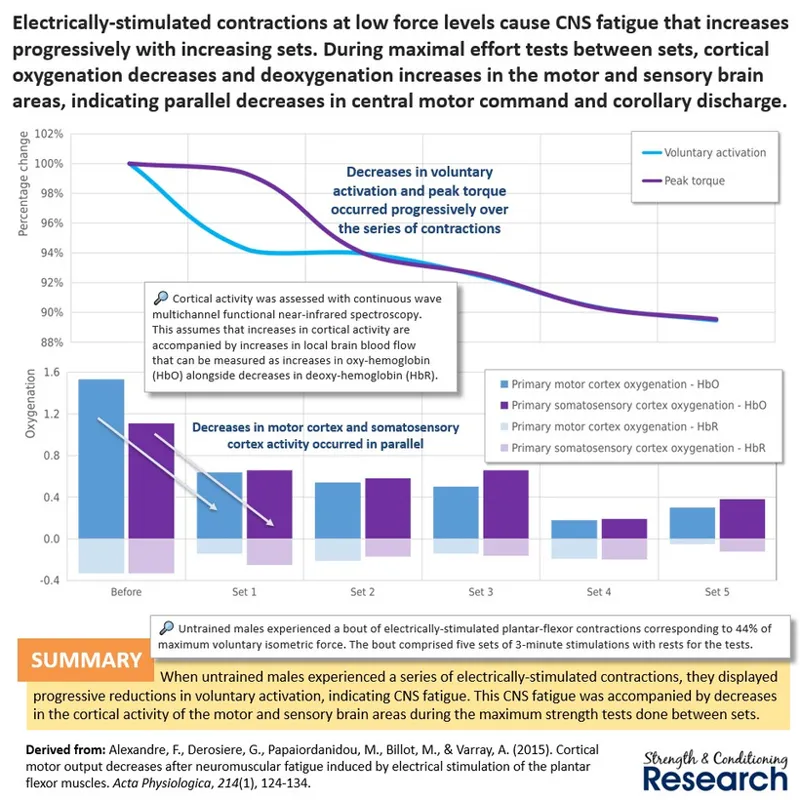
The central nervous system fatigue caused by aerobic exercise is most likely supraspinal in nature, caused by increases in the perception of effort. Indeed, repeated, low-force contractions cause some reductions in voluntary activation in combination with increased levels of effort perception as a result of changes in brain oxygenation.
.
#4. Post-workout fatigue
When aerobic exercise is performed the day before a strength training workout, post-workout fatigue mechanisms could be present when the strength training workout starts. Research has shown that there are long-lasting reductions in voluntary activation after cardiovascular exercise bouts, indicating reductions in motor unit recruitment.
.
Also, there are long-lasting reductions in single muscle fiber mechanical tension levels as measured by low-frequency fatigue, indicating the presence of excitation-contraction coupling failure.
.
Currently, our model of post-workout fatigue involves a single factor driving all of the post-workout fatigue mechanisms, which is the magnitude of calcium ion accumulation during the workout itself.
.
This means that there are five strength training variables that cause post-workout fatigue. We can translate these into most aerobic exercise contexts as: [1] intensity, [2] duration, and [3] presence of eccentric contractions.
.
Conclusions
For many years, researchers have argued that aerobic exercise reduces the hypertrophy produced by strength training workouts through a complicated molecular signaling interference mechanism. Recently, this hypothesis has been criticized to the point where it is no longer supportable. Yet, there is a simple explanation in the form of fatigue interference. Meaningful muscle growth is known to require [1] very high levels of motor unit recruitment, and [2] sufficiently high levels of single muscle fiber mechanical tension. Fatigue mechanisms reduce both motor unit recruitment (by means of central nervous system fatigue mechanisms) and single muscle fiber mechanical tension (by means of calcium ion-related fatigue mechanisms like excitation-contraction coupling failure). When done immediately before strength training workouts, the peri-workout fatigue experienced during aerobic exercise will spill over and reduce the hypertrophy stimulus experienced in the strength training workout. When done the day before strength training workouts, the post-workout fatigue experienced during aerobic exercise will also reduce the hypertrophy stimulus experienced in the strength training workout. Aerobic exercise involves greater fatigue when [1] it is higher intensity, [2] it is longer duration, and [3] it involves eccentric contractions. Hence, when we wish to combine aerobic exercise in the same program as strength training, it is helpful to avoid types of aerobic exercise with a prominent eccentric component (such as running) and avoid both very high intensities and very long durations.

Comments (2)
So if you like to strength train mon-wed-friday, when should you put in two days of run intervals to minimize interference and fatigue?
Physiologically, the best time to minimize the interference effects of the intervals on the strength training adaptations would be immediately after two of the strength training workouts. However, one intervals session could also be done on Saturday morning.