



Eccentric training
Eccentric training causes a different set of adaptations from isometric and concentric training. Some of these unique adaptations explain why eccentric training produces greater gains in eccentric strength than in isometric or concentric strength. Others cause different effects, which we might not necessarily predict.
.
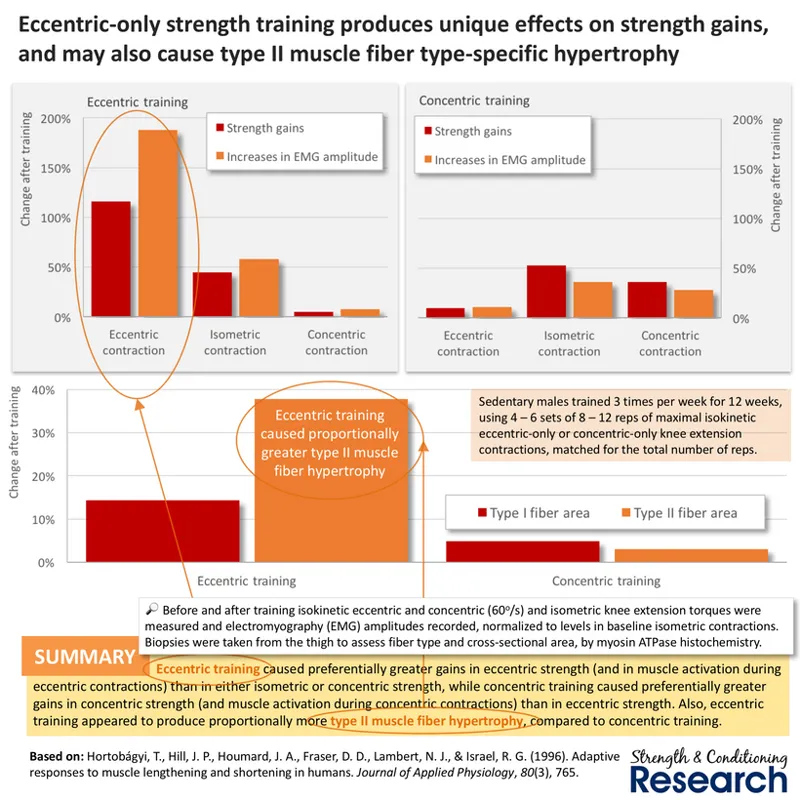
#1. Improvements in eccentric contraction-specific coordination
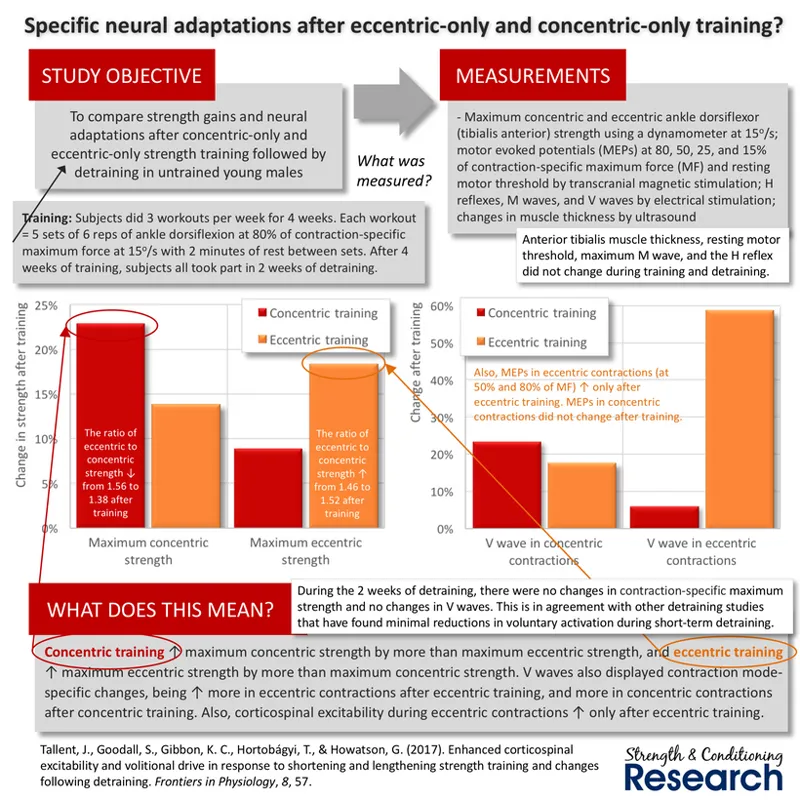
Eccentric contractions appear to be controlled differently by the brain than isometric or concentric contractions. Consequently, practising with isometric or concentric contractions does not improve coordination in eccentric contractions. Practising eccentric contractions appears to be necessary for coordination in eccentric contractions to improve.
.
The process of improving coordination during eccentric contractions appears to be relatively fast (as it is for concentric contractions) and most of the gains occur within a couple of weeks of training. How rapidly these gains in coordination are lost once practice sessions are stopped is unclear.
.
#2. Improvements in voluntary activation
Generally, most people display a much reduced level of voluntary activation when performing maximal effort eccentric contractions compared to maximal effort concentric or isometric contractions.
.
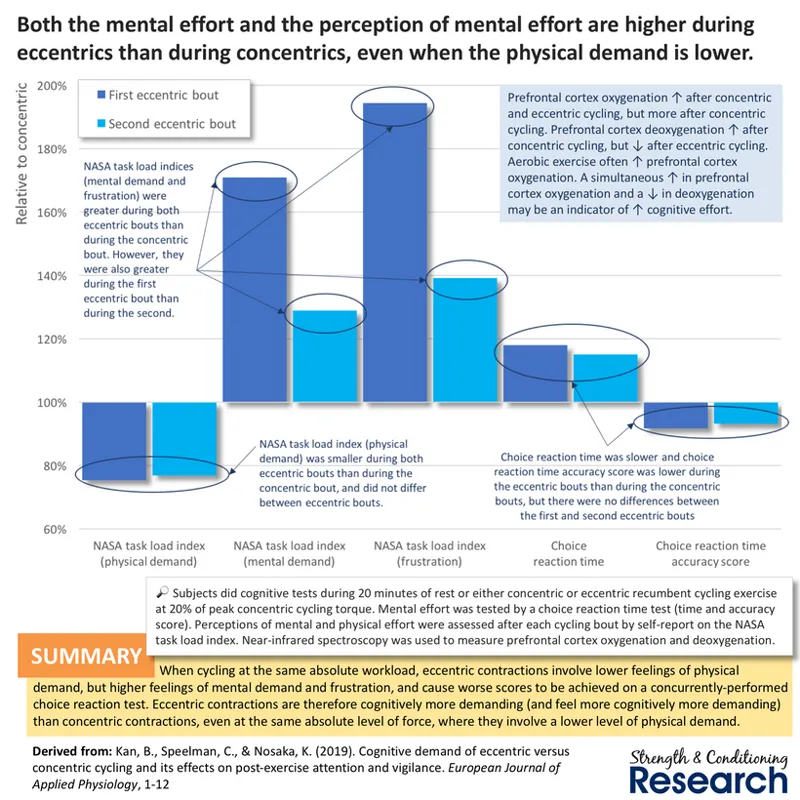
This reduced level of voluntary activation is most likely caused by the greater cognitive load that we experience during eccentric contractions because of their increased coordination requirement.
.
When we practice eccentric training, we remove this cognitive demand and this results in an increase in voluntary activation that is specific to the contraction mode. Indeed, studies have shown that we need to practice eccentric contractions in order to produce increases in voluntary activation in that particular contraction mode.
.
#3. Improvements in active muscle fiber stiffness
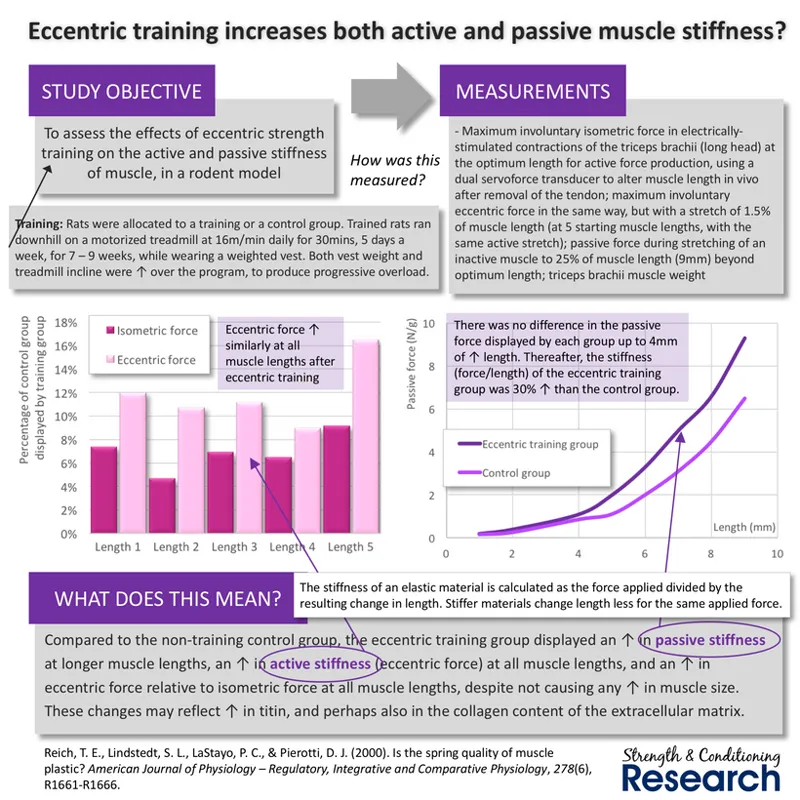
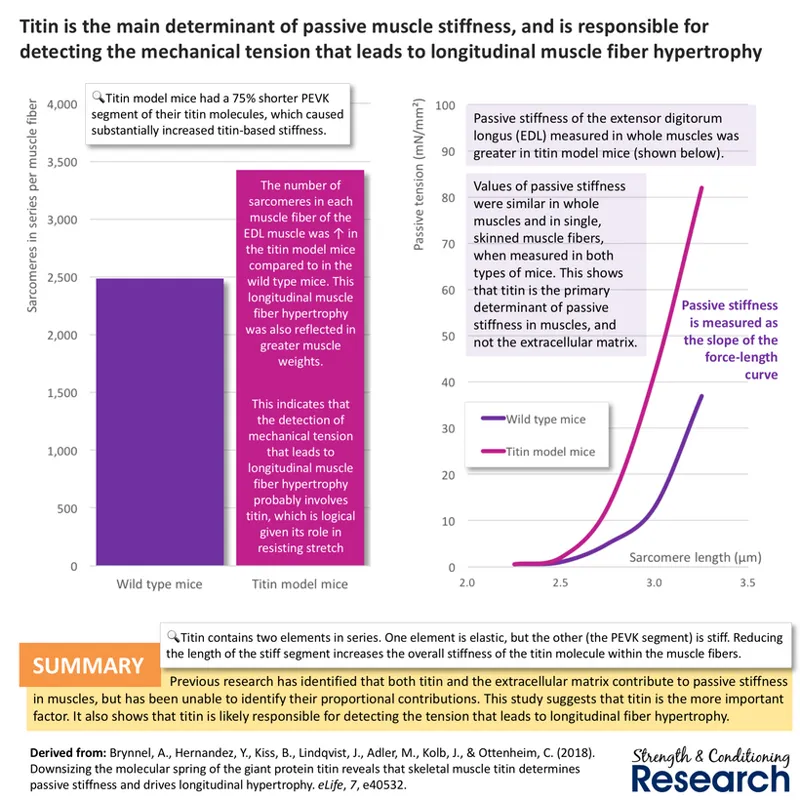
Animal model studies that involve the measurement of involuntary (electrically-stimulated) force production allow us to see the effects of different types of strength training while excluding the impact of neural adaptations. Eccentric training increases involuntary eccentric strength (and involuntary eccentric strength relative to involuntary isometric strength), even without increasing muscle size. This suggests that eccentric training modifies the stiffness of the individual muscle fibers, most likely by altering titin content in some way (either by increasing the amount of titin or shifting titin from a more compliant isoform to a stiffer isoform).
.
#4. Longitudinal hypertrophy and regional hypertrophy
While both eccentric training and concentric training produce similar total hypertrophy, the type and location of the hypertrophy within the muscle seem to differ. Eccentric training primarily produces longitudinal hypertrophy (an increase in muscle fiber length), while concentric training primarily produces transverse hypertrophy (an increase in muscle fiber diameter). Similarly, eccentric training mainly causes distal region muscle growth, while concentric training mainly produces middle region muscle growth. These differences in regional muscle growth are likely due to the differences in the type of hypertrophy (longitudinal versus transverse).
.
Eccentric training probably causes mainly longitudinal hypertrophy because it involves the stretching of activated titin. Titin is the molecule inside muscle fibers that produces passive stiffness during eccentric contractions, and when it detects passive mechanical tension during a muscular contraction, it signals the muscle fiber to increase in length. When titin signaling is absent (but some mechanical tension is still present), muscle fibers grow in diameter instead.
.
#5. Fast twitch fiber hypertrophy
After eccentric training, the fast twitch muscle fibers of a muscle seem to grow more than the slow twitch fibers, when compared to concentric training. This may be because the additional passive tension that is provided by titin during eccentric contractions (and which stimulates most of the hypertrophy during eccentric training) is different in fast twitch and slow twitch fibers. Titin isoforms differ between fast twitch and slow twitch fibers. They are more compliant in slow twitch fibers, so produce less passive force. Conversely, they are stiffer in fast twitch fibers, so the produce more force. Thus, when a muscle performs an eccentric contraction, the fast twitch fibers produce more passive force than the slow twitch fibers, and therefore they grow more.
.
#6. More rapid muscle fiber type shifts towards oxidative types
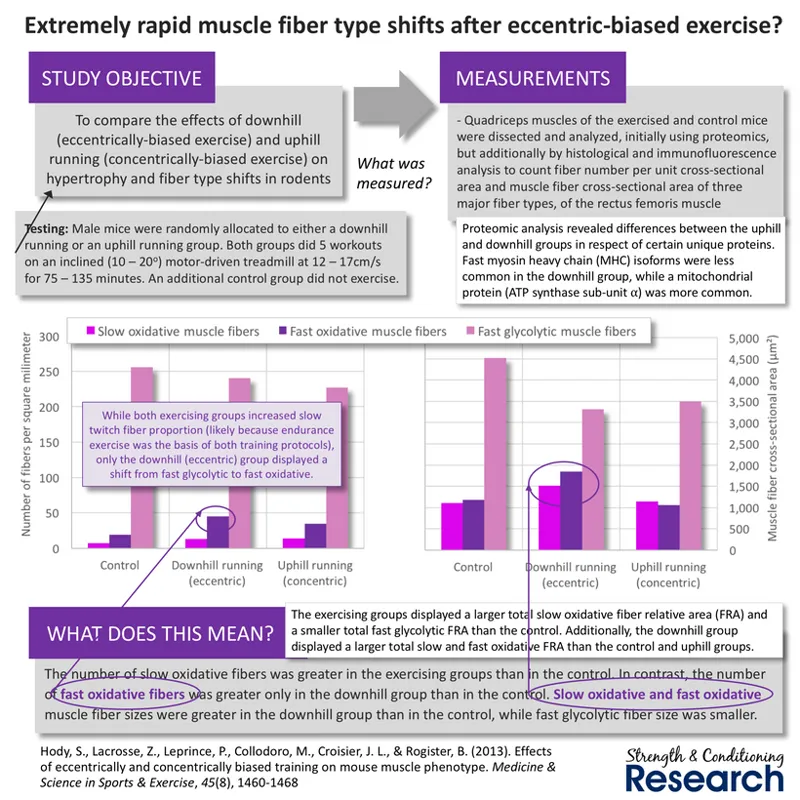
After eccentric training, the very fast twitch muscle fibers of a muscle seem to convert towards more oxidative types more rapidly than after to concentric training. This may be because of the greater calcium ion accumulation that occurs during eccentric contractions.
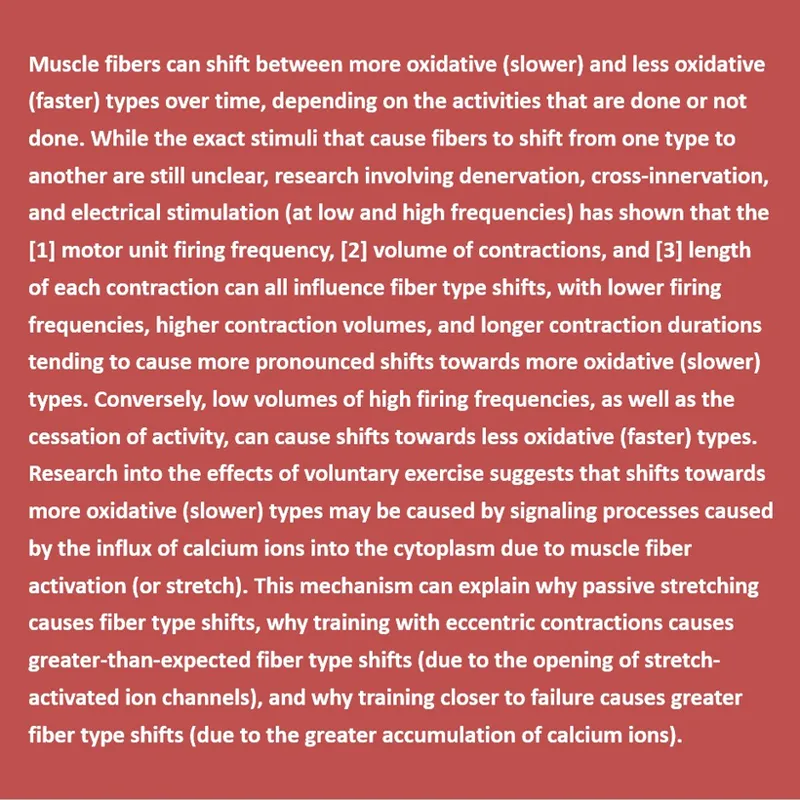
Indeed, research has shown that the stimulus that causes muscle fibers to shift towards more oxidative types is the accumulation of calcium ions inside the cytoplasm (read more).
Conclusions
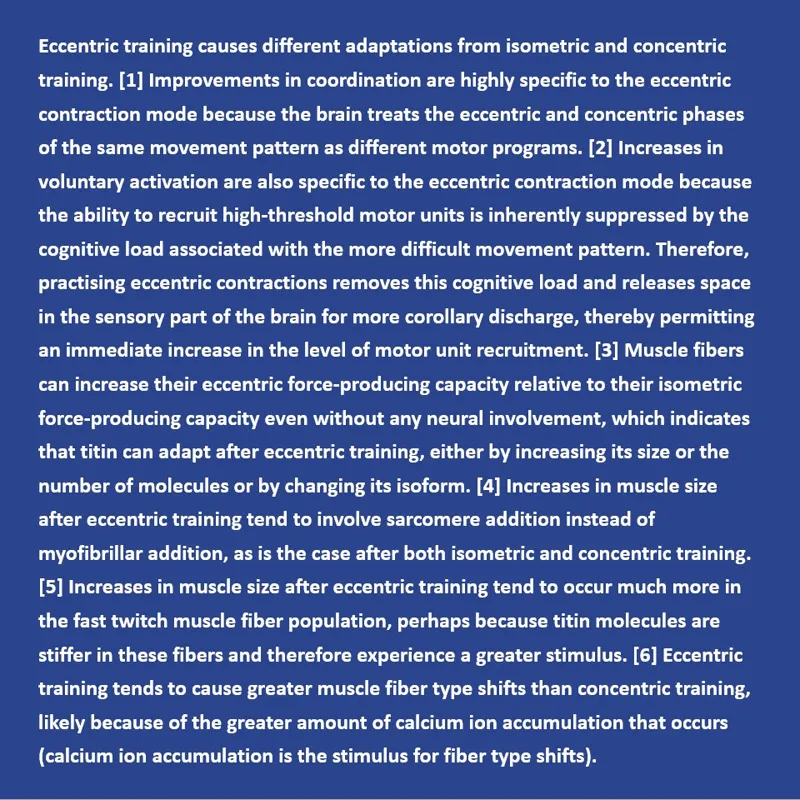
Eccentric training causes different adaptations from both isometric and concentric training. [1] Improvements in coordination are highly specific to the eccentric contraction mode because the brain seems to treat the eccentric and concentric phases of the same movement pattern as different motor programs. [2] Increases in voluntary activation are also specific to the eccentric contraction mode because the ability to recruit high-threshold motor units is inherently suppressed by the cognitive load associated with the more difficult movement pattern. Thus, practising eccentric contractions removes this cognitive load and releases space in the sensory part of the brain for more corollary discharge, thereby permitting an immediate increase in the level of motor unit recruitment. [3] Muscle fibers can increase their eccentric force-producing capacity relative to their isometric force-producing capacity even without any neural involvement, which indicates that titin can adapt after eccentric training, either by increasing its size or number of molecules or by changing its isoform. [4] Increases in muscle size after eccentric training tend to involve sarcomere addition instead of myofibrillar addition, as is the case after both isometric and concentric training. [5] Increases in muscle size after eccentric training tend to occur much more in the fast twitch muscle fiber population, perhaps because titin molecules are stiffer in these fibers and therefore experience a greater stimulus. [6] Eccentric training tends to cause greater muscle fiber type shifts than concentric training, likely because of the greater amount of calcium ion accumulation that occurs (calcium ion accumulation is the stimulus for fiber type shifts).

Comments (3)
Hi chris, hope you are doing great. I observed a few time with my team sports athletes clients that when we are increasing their eccentric strength ratio in response to a strength plateau (eccentric 1rm / concentric 1 rm) they tends to breaks their plateau and start increasing strength once again. Do you have a explanation behind the mecanisms behind that ? Is it because of an adaptation on the muscular levels ? An increase in the maximum tolerable perceived effort ? A mixed of both or a completely different aspect ? Thx in advance
Chris, does eccentric contraction transfers better to concentric than the opposite?
Mostly, yes. There are some variances depending on the contraction velocity, however.