


Pre-exhaustion training
Bodybuilders often make use of advanced training techniques. Pre-exhaustion training is a common advanced training technique that involves performing a set of a single-joint strength training exercise for one muscle (such as the knee extension) immediately before a multi-joint exercise that involves the same muscle (such as the leg press). Four key physiological observations help us to understand what this technique is actually doing.
.
#1. The principle of neuromechanical matching
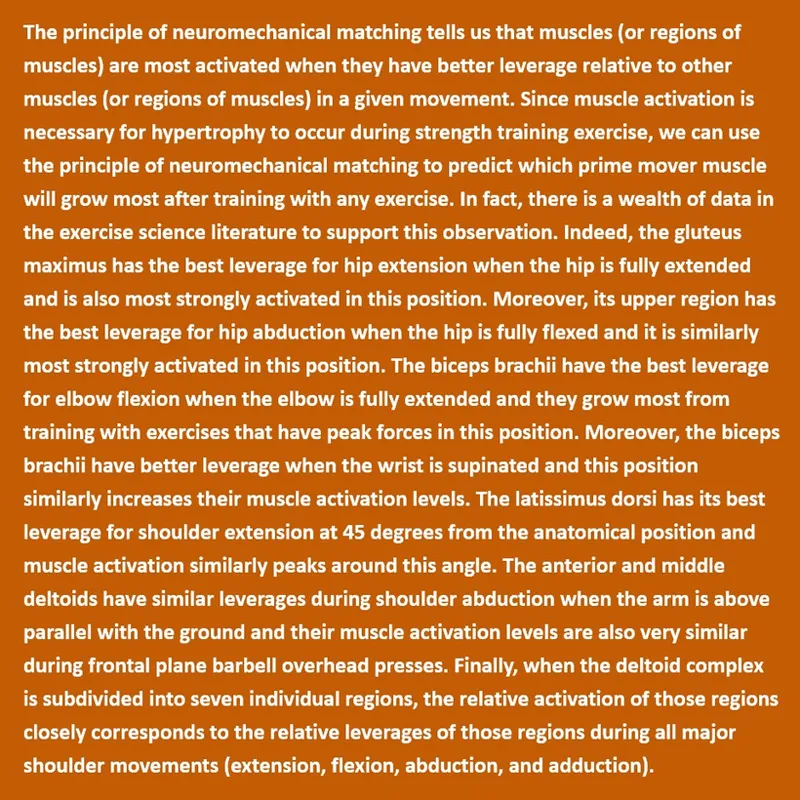
The principle of neuromechanical matching tells us that when multiple muscles are working in an exercise, the muscles with the best leverage will receive the largest proportion of the central motor command, leading them to achieve the highest levels of motor unit recruitment (read more). Evidently, muscles do not change the amount of leverage that they have when fatigue develops.
.
#2. Motor programs break down when fatigue is present
When fatigue mechanisms arise, our ability to produce well-coordinated movements decreases and the efficiency of the resulting movement pattern is reduced (read more). One explanation for why this happens is that the brain does not alter the coordination pattern that it sends to the muscles despite the fact that fatigue mechanisms are occurring that are altering the muscle forces that are produced in response to a given level of muscle activation. In other words, the brain uses the most efficient motor program that it knows but the resulting movement pattern is detrimentally changed by fatigue.
.
Indeed, there is good evidence that the brain does not change coordination patterns in the presence of fatigue. One key observation is that movement practice in a fatigued state is carried over and used as a motor program in an unfatigued state. This suggests that the brain does not store different motor programs for a movement according to the amount of fatigue that is present. Rather, it always uses the same motor program (and therefore the same relative muscle activation levels) and while the resulting movement is usually well-coordinated in an unfatigued state, it is poorly-coordinated in fatigued state.
.
#3. Effects of exercise selection on motor unit recruitment
The amount of motor unit recruitment that we can achieve in a muscle is related to the amount of muscle mass that is being used overall in the exercise. This means that any single-joint exercise that is performed for a muscle group as a pre-exhaustion (like a knee extension) will involve higher motor unit recruitment levels in the quadriceps compared to the subsequent multi-joint exercise that is done afterwards (read more).
.
#3. Central nervous system (CNS) fatigue
CNS fatigue actually develops during all series of muscular contractions. For this reason, performing any single-joint exercise immediately prior to a multi-joint exercise will mean that there is CNS fatigue present for the working muscle in the multi-joint exercise and this will reduce its ability to achieve high levels of motor unit recruitment.
.
Conclusions
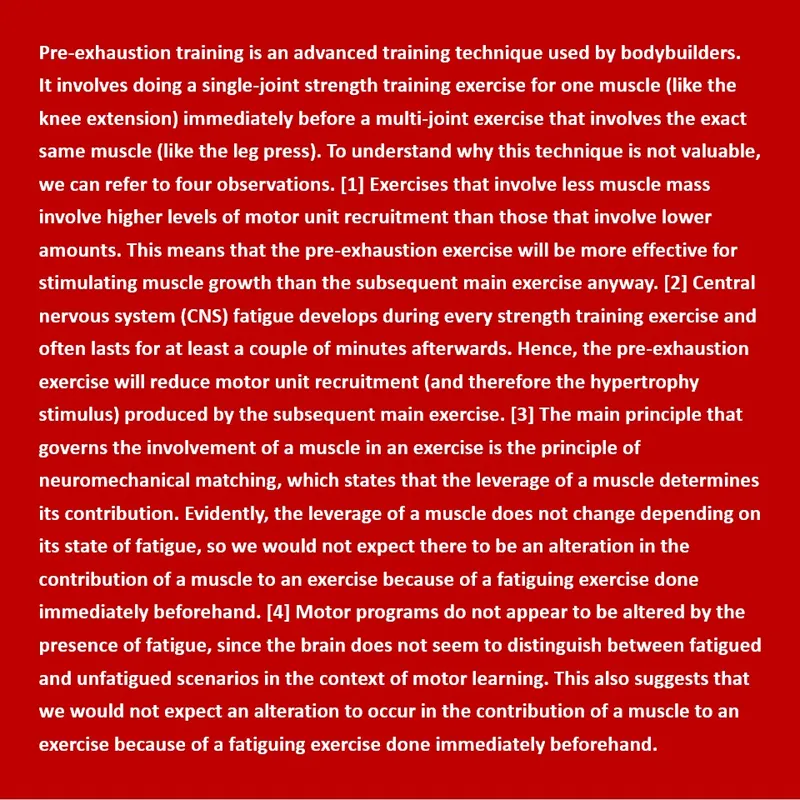
Pre-exhaustion training is an advanced training technique used by bodybuilders. It involves doing a single-joint strength training exercise for one muscle (like the knee extension) immediately before a multi-joint exercise that involves the exact same muscle (like the leg press). To understand why this technique is not valuable, we can refer to four observations. [1] exercises that involve less muscle mass involve higher levels of motor unit recruitment than those that involve lower amounts. This means that the pre-exhaustion exercise will be more effective for stimulating muscle growth than the subsequent main exercise anyway. [2] central nervous system (CNS) fatigue develops during every strength training exercise and generally lasts for at least a couple of minutes afterwards. Therefore, the pre-exhaustion exercise will reduce motor unit recruitment (and therefore the hypertrophy stimulus) produced by the subsequent main exercise. [3] the main principle that governs the involvement of a muscle in an exercise is the principle of neuromechanical matching, which states that the leverage of a muscle determines its contribution. Evidently, the leverage of a muscle does not change depending on its state of fatigue, so we would not expect there to be an alteration in the contribution of a muscle to an exercise because of a fatiguing exercise done immediately beforehand. [4] motor programs do not appear to be altered by the presence of fatigue, since the brain does not seem to distinguish between fatigued and unfatigued scenarios in the context of motor learning. This also suggests that we would not expect an alteration to occur in the contribution of a muscle to an exercise because of a fatiguing exercise done immediately beforehand.


Comments (3)
Thank you, Chris. Always a pleasure to get your fast answer!
Chris, this is a great post because a lot of new trainers now like to superset exercises that involve the same muscle groups but in different muscle lengths - shortened and lengthened. Most popular are glute hip thrusts with leg press (feet high for more gluteus maximus involvement) or romanian deadlifts. In my opinion, it is also NOT an effective strategy for better hypertrophic outcomes, but what is your opinion on that? Thank you!
I agree, because agonist supersets are often going to produce the same effect as training with short rest periods (reduced hypertrophy). Even when done as alternating sets with proper rest periods between each exercise and each set, they may still not be as effective as performing each exercise separately (with the short muscle length exercise done first) because the extra fatigue caused by training with the long muscle length (due to the opening of stretch-activated ion channels) will interfere with the stimulus for hypertrophy achieved by the short muscle length exercise.