





Force-velocity profiling
Force-velocity profiling, and the training programs that can be written based on the knowledge of an athlete's optimal and actual profiles, is a valuable tool for athletic development. Removing a force-velocity imbalance by moving the force-velocity profile closer to the optimal one is a way of improving performance independently of changes in maximum strength or speed.
.
#1. What is a force-velocity profile?
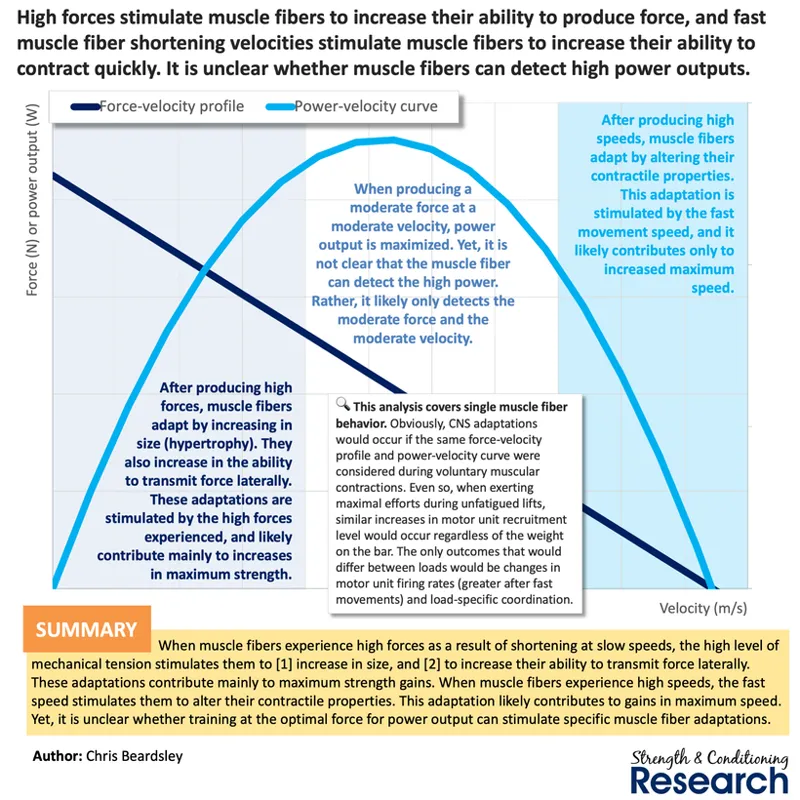
Force-velocity profiles for a range of exercises can be generated by simply measuring the force and the velocity achieved by an athlete during the performance of an exercise with a range of loads. This data can then be used to create a graph of the force-velocity line as well as the power-velocity curve. The force-velocity line will always be linear (with a maximum force at zero velocity and a maximum velocity at zero force), while the power-velocity curve will rise to a maximum power output at a moderate velocity.
.
Both the force-velocity line and the power-velocity curve will be different for different exercises. Thus, it is important to measure the data in the exercise or movement that most closely corresponds to the sporting movement.
.
Similarly the force-velocity line and the power-velocity curve are also different for different individuals. Consequently, it is important to measure the sporting movement or exercise for each athlete separately.
.
Although most force-velocity profiles have been tested in linear movements, it is also possible to assess rotational activities such as occur during throwing.
.
#2. Does a force-velocity imbalance affect athletic performance?
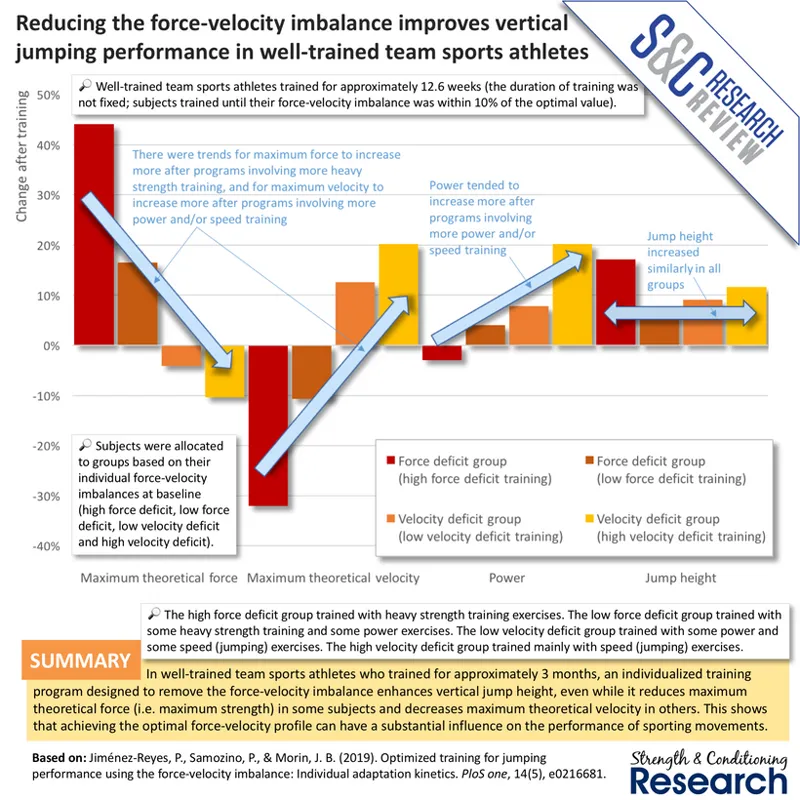
Years ago, researchers identified that the force-velocity profile of an athlete affected the vertical jump height that they could attain, in addition to the magnitude of the maximal power output achieved. Essentially, if the maximal power output achievable occurs at a velocity similar to the velocity achieved in the tested movement, the force-velocity profile is likely to be optimal. However, if the maximal power output achievable occurs at a slower velocity or a faster velocity, then there is an imbalance. Imbalances can occur either because maximum strength is too high relative to maximum speed, or alternatively because maximum speed is too high relative to maximum strength.
.
#3. Can training to reduce the force-velocity imbalance enhance performance?
Following up on the earlier research, it was later discovered that training that shifted the actual force-velocity profile to become closer to the optimal force-velocity profile (and thereby reducing a force-velocity imbalance) was more effective for improving vertical jump height in comparison with training that moved the force-velocity profile in the opposite direction. Clearly, this provides another avenue for athletic development, in addition to simply increasing the qualities of strength and speed independently.
.
#4. How can a force-velocity imbalance change?
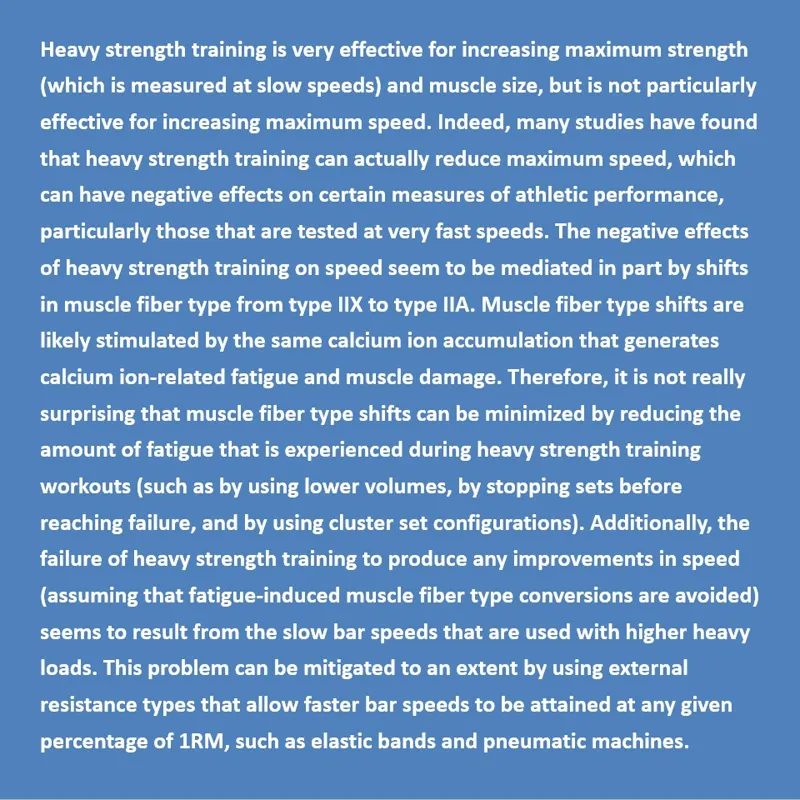
Force-velocity imbalances can be removed by training to enhance strength to a greater extent than speed, or by training to enhance speed to a greater extent than strength (depending on the imbalance). Indeed, heavy strength training causes greater increases in maximum strength compared to speed. In this way, it can cause a shift in the force-velocity profile gradient. This happens because of various adaptations (read more).
.
Similarly, fast movement training (like plyometrics) causes greater increases in speed compared to maximum strength. Therefore, it also causes a shift in the force-velocity profile gradient. This happens because of different adaptations (read more).
.
Consequently, if the actual and optimal force-velocity profiles of the athlete are known, training programs can be devised to suit the situation. If the actual force-velocity profile is excessively force-dominant, the training program can be structured to contain a high proportion of fast movements (such as plyometrics) and a small proportion of heavy strength training. Conversely, if the actual force-velocity profile is excessively velocity-dominant, the training program can be structured to contain a high proportion of heavy strength training and and a small proportion of fast movements (such as plyometrics).
.
#5. Can force-velocity imbalances be avoided in the first place?
Fast movement training, which preferentially increases strength relative to speed, typically produces no negative effects on maximum strength. However, heavy strength training typically causes adaptations that have negatives effect on speed, some of which actually provide little benefit for maximum strength. However, strength training programs can be structured in certain ways so as to avoid such negative effects (read more).
.
Conclusions
Force-velocity profiles can be created by recording force and velocity during the performance of an exercise with a range of loads. This data can be used to create a force-velocity (FV) line and a power-velocity (PV) curve. The FV line is linear (with maximum force at zero velocity and maximum velocity at zero force), but the PV curve rises to a maximum power output at one specific moderate velocity. The FV line and the PV curve differ between both individuals and exercises. Thus, it is important to record data in an exercise or movement that closely corresponds to the sporting movement. The same maximum power output can be achieved with different FV lines (and hence with maximum power output occurring at different velocities). Thus, maximum power output and the FV line each independently affect exercise performance. FV lines can either be optimal or imbalanced. Imbalances occur either because strength is too high relative to speed, or because speed is too high relative to strength. FV imbalances can be removed by heavy strength training to enhance strength relative to speed, or by fast movement training to enhance speed relative to strength. Training programs can also be constructed (in various ways) to produce similar effects on strength and speed, if the FV line is already optimal.


Comments (1)
Hey Chris I didn't quite understand how one can evaluate whether an athlete's force-velocity profile (in a given exercise) is imbalanced or not. How can we know what F-V line and P-V curve would be optimal (and hence, know which qualities to focus on improving)? What are the factors this depends on and is there a formula to calculate an "optimal" F-V line/P-V curve? I would be glad if you could shed light on this matter and by the way, thanks for your work, it has been great working through the FAQ and improving my knowledge about exercise physiology thus far.